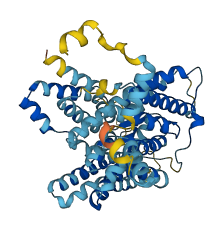
Descriptions
The autoinhibited protein was predicted that may have potential autoinhibitory elements via cis-regPred.
Autoinhibitory domains (AIDs)
Target domain |
|
Relief mechanism |
|
Assay |
cis-regPred |
Accessory elements
No accessory elements
Autoinhibited structure

Activated structure
1 structures for Q02920
| Entry ID | Method | Resolution | Chain | Position | Source |
|---|---|---|---|---|---|
| AF-Q02920-F1 | Predicted | AlphaFoldDB |
No variants for Q02920
| Variant ID(s) | Position | Change | Description | Diseaes Association | Provenance |
|---|---|---|---|---|---|
| No variants for Q02920 | |||||
No associated diseases with Q02920
1 GO annotations of cellular component
| Name | Definition |
|---|---|
| integral component of plasma membrane | The component of the plasma membrane consisting of the gene products and protein complexes having at least some part of their peptide sequence embedded in the hydrophobic region of the membrane. |
1 GO annotations of molecular function
| Name | Definition |
|---|---|
| secondary active sulfate transmembrane transporter activity | Enables the secondary active transfer of sulfate from one side of a membrane to the other. Secondary active transport is the transfer of a solute across a membrane, up its concentration gradient. The transporter binds the solute and undergoes a series of conformational changes. Transport works equally well in either direction and is driven by a chemiosmotic source of energy. Secondary active transporters include symporters and antiporters. |
1 GO annotations of biological process
| Name | Definition |
|---|---|
| nodulation | The formation of nitrogen-fixing root nodules on plant roots. |
15 homologous proteins in AiPD
| UniProt AC | Gene Name | Protein Name | Species | Evidence Code |
|---|---|---|---|---|
| A6QNW6 | SLC26A8 | Testis anion transporter 1 | Bos taurus (Bovine) | PR |
| P50443 | SLC26A2 | Sulfate transporter | Homo sapiens (Human) | PR |
| P58743 | SLC26A5 | Prestin | Homo sapiens (Human) | PR |
| Q86WA9 | SLC26A11 | Sodium-independent sulfate anion transporter | Homo sapiens (Human) | PR |
| Q8TE54 | SLC26A7 | Anion exchange transporter | Homo sapiens (Human) | PR |
| Q96RN1 | SLC26A8 | Testis anion transporter 1 | Homo sapiens (Human) | PR |
| Q8R0C3 | Slc26a8 | Testis anion transporter 1 | Mus musculus (Mouse) | PR |
| Q99NH7 | Slc26a5 | Prestin | Mus musculus (Mouse) | PR |
| Q9R155 | Slc26a4 | Pendrin | Mus musculus (Mouse) | PR |
| Q9WVC8 | Slc26a3 | Chloride anion exchanger | Mus musculus (Mouse) | PR |
| Q924C9 | Slc26a3 | Chloride anion exchanger | Rattus norvegicus (Rat) | PR |
| Q9EPH0 | Slc26a5 | Prestin | Rattus norvegicus (Rat) | PR |
| Q8GYH8 | SULTR4;2 | Probable sulfate transporter 4.2 | Arabidopsis thaliana (Mouse-ear cress) | PR |
| Q9SV13 | SULTR3;1 | Sulfate transporter 3.1 | Arabidopsis thaliana (Mouse-ear cress) | PR |
| Q9FY46 | SULTR4;1 | Sulfate transporter 4.1, chloroplastic | Arabidopsis thaliana (Mouse-ear cress) | PR |
| 10 | 20 | 30 | 40 | 50 | 60 |
| MAHQWVLNAP | EPPSMLRQVV | DNVKETLLPH | PNPNTFSYLR | NQPFSKRAFA | LLQNLFPILA |
| 70 | 80 | 90 | 100 | 110 | 120 |
| SLQNYNAQKL | KCDLMAGLTL | AIFAIPQCMG | NATLARLSPE | YGLYTGIVPP | LIYAMLASSR |
| 130 | 140 | 150 | 160 | 170 | 180 |
| EIVIGPGSVD | SLLLSSMIQT | LKVPIHDSST | YIQLVFTVTF | FAGIFQVAFG | LFRFGFLVEH |
| 190 | 200 | 210 | 220 | 230 | 240 |
| LSQATIVGFL | AAAAVGIGLQ | QLKGLFGIDN | FNNKTDLFSV | VKSLWTSFKN | QSAWHPYNLI |
| 250 | 260 | 270 | 280 | 290 | 300 |
| IGFSFLCFIL | FTRFLGKRNK | KLMWLSHVAP | LLSVIGSSAI | AYKINFNELQ | VKDYKVAVLG |
| 310 | 320 | 330 | 340 | 350 | 360 |
| PIKGGSLNPS | SLHQLTFDSQ | VVGHLIRIGL | TIAIISLTGS | IAVGRSFASL | KGHSIDPNRE |
| 370 | 380 | 390 | 400 | 410 | 420 |
| VVSLGIMNIV | GSLTSCYIAS | GSLSRTAVNY | NAGSETMVSI | IVMALTVLMS | LKFLTGLLYF |
| 430 | 440 | 450 | 460 | 470 | 480 |
| TPKAILAAII | LSAVPGLIDL | NKAREIWKVD | KMDFLACTGA | FLGVLFASVE | IGLAIGCRSR |
| YHLRR |