Q91XU3
Gene name |
Pip4k2c |
Protein name |
Phosphatidylinositol 5-phosphate 4-kinase type-2 gamma |
Names |
Phosphatidylinositol 5-phosphate 4-kinase type II gamma, PI(5)P 4-kinase type II gamma, PIP4KII-gamma |
Species |
Mus musculus (Mouse) |
KEGG Pathway |
mmu:117150 |
EC number |
2.7.1.149: Phosphotransferases with an alcohol group as acceptor |
Protein Class |
|
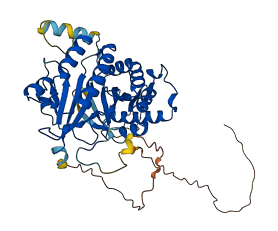
Descriptions
The autoinhibited protein was predicted that may have potential autoinhibitory elements via cis-regPred.
Autoinhibitory domains (AIDs)
Target domain |
|
Relief mechanism |
|
Assay |
cis-regPred |
Accessory elements
No accessory elements
Autoinhibited structure

Activated structure
1 structures for Q91XU3
| Entry ID | Method | Resolution | Chain | Position | Source |
|---|---|---|---|---|---|
| AF-Q91XU3-F1 | Predicted | AlphaFoldDB |
13 variants for Q91XU3
| Variant ID(s) | Position | Change | Description | Diseaes Association | Provenance |
|---|---|---|---|---|---|
| rs3389141797 | 38 | V>E | No | EVA | |
| rs3389123767 | 60 | N>D | No | EVA | |
| rs3400571019 | 123 | L>F | No | EVA | |
| rs3389141169 | 147 | R>L | No | EVA | |
| rs3389118651 | 159 | I>S | No | EVA | |
| rs3401551926 | 185 | F>L | No | EVA | |
| rs3401763459 | 185 | F>Y | No | EVA | |
| rs29359742 | 276 | L>M | No | EVA | |
| rs3389096666 | 293 | G>D | No | EVA | |
| rs3389134603 | 343 | G>D | No | EVA | |
| rs3389129792 | 380 | D>G | No | EVA | |
| rs3389071051 | 395 | G>E | No | EVA | |
| rs3389123710 | 408 | Y>* | No | EVA |
No associated diseases with Q91XU3
1 regional properties for Q91XU3
| Type | Name | Position | InterPro Accession |
|---|---|---|---|
| domain | Phosphatidylinositol-4-phosphate 5-kinase, core | 43 - 421 | IPR002498 |
Functions
| Description | ||
|---|---|---|
| EC Number | 2.7.1.149 | Phosphotransferases with an alcohol group as acceptor |
| Subcellular Localization |
|
|
| PANTHER Family | ||
| PANTHER Subfamily | ||
| PANTHER Protein Class | ||
| PANTHER Pathway Category | No pathway information available | |
6 GO annotations of cellular component
| Name | Definition |
|---|---|
| autophagosome | A double-membrane-bounded compartment that engulfs endogenous cellular material as well as invading microorganisms to target them to the lytic vacuole/lysosome for degradation as part of macroautophagy. |
| cytosol | The part of the cytoplasm that does not contain organelles but which does contain other particulate matter, such as protein complexes. |
| endoplasmic reticulum | The irregular network of unit membranes, visible only by electron microscopy, that occurs in the cytoplasm of many eukaryotic cells. The membranes form a complex meshwork of tubular channels, which are often expanded into slitlike cavities called cisternae. The ER takes two forms, rough (or granular), with ribosomes adhering to the outer surface, and smooth (with no ribosomes attached). |
| intracellular organelle | Organized structure of distinctive morphology and function, occurring within the cell. Includes the nucleus, mitochondria, plastids, vacuoles, vesicles, ribosomes and the cytoskeleton. Excludes the plasma membrane. |
| nucleoplasm | That part of the nuclear content other than the chromosomes or the nucleolus. |
| plasma membrane | The membrane surrounding a cell that separates the cell from its external environment. It consists of a phospholipid bilayer and associated proteins. |
4 GO annotations of molecular function
| Name | Definition |
|---|---|
| 1-phosphatidylinositol-4-phosphate 5-kinase activity | Catalysis of the reaction: 1-phosphatidyl-1D-myo-inositol 4-phosphate + ATP = 1-phosphatidyl-1D-myo-inositol 4,5-bisphosphate + ADP + 2 H(+). |
| 1-phosphatidylinositol-5-phosphate 4-kinase activity | Catalysis of the reaction: ATP + 1-phosphatidyl-1D-myo-inositol 5-phosphate = ADP + 1-phosphatidyl-1D-myo-inositol 4,5-bisphosphate. |
| ATP binding | Binding to ATP, adenosine 5'-triphosphate, a universally important coenzyme and enzyme regulator. |
| identical protein binding | Binding to an identical protein or proteins. |
7 GO annotations of biological process
| Name | Definition |
|---|---|
| 1-phosphatidyl-1D-myo-inositol 4,5-bisphosphate biosynthetic process | The chemical reactions and pathways resulting in the formation of 1-phosphatidyl-1D-myo-inositol 4,5-bisphosphate. |
| negative regulation of 1-phosphatidylinositol-4-phosphate 5-kinase activity | Any process that decreases the frequency, rate or extent of the catalysis of the reaction: ATP + 1-phosphatidyl-1D-myo-inositol 4-phosphate = ADP + 1-phosphatidyl-1D-myo-inositol 4,5-bisphosphate. |
| negative regulation of insulin receptor signaling pathway | Any process that stops, prevents, or reduces the frequency, rate or extent of insulin receptor signaling. |
| phosphatidylinositol phosphate biosynthetic process | The chemical reactions and pathways resulting in the formation of phosphatidylinositol phosphate. |
| phosphorylation | The process of introducing a phosphate group into a molecule, usually with the formation of a phosphoric ester, a phosphoric anhydride or a phosphoric amide. |
| positive regulation of autophagosome assembly | Any process that activates or increases the frequency, rate or extent of autophagic vacuole assembly. |
| regulation of autophagy | Any process that modulates the frequency, rate or extent of autophagy. Autophagy is the process in which cells digest parts of their own cytoplasm. |
15 homologous proteins in AiPD
| UniProt AC | Gene Name | Protein Name | Species | Evidence Code |
|---|---|---|---|---|
| Q17QS4 | PIP5KL1 | Phosphatidylinositol 4-phosphate 5-kinase-like protein 1 | Bos taurus (Bovine) | PR |
| Q0P5F7 | PIP4K2C | Phosphatidylinositol 5-phosphate 4-kinase type-2 gamma | Bos taurus (Bovine) | PR |
| Q99755 | PIP5K1A | Phosphatidylinositol 4-phosphate 5-kinase type-1 alpha | Homo sapiens (Human) | PR |
| P78356 | PIP4K2B | Phosphatidylinositol 5-phosphate 4-kinase type-2 beta | Homo sapiens (Human) | PR |
| Q5T9C9 | PIP5KL1 | Phosphatidylinositol 4-phosphate 5-kinase-like protein 1 | Homo sapiens (Human) | PR |
| Q8TBX8 | PIP4K2C | Phosphatidylinositol 5-phosphate 4-kinase type-2 gamma | Homo sapiens (Human) | PR |
| Q80XI4 | Pip4k2b | Phosphatidylinositol 5-phosphate 4-kinase type-2 beta | Mus musculus (Mouse) | PR |
| Q6U7H8 | Pip5kl1 | Phosphatidylinositol 4-phosphate 5-kinase-like protein 1 | Mus musculus (Mouse) | PR |
| O88370 | Pip4k2c | Phosphatidylinositol 5-phosphate 4-kinase type-2 gamma | Rattus norvegicus (Rat) | PR |
| O48709 | PIP5K3 | Phosphatidylinositol 4-phosphate 5-kinase 3 | Arabidopsis thaliana (Mouse-ear cress) | PR |
| Q56YP2 | PIP5K1 | Phosphatidylinositol 4-phosphate 5-kinase 1 | Arabidopsis thaliana (Mouse-ear cress) | PR |
| Q9SFB8 | PIP5K6 | Phosphatidylinositol 4-phosphate 5-kinase 6 | Arabidopsis thaliana (Mouse-ear cress) | PR |
| Q8L796 | PIP5K2 | Phosphatidylinositol 4-phosphate 5-kinase 2 | Arabidopsis thaliana (Mouse-ear cress) | PR |
| Q6GL14 | pip4k2c | Phosphatidylinositol 5-phosphate 4-kinase type-2 gamma | Xenopus tropicalis (Western clawed frog) (Silurana tropicalis) | PR |
| Q6IQE1 | pip4k2c | Phosphatidylinositol 5-phosphate 4-kinase type-2 gamma | Danio rerio (Zebrafish) (Brachydanio rerio) | PR |
| 10 | 20 | 30 | 40 | 50 | 60 |
| MASSSVPPAT | APAAAGGPGP | GFGFASKTKK | KHFVQQKVKV | FRAADPLVGV | FLWGVAHSIN |
| 70 | 80 | 90 | 100 | 110 | 120 |
| ELSQVPPPVM | LLPDDFKASS | KIKVNNHFFH | RENLPSHFKF | KEYCPQVFRN | LRDRFAIDDH |
| 130 | 140 | 150 | 160 | 170 | 180 |
| DYLVSLTRSP | PSETEGSDGR | FLISYDRTLV | IKEVSSEDIA | DMHSNLSNYH | QYIVKCHGNT |
| 190 | 200 | 210 | 220 | 230 | 240 |
| LLPQFLGMYR | VSVENEDSYM | LVMRNMFSHR | LPVHRKYDLK | GSLVSREASD | KEKVKELPTL |
| 250 | 260 | 270 | 280 | 290 | 300 |
| KDMDFLNKNQ | KVYIGEEEKK | VFLEKLKRDV | EFLVQLKIMD | YSLLLGIHDI | IRGSEPEEEG |
| 310 | 320 | 330 | 340 | 350 | 360 |
| PVREEESEWD | GDCNLAGPPA | LVGSYGTSPE | GIGGYIHSHR | PLGPGEFESF | IDVYAIRSAE |
| 370 | 380 | 390 | 400 | 410 | 420 |
| GAPQKEVYFM | GLIDILTQYD | AKKKAAHAAK | TVKHGAGAEI | STVHPEQYAK | RFLDFIANIF |
| A |