Q8VHN2
Gene name |
Grin3b |
Protein name |
Glutamate receptor ionotropic, NMDA 3B |
Names |
GluN3B, N-methyl-D-aspartate receptor subtype 3B, NMDAR3B, NR3B |
Species |
Rattus norvegicus (Rat) |
KEGG Pathway |
rno:170796 |
EC number |
|
Protein Class |
|
Descriptions
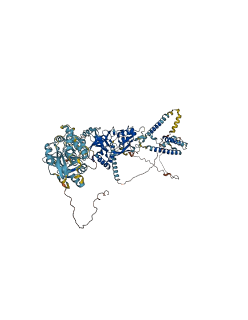
The autoinhibited protein was predicted that may have potential autoinhibitory elements via cis-regPred.
Autoinhibitory domains (AIDs)
Target domain |
|
Relief mechanism |
|
Assay |
cis-regPred |
Accessory elements
No accessory elements
Autoinhibited structure

Activated structure
3 structures for Q8VHN2
| Entry ID | Method | Resolution | Chain | Position | Source |
|---|---|---|---|---|---|
| 2RCA | X-ray | 158 A | PDB | ||
| 2RCB | X-ray | 162 A | PDB | ||
| AF-Q8VHN2-F1 | Predicted | AlphaFoldDB |
No variants for Q8VHN2
| Variant ID(s) | Position | Change | Description | Diseaes Association | Provenance |
|---|---|---|---|---|---|
| No variants for Q8VHN2 | |||||
No associated diseases with Q8VHN2
Functions
7 GO annotations of cellular component
| Name | Definition |
|---|---|
| anchoring junction | A cell junction that mechanically attaches a cell (and its cytoskeleton) to neighboring cells or to the extracellular matrix. |
| endoplasmic reticulum membrane | The lipid bilayer surrounding the endoplasmic reticulum. |
| hippocampal mossy fiber to CA3 synapse | One of the giant synapses that form between the mossy fiber axons of dentate gyrus granule cells and the large complex spines of CA3 pyramidal cells. It consists of a giant bouton known as the mossy fiber expansion, synapsed to the complex, multiheaded spine (thorny excresence) of a CA3 pyramidal cell. |
| integral component of postsynaptic density membrane | The component of the postsynaptic density membrane consisting of the gene products and protein complexes having at least some part of their peptide sequence embedded in the hydrophobic region of the membrane. |
| neuronal cell body | The portion of a neuron that includes the nucleus, but excludes cell projections such as axons and dendrites. |
| NMDA selective glutamate receptor complex | An assembly of four or five subunits which form a structure with an extracellular N-terminus and a large loop that together form the ligand binding domain. The C-terminus is intracellular. The ionotropic glutamate receptor complex itself acts as a ligand gated ion channel; on binding glutamate, charged ions pass through a channel in the center of the receptor complex. NMDA receptors are composed of assemblies of NR1 subunits (Figure 3) and NR2 subunits, which can be one of four separate gene products (NR2A-D). Expression of both subunits are required to form functional channels. The glutamate binding domain is formed at the junction of NR1 and NR2 subunits. NMDA receptors are permeable to calcium ions as well as being permeable to other ions. Thus NMDA receptor activation leads to a calcium influx into the post-synaptic cells, a signal thought to be crucial for the induction of NMDA-receptor dependent LTP and LTD. |
| plasma membrane | The membrane surrounding a cell that separates the cell from its external environment. It consists of a phospholipid bilayer and associated proteins. |
7 GO annotations of molecular function
| Name | Definition |
|---|---|
| cation channel activity | Enables the energy-independent passage of cations across a lipid bilayer down a concentration gradient. |
| glycine binding | Binding to glycine, aminoethanoic acid. |
| ionotropic glutamate receptor activity | Catalysis of the transmembrane transfer of an ion by a channel that opens when glutamate has been bound by the channel complex or one of its constituent parts. |
| ligand-gated ion channel activity | Enables the transmembrane transfer of an ion by a channel that opens when a specific ligand has been bound by the channel complex or one of its constituent parts. |
| neurotransmitter binding | Binding to a neurotransmitter, any chemical substance that is capable of transmitting (or inhibiting the transmission of) a nerve impulse from a neuron to another cell. |
| neurotransmitter receptor activity | Combining with a neurotransmitter and transmitting the signal to initiate a change in cell activity. |
| signaling receptor activity | Receiving a signal and transmitting it in the cell to initiate a change in cell activity. A signal is a physical entity or change in state that is used to transfer information in order to trigger a response. |
4 GO annotations of biological process
| Name | Definition |
|---|---|
| calcium ion transmembrane transport | A process in which a calcium ion is transported from one side of a membrane to the other by means of some agent such as a transporter or pore. |
| ionotropic glutamate receptor signaling pathway | The series of molecular signals initiated by glutamate binding to a glutamate receptor on the surface of the target cell, followed by the movement of ions through a channel in the receptor complex, and ending with the regulation of a downstream cellular process, e.g. transcription. |
| protein insertion into membrane | The process that results in the incorporation of a protein into a biological membrane. Incorporation in this context means having some part or covalently attached group that is inserted into the the hydrophobic region of one or both bilayers. |
| regulation of calcium ion transport | Any process that modulates the frequency, rate or extent of the directed movement of calcium ions into, out of or within a cell, or between cells, by means of some agent such as a transporter or pore. |
13 homologous proteins in AiPD
| UniProt AC | Gene Name | Protein Name | Species | Evidence Code |
|---|---|---|---|---|
| Q12879 | GRIN2A | Glutamate receptor ionotropic, NMDA 2A | Homo sapiens (Human) | PR |
| O60391 | GRIN3B | Glutamate receptor ionotropic, NMDA 3B | Homo sapiens (Human) | PR |
| Q91ZU9 | Grin3b | Glutamate receptor ionotropic, NMDA 3B | Mus musculus (Mouse) | PR |
| P19491 | Gria2 | Glutamate receptor 2 | Rattus norvegicus (Rat) | PR |
| P35439 | Grin1 | Glutamate receptor ionotropic, NMDA 1 | Rattus norvegicus (Rat) | PR |
| Q9C8E7 | GLR3.3 | Glutamate receptor 3.3 | Arabidopsis thaliana (Mouse-ear cress) | PR |
| Q9SHV2 | GLR2.3 | Glutamate receptor 2.3 | Arabidopsis thaliana (Mouse-ear cress) | PR |
| Q9SHV1 | GLR2.2 | Glutamate receptor 2.2 | Arabidopsis thaliana (Mouse-ear cress) | PR |
| O81078 | GLR2.9 | Glutamate receptor 2.9 | Arabidopsis thaliana (Mouse-ear cress) | PR |
| Q9SDQ4 | GLR3.7 | Glutamate receptor 3.7 | Arabidopsis thaliana (Mouse-ear cress) | PR |
| Q84W41 | GLR3.6 | Glutamate receptor 3.6 | Arabidopsis thaliana (Mouse-ear cress) | PR |
| O81776 | GLR2.4 | Glutamate receptor 2.4 | Arabidopsis thaliana (Mouse-ear cress) | PR |
| O04660 | GLR2.1 | Glutamate receptor 2.1 | Arabidopsis thaliana (Mouse-ear cress) | PR |
| 10 | 20 | 30 | 40 | 50 | 60 |
| MESVRTLWLS | VALALAVGSR | VVRGHPQPCR | VPTRAGASVR | LAALLPRAPA | ARARVLAALA |
| 70 | 80 | 90 | 100 | 110 | 120 |
| TPAPRLPHNL | SLELVAVASP | TRDPASLARG | LCQVLAPPGV | VASIAFPEAR | PELRLLQFLA |
| 130 | 140 | 150 | 160 | 170 | 180 |
| AATETPVVSV | LRREVRTALG | APTPFHLQLD | WASPLETILD | VLVSLVRAHA | WEDIALVLCR |
| 190 | 200 | 210 | 220 | 230 | 240 |
| VRDPGSLVTL | WTNHASQAPK | FVLDLSRLDS | RNDSLRAGLA | LLGALEGGGT | PVPAAVLLGC |
| 250 | 260 | 270 | 280 | 290 | 300 |
| STARAHEVLE | AAPPGPQWLL | GTPLPAEALP | TTGLPPGVLA | LGETEQHSLE | AVVHDMVELV |
| 310 | 320 | 330 | 340 | 350 | 360 |
| AQALSSMALV | HPERALLPAV | VNCDDLKTGG | SEATGRTLAR | FLGNTSFQGR | TGAVWVTGSS |
| 370 | 380 | 390 | 400 | 410 | 420 |
| QVHVSRHFKV | WSLRRDPLGA | PAWATVGSWQ | DGQLDFQPGA | AALRVPSPSG | TQARPKLRVV |
| 430 | 440 | 450 | 460 | 470 | 480 |
| TLVEHPFVFT | RESDEDGQCP | AGQLCLDPGT | NDSARLDALF | AALVNGSVPR | TLRRCCYGYC |
| 490 | 500 | 510 | 520 | 530 | 540 |
| IDLLERLAED | LAFDFELYIV | GDGKYGALRD | GRWTGLVGDL | LAGRAHMAVT | SFSINSARSQ |
| 550 | 560 | 570 | 580 | 590 | 600 |
| VVDFTSPFFS | TSLGIMVRTR | DTASPIGAFM | WPLHWSMWVG | VFAALHLTAL | FLTLYEWRSP |
| 610 | 620 | 630 | 640 | 650 | 660 |
| YGLTPRGRNR | GTVFSYSSAL | NLCYAILFGR | TVSSKTPKCP | TGRFLMNLWA | IFCLLVLSSY |
| 670 | 680 | 690 | 700 | 710 | 720 |
| TANLAAVMVG | DKTFEELSGI | HDPKLHHPSQ | GFRFGTVWES | SAEAYIKASF | PEMHAHMRRH |
| 730 | 740 | 750 | 760 | 770 | 780 |
| SAPTTPHGVA | MLTSDPPKLN | AFIMDKSLLD | YEVSIDADCK | LLTVGKPFAI | EGYGIGLPQN |
| 790 | 800 | 810 | 820 | 830 | 840 |
| SPLTSNLSEF | ISRYKSSGFI | DLLHDKWYKM | VPCGKRVFAV | TETLQMGVYH | FSGLFVLLCL |
| 850 | 860 | 870 | 880 | 890 | 900 |
| GLGSALLTSL | GEHVFYRLVL | PRIRRGNKLQ | YWLHTSQKIH | RALNTGPPEG | QQERAEQERS |
| 910 | 920 | 930 | 940 | 950 | 960 |
| GPKDELPATD | GAGRWRRVRR | AVERERRVRF | LLEPGEAGGD | RPWLCSNGPG | LQAELRELEL |
| 970 | 980 | 990 | 1000 | ||
| RIEAARERLR | SALLRRGELR | ALLGDGTRLR | PLRLLHAAPA | ES |