Q8L4M6
Gene name |
GATA3 (At4g34680, T4L20.260) |
Protein name |
GATA transcription factor 3 |
Names |
AtGATA-3 |
Species |
Arabidopsis thaliana (Mouse-ear cress) |
KEGG Pathway |
ath:AT4G34680 |
EC number |
|
Protein Class |
|
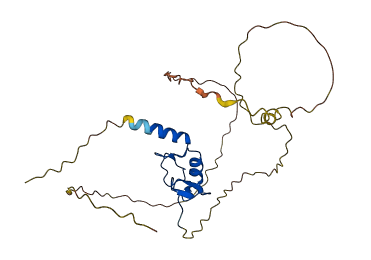
Descriptions
The autoinhibited protein was predicted that may have potential autoinhibitory elements via cis-regPred.
Autoinhibitory domains (AIDs)
Target domain |
|
Relief mechanism |
|
Assay |
cis-regPred |
Accessory elements
No accessory elements
Autoinhibited structure

Activated structure
1 structures for Q8L4M6
| Entry ID | Method | Resolution | Chain | Position | Source |
|---|---|---|---|---|---|
| AF-Q8L4M6-F1 | Predicted | AlphaFoldDB |
18 variants for Q8L4M6
| Variant ID(s) | Position | Change | Description | Diseaes Association | Provenance |
|---|---|---|---|---|---|
| ENSVATH06824543 | 3 | L>Q | No | 1000Genomes | |
| tmp_4_16553745_G_A | 16 | G>R | No | 1000Genomes | |
| tmp_4_16553787_T_A | 30 | S>T | No | 1000Genomes | |
| tmp_4_16553862_C_G | 55 | Q>E | No | 1000Genomes | |
| ENSVATH02957993 | 62 | V>G | No | 1000Genomes | |
| ENSVATH12393206 | 63 | V>F | No | 1000Genomes | |
| ENSVATH06824547 | 120 | L>V | No | 1000Genomes | |
| tmp_4_16554168_C_T | 123 | T>I | No | 1000Genomes | |
| tmp_4_16554240_C_G | 147 | T>S | No | 1000Genomes | |
| ENSVATH00552754 | 159 | H>N | No | 1000Genomes | |
| ENSVATH12393211 | 177 | V>A | No | 1000Genomes | |
| ENSVATH06824548 | 188 | N>Y | No | 1000Genomes | |
| ENSVATH06824550 | 232 | I>F | No | 1000Genomes | |
| ENSVATH06824552 | 253 | T>I | No | 1000Genomes | |
| tmp_4_16554563_G_T | 255 | E>* | No | 1000Genomes | |
| tmp_4_16554571_T_A | 257 | S>R | No | 1000Genomes | |
| tmp_4_16554573_C_A | 258 | T>N | No | 1000Genomes | |
| tmp_4_16554605_T_A | 269 | W>R | No | 1000Genomes |
No associated diseases with Q8L4M6
No regional properties for Q8L4M6
| Type | Name | Position | InterPro Accession |
|---|---|---|---|
| No domain, repeats, and functional sites for Q8L4M6 | |||
2 GO annotations of cellular component
| Name | Definition |
|---|---|
| nucleolus | A small, dense body one or more of which are present in the nucleus of eukaryotic cells. It is rich in RNA and protein, is not bounded by a limiting membrane, and is not seen during mitosis. Its prime function is the transcription of the nucleolar DNA into 45S ribosomal-precursor RNA, the processing of this RNA into 5.8S, 18S, and 28S components of ribosomal RNA, and the association of these components with 5S RNA and proteins synthesized outside the nucleolus. This association results in the formation of ribonucleoprotein precursors; these pass into the cytoplasm and mature into the 40S and 60S subunits of the ribosome. |
| nucleus | A membrane-bounded organelle of eukaryotic cells in which chromosomes are housed and replicated. In most cells, the nucleus contains all of the cell's chromosomes except the organellar chromosomes, and is the site of RNA synthesis and processing. In some species, or in specialized cell types, RNA metabolism or DNA replication may be absent. |
3 GO annotations of molecular function
| Name | Definition |
|---|---|
| DNA-binding transcription factor activity | A transcription regulator activity that modulates transcription of gene sets via selective and non-covalent binding to a specific double-stranded genomic DNA sequence (sometimes referred to as a motif) within a cis-regulatory region. Regulatory regions include promoters (proximal and distal) and enhancers. Genes are transcriptional units, and include bacterial operons. |
| transcription cis-regulatory region binding | Binding to a specific sequence of DNA that is part of a regulatory region that controls transcription of that section of the DNA. The transcribed region might be described as a gene, cistron, or operon. |
| zinc ion binding | Binding to a zinc ion (Zn). |
3 GO annotations of biological process
| Name | Definition |
|---|---|
| cell differentiation | The process in which relatively unspecialized cells, e.g. embryonic or regenerative cells, acquire specialized structural and/or functional features that characterize the cells, tissues, or organs of the mature organism or some other relatively stable phase of the organism's life history. Differentiation includes the processes involved in commitment of a cell to a specific fate and its subsequent development to the mature state. |
| circadian rhythm | Any biological process in an organism that recurs with a regularity of approximately 24 hours. |
| positive regulation of DNA-templated transcription | Any process that activates or increases the frequency, rate or extent of cellular DNA-templated transcription. |
18 homologous proteins in AiPD
| UniProt AC | Gene Name | Protein Name | Species | Evidence Code |
|---|---|---|---|---|
| P23769 | GATA2 | Endothelial transcription factor GATA-2 | Homo sapiens (Human) | PR |
| O09100 | Gata2 | Endothelial transcription factor GATA-2 | Mus musculus (Mouse) | PR |
| Q942A1 | RR4 | Two-component response regulator ORR4 | Oryza sativa subsp japonica (Rice) | PR |
| Q6H468 | RR11 | Two-component response regulator ORR11 | Oryza sativa subsp japonica (Rice) | PR |
| Q0PVB3 | RR7 | Two-component response regulator ORR7 | Oryza sativa subsp japonica (Rice) | PR |
| Q7Y0W5 | EHD1 | Two-component response regulator ORR30 | Oryza sativa subsp japonica (Rice) | PR |
| Q9ZWS9 | ARR3 | Two-component response regulator ARR3 | Arabidopsis thaliana (Mouse-ear cress) | PR |
| Q9FXD6 | ARR11 | Two-component response regulator ARR11 | Arabidopsis thaliana (Mouse-ear cress) | PR |
| Q9SB04 | ARR5 | Two-component response regulator ARR5 | Arabidopsis thaliana (Mouse-ear cress) | PR |
| O80366 | ARR9 | Two-component response regulator ARR9 | Arabidopsis thaliana (Mouse-ear cress) | PR |
| Q6LA43 | APRR2 | Two-component response regulator-like APRR2 | Arabidopsis thaliana (Mouse-ear cress) | PR |
| Q93WK5 | APRR7 | Two-component response regulator-like APRR7 | Arabidopsis thaliana (Mouse-ear cress) | PR |
| Q9FJ16 | APRR4 | Putative two-component response regulator-like APRR4 | Arabidopsis thaliana (Mouse-ear cress) | PR |
| Q9LVG4 | APRR3 | Two-component response regulator-like APRR3 | Arabidopsis thaliana (Mouse-ear cress) | PR |
| Q9LKL2 | APRR1 | Two-component response regulator-like APRR1 | Arabidopsis thaliana (Mouse-ear cress) | PR |
| O65515 | GATA7 | GATA transcription factor 7 | Arabidopsis thaliana (Mouse-ear cress) | PR |
| Q9LT45 | GATA29 | GATA transcription factor 29 | Arabidopsis thaliana (Mouse-ear cress) | PR |
| Q9SKN6 | GATA13 | Putative GATA transcription factor 13 | Arabidopsis thaliana (Mouse-ear cress) | PR |
| 10 | 20 | 30 | 40 | 50 | 60 |
| MELWTEARAL | KASLRGESTI | SLKHHQVIVS | EDLSRTSSLP | EDFSVECFLD | FSEGQKEEEE |
| 70 | 80 | 90 | 100 | 110 | 120 |
| EVVSVSSSQE | QEEQEHDCVF | SSQPCIFDQL | PSLPDEDVEE | LEWVSRVVDD | CSSPEVSLLL |
| 130 | 140 | 150 | 160 | 170 | 180 |
| TQTHKTKPSF | SRIPVKPRTK | RSRNSLTGSR | VWPLVSTNHQ | HAATEQLRKK | KQETVLVFQR |
| 190 | 200 | 210 | 220 | 230 | 240 |
| RCSHCGTNNT | PQWRTGPVGP | KTLCNACGVR | FKSGRLCPEY | RPADSPTFSN | EIHSNLHRKV |
| 250 | 260 | ||||
| LELRKSKELG | EETGEASTKS | DPVKFGSKW |