Q6ZQ88
Gene name |
Kdm1a |
Protein name |
Lysine-specific histone demethylase 1A |
Names |
BRAF35-HDAC complex protein BHC110, Flavin-containing amine oxidase domain-containing protein 2 |
Species |
Mus musculus (Mouse) |
KEGG Pathway |
mmu:99982 |
EC number |
1.14.99.66: Miscellaneous |
Protein Class |
|
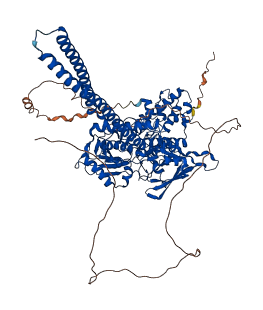
Descriptions
The autoinhibited protein was predicted that may have potential autoinhibitory elements via cis-regPred.
Autoinhibitory domains (AIDs)
Target domain |
|
Relief mechanism |
|
Assay |
cis-regPred |
Accessory elements
No accessory elements
Autoinhibited structure

Activated structure
1 structures for Q6ZQ88
| Entry ID | Method | Resolution | Chain | Position | Source |
|---|---|---|---|---|---|
| AF-Q6ZQ88-F1 | Predicted | AlphaFoldDB |
31 variants for Q6ZQ88
| Variant ID(s) | Position | Change | Description | Diseaes Association | Provenance |
|---|---|---|---|---|---|
| rs3388723010 | 130 | N>I | No | EVA | |
| rs3388718218 | 132 | S>L | No | EVA | |
| rs3388720720 | 160 | P>L | No | EVA | |
| rs3388722577 | 174 | G>VSDG* | No | EVA | |
| rs3388722521 | 194 | A>T | No | EVA | |
| rs3388710130 | 254 | H>N | No | EVA | |
| rs3394985723 | 275 | P>L | No | EVA | |
| rs3394936866 | 276 | I>V | No | EVA | |
| rs3388715753 | 315 | G>D | No | EVA | |
| rs3388722566 | 330 | L>I | No | EVA | |
| rs3388724629 | 379 | V>I | No | EVA | |
| rs3388715763 | 420 | Q>K | No | EVA | |
| rs3394936816 | 450 | V>E | No | EVA | |
| rs3388724559 | 451 | N>S | No | EVA | |
| rs3388720325 | 528 | Q>H | No | EVA | |
| rs3388714192 | 538 | E>K | No | EVA | |
| rs3394385927 | 559 | F>L | No | EVA | |
| rs3388729283 | 621 | A>V | No | EVA | |
| rs3388699927 | 633 | Q>E | No | EVA | |
| rs3388722533 | 660 | L>F | No | EVA | |
| rs3410540320 | 670 | V>E | No | EVA | |
| rs3388720288 | 671 | F>S | No | EVA | |
| rs3388718227 | 680 | G>E | No | EVA | |
| rs3388718142 | 690 | G>V | No | EVA | |
| rs3394932680 | 701 | A>G | No | EVA | |
| rs3394911499 | 704 | L>V | No | EVA | |
| rs3412926804 | 706 | A>D | No | EVA | |
| rs3388706639 | 706 | A>T | No | EVA | |
| rs3388729253 | 715 | I>T | No | EVA | |
| rs3388699921 | 765 | V>A | No | EVA | |
| rs3388718198 | 770 | S>F | No | EVA |
No associated diseases with Q6ZQ88
Functions
| Description | ||
|---|---|---|
| EC Number | 1.14.99.66 | Miscellaneous |
| Subcellular Localization |
|
|
| PANTHER Family | ||
| PANTHER Subfamily | ||
| PANTHER Protein Class | ||
| PANTHER Pathway Category | No pathway information available | |
6 GO annotations of cellular component
| Name | Definition |
|---|---|
| chromatin | The ordered and organized complex of DNA, protein, and sometimes RNA, that forms the chromosome. |
| chromosome, telomeric region | The end of a linear chromosome, required for the integrity and maintenance of the end. A chromosome telomere usually includes a region of telomerase-encoded repeats the length of which rarely exceeds 20 bp each and that permits the formation of a telomeric loop (T-loop). The telomeric repeat region is usually preceded by a sub-telomeric region that is gene-poor but rich in repetitive elements. Some telomeres only consist of the latter part (for eg. D. melanogaster telomeres). |
| DNA repair complex | A protein complex involved in DNA repair processes including direct reversal, base excision repair, nucleotide excision repair, photoreactivation, bypass, double-strand break repair pathway, and mismatch repair pathway. |
| nucleoplasm | That part of the nuclear content other than the chromosomes or the nucleolus. |
| nucleus | A membrane-bounded organelle of eukaryotic cells in which chromosomes are housed and replicated. In most cells, the nucleus contains all of the cell's chromosomes except the organellar chromosomes, and is the site of RNA synthesis and processing. In some species, or in specialized cell types, RNA metabolism or DNA replication may be absent. |
| protein-containing complex | A stable assembly of two or more macromolecules, i.e. proteins, nucleic acids, carbohydrates or lipids, in which at least one component is a protein and the constituent parts function together. |
19 GO annotations of molecular function
| Name | Definition |
|---|---|
| chromatin binding | Binding to chromatin, the network of fibers of DNA, protein, and sometimes RNA, that make up the chromosomes of the eukaryotic nucleus during interphase. |
| demethylase activity | Catalysis of the removal of a methyl group from a substrate. |
| DNA-binding transcription factor binding | Binding to a DNA-binding transcription factor, a protein that interacts with a specific DNA sequence (sometimes referred to as a motif) within the regulatory region of a gene to modulate transcription. |
| enzyme binding | Binding to an enzyme, a protein with catalytic activity. |
| flavin adenine dinucleotide binding | Binding to FAD, flavin-adenine dinucleotide, the coenzyme or the prosthetic group of various flavoprotein oxidoreductase enzymes, in either the oxidized form, FAD, or the reduced form, FADH2. |
| histone demethylase activity | Catalysis of the removal of a methyl group from a histone. |
| histone H3-di/monomethyl-lysine-4 FAD-dependent demethylase activity | Catalysis of the removal of a methyl group from a di- or a monomethyl-lysine residue at position 4 of the histone H3 protein. This is a flavin adenine dinucleotide (FAD)-dependent amine oxidation reaction. |
| histone H3-methyl-lysine-4 demethylase activity | Catalysis of the removal of a methyl group from a modified lysine residue at position 4 of the histone H3 protein. |
| histone H3-methyl-lysine-9 demethylase activity | Catalysis of the removal of a methyl group from a modified lysine residue at position 9 of the histone H3 protein. |
| lncRNA binding | Binding to a long noncoding RNA (lncRNA). |
| MRF binding | Binding to Myogenic Regulatory Factor (MRF), a member of the basic Helix-Loop-Helix (bHLH) superfamily of transcription factors. |
| nuclear androgen receptor binding | Binding to a nuclear androgen receptor. |
| nuclear receptor coactivator activity | A transcription coactivator activity that activates or increases the transcription of specific gene sets via binding to a DNA-bound nuclear receptor, either on its own or as part of a complex. Coactivators often act by altering chromatin structure and modifications. For example, one class of transcription coregulators modifies chromatin structure through covalent modification of histones. A second class remodels the conformation of chromatin in an ATP-dependent fashion. A third class modulates interactions of DNA-bound DNA-binding transcription factors with other transcription coregulators. A fourth class of coactivator activity is the bridging of a DNA-binding transcription factor to the general (basal) transcription machinery. The Mediator complex, which bridges sequence-specific DNA binding transcription factors and RNA polymerase, is also a transcription coactivator. |
| oxidoreductase activity | Catalysis of an oxidation-reduction (redox) reaction, a reversible chemical reaction in which the oxidation state of an atom or atoms within a molecule is altered. One substrate acts as a hydrogen or electron donor and becomes oxidized, while the other acts as hydrogen or electron acceptor and becomes reduced. |
| p53 binding | Binding to one of the p53 family of proteins. |
| promoter-specific chromatin binding | Binding to a section of chromatin that is associated with gene promoter sequences of DNA. |
| RNA polymerase II cis-regulatory region sequence-specific DNA binding | Binding to a specific upstream regulatory DNA sequence (transcription factor recognition sequence or binding site) located in cis relative to the transcription start site (i.e., on the same strand of DNA) of a gene transcribed by RNA polymerase II. |
| RNA polymerase II-specific DNA-binding transcription factor binding | Binding to a sequence-specific DNA binding RNA polymerase II transcription factor, any of the factors that interact selectively and non-covalently with a specific DNA sequence in order to modulate transcription. |
| telomeric repeat-containing RNA binding | Binding to long non-coding RNA molecules transcribed from subtelomeric regions in most eukaryotes. Telomeric repeat-containing RNA (TERRA) molecules consist of subtelomeric-derived sequences and G-rich telomeric repeats. |
40 GO annotations of biological process
| Name | Definition |
|---|---|
| cell differentiation | The process in which relatively unspecialized cells, e.g. embryonic or regenerative cells, acquire specialized structural and/or functional features that characterize the cells, tissues, or organs of the mature organism or some other relatively stable phase of the organism's life history. Differentiation includes the processes involved in commitment of a cell to a specific fate and its subsequent development to the mature state. |
| cellular response to gamma radiation | Any process that results in a change in state or activity of a cell (in terms of movement, secretion, enzyme production, gene expression, etc.) as a result of a gamma radiation stimulus. Gamma radiation is a form of electromagnetic radiation (EMR) or light emission of a specific frequency produced from sub-atomic particle interaction, such as electron-positron annihilation and radioactive decay. Gamma rays are generally characterized as EMR having the highest frequency and energy, and also the shortest wavelength, within the electromagnetic radiation spectrum. |
| cellular response to UV | Any process that results in a change in state or activity of a cell (in terms of movement, secretion, enzyme production, gene expression, etc.) as a result of an ultraviolet radiation (UV light) stimulus. Ultraviolet radiation is electromagnetic radiation with a wavelength in the range of 10 to 380 nanometers. |
| chromatin organization | The assembly or remodeling of chromatin composed of DNA complexed with histones, other associated proteins, and sometimes RNA. |
| granulocyte differentiation | The process in which a myeloid precursor cell acquires the specialized features of a granulocyte. Granulocytes are a class of leukocytes characterized by the presence of granules in their cytoplasm. These cells are active in allergic immune reactions such as arthritic inflammation and rashes. This class includes basophils, eosinophils and neutrophils. |
| guanine metabolic process | The chemical reactions and pathways involving guanine, 2-amino-6-hydroxypurine, a purine that is one of the five main bases found in nucleic acids and a component of a number of phosphorylated guanosine derivatives whose metabolic or regulatory functions are important. |
| histone H3-K4 demethylation | The modification of histone H3 by the removal of a methyl group from lysine at position 4 of the histone. |
| histone H3-K9 demethylation | The modification of histone H3 by the removal of a methyl group from lysine at position 9 of the histone. |
| muscle cell development | The process whose specific outcome is the progression of a muscle cell over time, from its formation to the mature structure. Muscle cell development does not include the steps involved in committing an unspecified cell to the muscle cell fate. |
| negative regulation of DNA damage response, signal transduction by p53 class mediator | Any process that stops, prevents, or reduces the frequency, rate or extent of the cascade of processes induced by the cell cycle regulator phosphoprotein p53, or an equivalent protein, in response to the detection of DNA damage. |
| negative regulation of DNA-binding transcription factor activity | Any process that stops, prevents, or reduces the frequency, rate or extent of the activity of a transcription factor, any factor involved in the initiation or regulation of transcription. |
| negative regulation of DNA-templated transcription | Any process that stops, prevents, or reduces the frequency, rate or extent of cellular DNA-templated transcription. |
| negative regulation of histone H3-K4 methylation | Any process that stops, prevents, or reduces the frequency, rate or extent of the covalent addition of a methyl group to the lysine at position 4 of histone H3. |
| negative regulation of histone H3-K9 methylation | Any process that stops, prevents, or reduces the frequency, rate or extent of the covalent addition of a methyl group to the lysine at position 9 of histone H3. |
| negative regulation of intrinsic apoptotic signaling pathway in response to DNA damage by p53 class mediator | Any process that stops, prevents or reduces the frequency, rate or extent of intrinsic apoptotic signaling pathway in response to DNA damage by p53 class mediator. |
| negative regulation of neurogenesis | Any process that stops, prevents, or reduces the frequency, rate or extent of neurogenesis, the generation of cells within the nervous system. |
| negative regulation of protein binding | Any process that stops, prevents, or reduces the frequency, rate or extent of protein binding. |
| negative regulation of transcription by RNA polymerase II | Any process that stops, prevents, or reduces the frequency, rate or extent of transcription mediated by RNA polymerase II. |
| neuron projection extension | Long distance growth of a single neuron projection involved in cellular development. A neuron projection is a prolongation or process extending from a nerve cell, e.g. an axon or dendrite. |
| pituitary gland development | The progression of the pituitary gland over time from its initial formation until its mature state. The pituitary gland is an endocrine gland that secretes hormones that regulate many other glands. |
| positive regulation of cell size | Any process that increases cell size. |
| positive regulation of chromatin binding | Any process that increases the frequency, rate or extent of chromatin binding. Chromatin binding is the selective interaction with chromatin, the network of fibers of DNA, protein, and sometimes RNA, that make up the chromosomes of the eukaryotic nucleus during interphase. |
| positive regulation of cold-induced thermogenesis | Any process that activates or increases the frequency, rate or extent of cold-induced thermogenesis. |
| positive regulation of DNA-binding transcription factor activity | Any process that activates or increases the frequency, rate or extent of activity of a transcription factor, any factor involved in the initiation or regulation of transcription. |
| positive regulation of erythrocyte differentiation | Any process that activates or increases the frequency, rate or extent of erythrocyte differentiation. |
| positive regulation of histone ubiquitination | Any process that activates or increases the frequency, rate or extent of the addition of a ubiquitin group to a histone protein. |
| positive regulation of megakaryocyte differentiation | Any process that activates or increases the frequency, rate or extent of megakaryocyte differentiation. |
| positive regulation of neural precursor cell proliferation | Any process that activates or increases the frequency, rate or extent of neural precursor cell proliferation. |
| positive regulation of neuroblast proliferation | Any process that activates or increases the rate of neuroblast proliferation. |
| positive regulation of neuron projection development | Any process that increases the rate, frequency or extent of neuron projection development. Neuron projection development is the process whose specific outcome is the progression of a neuron projection over time, from its formation to the mature structure. A neuron projection is any process extending from a neural cell, such as axons or dendrites (collectively called neurites). |
| positive regulation of stem cell proliferation | Any process that activates or increases the frequency, rate or extent of stem cell proliferation. |
| positive regulation of transcription by RNA polymerase II | Any process that activates or increases the frequency, rate or extent of transcription from an RNA polymerase II promoter. |
| protein demethylation | The removal of a methyl group, from a protein amino acid. A methyl group is derived from methane by the removal of a hydrogen atom. |
| regulation of DNA methylation-dependent heterochromatin assembly | Any process that modulates the rate, frequency, or extent of DNA methylation-dependent heterochromatin formation. |
| regulation of double-strand break repair via homologous recombination | Any process that modulates the frequency, rate or extent of the error-free repair of a double-strand break in DNA in which the broken DNA molecule is repaired using homologous sequences. |
| regulation of neurogenesis | Any process that modulates the frequency, rate or extent of neurogenesis, the generation of cells in the nervous system. |
| regulation of primitive erythrocyte differentiation | Any process that modulates the rate, frequency, or extent of primitive erythrocyte differentiation. Primitive erythrocyte differentiation occurs as part of the process of primitive hemopoiesis. |
| regulation of protein localization | Any process that modulates the frequency, rate or extent of any process in which a protein is transported to, or maintained in, a specific location. |
| regulation of transcription by RNA polymerase II | Any process that modulates the frequency, rate or extent of transcription mediated by RNA polymerase II. |
| transcription by RNA polymerase II | The synthesis of RNA from a DNA template by RNA polymerase II (RNAP II), originating at an RNA polymerase II promoter. Includes transcription of messenger RNA (mRNA) and certain small nuclear RNAs (snRNAs). |
13 homologous proteins in AiPD
| UniProt AC | Gene Name | Protein Name | Species | Evidence Code |
|---|---|---|---|---|
| P56560 | MAOB | Amine oxidase [flavin-containing] B | Bos taurus (Bovine) | PR |
| P21398 | MAOA | Amine oxidase [flavin-containing] A | Bos taurus (Bovine) | PR |
| Q8NB78 | KDM1B | Lysine-specific histone demethylase 2 | Homo sapiens (Human) | PR |
| P21397 | MAOA | Amine oxidase [flavin-containing] A | Homo sapiens (Human) | PR |
| P27338 | MAOB | Amine oxidase [flavin-containing] B | Homo sapiens (Human) | PR |
| Q9NWM0 | SMOX | Spermine oxidase | Homo sapiens (Human) | PR |
| O60341 | KDM1A | Lysine-specific histone demethylase 1A | Homo sapiens (Human) | PR |
| Q64133 | Maoa | Amine oxidase [flavin-containing] A | Mus musculus (Mouse) | PR |
| Q6Q2J0 | MAOA | Amine oxidase [flavin-containing] A | Sus scrofa (Pig) | PR |
| P19643 | Maob | Amine oxidase [flavin-containing] B | Rattus norvegicus (Rat) | PR |
| P21396 | Maoa | Amine oxidase [flavin-containing] A | Rattus norvegicus (Rat) | PR |
| P28554 | PDS | 15-cis-phytoene desaturase, chloroplastic/chromoplastic | Solanum lycopersicum (Tomato) (Lycopersicon esculentum) | PR |
| Q6NSN2 | mao | Amine oxidase [flavin-containing] | Danio rerio (Zebrafish) (Brachydanio rerio) | PR |
| 10 | 20 | 30 | 40 | 50 | 60 |
| MLSGKKAAAA | AAAAAAAAAA | GTEAGSGAAG | GAENGSEVAA | PPAGLTGPTD | MATGAAGERT |
| 70 | 80 | 90 | 100 | 110 | 120 |
| PRKKEPPRAS | PPGGLAEPPG | SAGPQAGPTA | GPGSATPMET | GIAETPEGRR | TSRRKRAKVE |
| 130 | 140 | 150 | 160 | 170 | 180 |
| YREMDESLAN | LSEDEYYSEE | ERNAKAEKEK | KLPPPPPQAP | PEEENESEPE | EPSGVEGAAF |
| 190 | 200 | 210 | 220 | 230 | 240 |
| QSRLPHDRMT | SQEAACFPDI | ISGPQQTQKV | FLFIRNRTLQ | LWLDNPKIQL | TFEATLQQLE |
| 250 | 260 | 270 | 280 | 290 | 300 |
| APYNSDTVLV | HRVHSYLERH | GLINFGIYKR | IKPLPIKKTG | KVIIIGSGVS | GLAAARQLQS |
| 310 | 320 | 330 | 340 | 350 | 360 |
| FGMDVTLLEA | RDRVGGRVAT | FRKGNYVADL | GAMVVTGLGG | NPMAVVSKQV | NMELAKIKQK |
| 370 | 380 | 390 | 400 | 410 | 420 |
| CPLYEANGQA | VPKEKDEMVE | QEFNRLLEAT | SYLSHQLDFN | VLNNKPVSLG | QALEVVIQLQ |
| 430 | 440 | 450 | 460 | 470 | 480 |
| EKHVKDEQIE | HWKKIVKTQE | ELKELLNKMV | NLKEKIKELH | QQYKEASEVK | PPRDITAEFL |
| 490 | 500 | 510 | 520 | 530 | 540 |
| VKSKHRDLTA | LCKEYDELAE | TQGKLEEKLQ | ELEANPPSDV | YLSSRDRQIL | DWHFANLEFA |
| 550 | 560 | 570 | 580 | 590 | 600 |
| NATPLSTLSL | KHWDQDDDFE | FTGSHLTVRN | GYSCVPVALA | EGLDIKLNTA | VRQVRYTASG |
| 610 | 620 | 630 | 640 | 650 | 660 |
| CEVIAVNTRS | TSQTFIYKCD | AVLCTLPLGV | LKQQPPAVQF | VPPLPEWKTS | AVQRMGFGNL |
| 670 | 680 | 690 | 700 | 710 | 720 |
| NKVVLCFDRV | FWDPSVNLFG | HVGSTTASRG | ELFLFWNLYK | APILLALVAG | EAAGIMENIS |
| 730 | 740 | 750 | 760 | 770 | 780 |
| DDVIVGRCLA | ILKGIFGSSA | VPQPKETVVS | RWRADPWARG | SYSYVAAGSS | GNDYDLMAQP |
| 790 | 800 | 810 | 820 | 830 | 840 |
| ITPGPSIPGA | PQPIPRLFFA | GEHTIRNYPA | TVHGALLSGL | REAGRIADQF | LGAMYTLPRQ |
| 850 | |||||
| ATPGVPAQQS | PSM |