Q6NW76
Gene name |
aurkb (stka) |
Protein name |
Aurora kinase B |
Names |
Serine/threonine kinase A, Serine/threonine-protein kinase 12, Serine/threonine-protein kinase aurora-B |
Species |
Danio rerio (Zebrafish) (Brachydanio rerio) |
KEGG Pathway |
|
EC number |
2.7.11.1: Protein-serine/threonine kinases |
Protein Class |
|
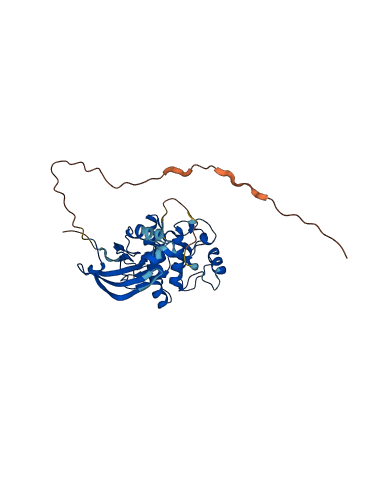
Descriptions
The autoinhibited protein was predicted that may have potential autoinhibitory elements via cis-regPred.
Autoinhibitory domains (AIDs)
Target domain |
|
Relief mechanism |
|
Assay |
cis-regPred |
Accessory elements
193-214 (Activation loop from InterPro)
Target domain |
53-303 (Protein kinase domain) |
Relief mechanism |
|
Assay |
|
Autoinhibited structure

Activated structure
1 structures for Q6NW76
| Entry ID | Method | Resolution | Chain | Position | Source |
|---|---|---|---|---|---|
| AF-Q6NW76-F1 | Predicted | AlphaFoldDB |
No variants for Q6NW76
| Variant ID(s) | Position | Change | Description | Diseaes Association | Provenance |
|---|---|---|---|---|---|
| No variants for Q6NW76 | |||||
No associated diseases with Q6NW76
Functions
| Description | ||
|---|---|---|
| EC Number | 2.7.11.1 | Protein-serine/threonine kinases |
| Subcellular Localization |
|
|
| PANTHER Family | ||
| PANTHER Subfamily | ||
| PANTHER Protein Class | ||
| PANTHER Pathway Category | No pathway information available | |
8 GO annotations of cellular component
| Name | Definition |
|---|---|
| chromosome passenger complex | A eukaryotically conserved protein complex that localizes to kinetochores in early mitosis, the spindle mid-zone in anaphase B and to the telophase midbody. It has been proposed that the passenger complex coordinates various events based on its location to different structures during the course of mitosis. Complex members include the BIR-domain-containing protein Survivin, Aurora kinase, INCENP and Borealin. |
| cytoplasm | The contents of a cell excluding the plasma membrane and nucleus, but including other subcellular structures. |
| kinetochore | A multisubunit complex that is located at the centromeric region of DNA and provides an attachment point for the spindle microtubules. |
| midbody | A thin cytoplasmic bridge formed between daughter cells at the end of cytokinesis. The midbody forms where the contractile ring constricts, and may persist for some time before finally breaking to complete cytokinesis. |
| nucleus | A membrane-bounded organelle of eukaryotic cells in which chromosomes are housed and replicated. In most cells, the nucleus contains all of the cell's chromosomes except the organellar chromosomes, and is the site of RNA synthesis and processing. In some species, or in specialized cell types, RNA metabolism or DNA replication may be absent. |
| spindle microtubule | Any microtubule that is part of a mitotic or meiotic spindle; anchored at one spindle pole. |
| spindle midzone | The area in the center of the spindle where the spindle microtubules from opposite poles overlap. |
| spindle pole centrosome | A centrosome from which one pole of a mitotic or meiotic spindle is organized. |
5 GO annotations of molecular function
| Name | Definition |
|---|---|
| ATP binding | Binding to ATP, adenosine 5'-triphosphate, a universally important coenzyme and enzyme regulator. |
| histone kinase activity (H3-S28 specific) | Catalysis of the transfer of a phosphate group to the serine-28 residue of histone H3. |
| histone serine kinase activity | Catalysis of the transfer of a phosphate group to a serine residue of a histone. |
| protein serine kinase activity | Catalysis of the reactions: ATP + protein serine = ADP + protein serine phosphate. |
| protein serine/threonine kinase activity | Catalysis of the reactions: ATP + protein serine = ADP + protein serine phosphate, and ATP + protein threonine = ADP + protein threonine phosphate. |
19 GO annotations of biological process
| Name | Definition |
|---|---|
| abscission | The controlled shedding of a body part. |
| cellular response to UV | Any process that results in a change in state or activity of a cell (in terms of movement, secretion, enzyme production, gene expression, etc.) as a result of an ultraviolet radiation (UV light) stimulus. Ultraviolet radiation is electromagnetic radiation with a wavelength in the range of 10 to 380 nanometers. |
| chromosome segregation | The process in which genetic material, in the form of chromosomes, is organized into specific structures and then physically separated and apportioned to two or more sets. In eukaryotes, chromosome segregation begins with the condensation of chromosomes, includes chromosome separation, and ends when chromosomes have completed movement to the spindle poles. |
| cleavage furrow formation | Generation of the cleavage furrow, a shallow groove in the cell surface near the old metaphase plate that marks the site of cytokinesis. This process includes the recruitment and localized activation of signals such as RhoA at the site of the future furrow to ensure that furrowing initiates at the correct site in the cell. |
| microtubule cytoskeleton organization | A process that is carried out at the cellular level which results in the assembly, arrangement of constituent parts, or disassembly of cytoskeletal structures comprising microtubules and their associated proteins. |
| mitotic cytokinesis | A cell cycle process that results in the division of the cytoplasm of a cell after mitosis, resulting in the separation of the original cell into two daughter cells. |
| mitotic cytokinesis checkpoint signaling | A signaling process that contributes to a mitotic cell cycle checkpoint that detects a defect in cytokinesis and prevents further rounds of nuclear division until cytokinesis is completed. |
| mitotic spindle assembly checkpoint signaling | A signal transduction process that contributes to a mitotic cell cycle spindle assembly checkpoint, that delays the metaphase/anaphase transition of a mitotic nuclear division until the spindle is correctly assembled and chromosomes are attached to the spindle. |
| mitotic spindle midzone assembly | The cell cycle process in which the aggregation, arrangement and bonding together of a set of components forms the spindle midzone. |
| mitotic spindle organization | A process that is carried out at the cellular level which results in the assembly, arrangement of constituent parts, or disassembly of the microtubule spindle during a mitotic cell cycle. |
| negative regulation of B cell apoptotic process | Any process that stops, prevents, or reduces the frequency, rate, or extent of B cell apoptotic process. |
| negative regulation of cytokinesis | Any process that stops, prevents, or reduces the frequency, rate or extent of the division of the cytoplasm of a cell, and its separation into two daughter cells. |
| negative regulation of transcription by RNA polymerase II | Any process that stops, prevents, or reduces the frequency, rate or extent of transcription mediated by RNA polymerase II. |
| positive regulation of cytokinesis | Any process that activates or increases the frequency, rate or extent of the division of the cytoplasm of a cell, and its separation into two daughter cells. |
| positive regulation of mitotic sister chromatid segregation | Any process that starts or increases the frequency, rate or extent of sister chromatid segregation during mitosis. |
| post-translational protein modification | The process of covalently altering one or more amino acids in a protein after the protein has been completely translated and released from the ribosome. |
| protein localization to kinetochore | Any process in which a protein is transported to, or maintained at, the kinetochore. |
| protein phosphorylation | The process of introducing a phosphate group on to a protein. |
| regulation of cytokinesis | Any process that modulates the frequency, rate or extent of the division of the cytoplasm of a cell and its separation into two daughter cells. |
15 homologous proteins in AiPD
| UniProt AC | Gene Name | Protein Name | Species | Evidence Code |
|---|---|---|---|---|
| P38991 | IPL1 | Spindle assembly checkpoint kinase | Saccharomyces cerevisiae (strain ATCC 204508 / S288c) (Baker's yeast) | PR |
| Q2TA06 | AURKA | Aurora kinase A | Bos taurus (Bovine) | PR |
| Q7YRC6 | AURKB | Aurora kinase B | Bos taurus (Bovine) | PR |
| Q9VKN7 | aurB | Aurora kinase B | Drosophila melanogaster (Fruit fly) | PR |
| O14965 | AURKA | Aurora kinase A | Homo sapiens (Human) | PR |
| Q9UQB9 | AURKC | Aurora kinase C | Homo sapiens (Human) | PR |
| Q96GD4 | AURKB | Aurora kinase B | Homo sapiens (Human) | PR |
| P97477 | Aurka | Aurora kinase A | Mus musculus (Mouse) | PR |
| O70126 | Aurkb | Aurora kinase B | Mus musculus (Mouse) | PR |
| O88445 | Aurkc | Aurora kinase C | Mus musculus (Mouse) | PR |
| A5GFW1 | AURKA | Aurora kinase A | Sus scrofa (Pig) | PR |
| Q9N0X0 | AURKB | Aurora kinase B | Sus scrofa (Pig) | PR |
| O55099 | Aurkb | Aurora kinase B | Rattus norvegicus (Rat) | PR |
| O01427 | air-2 | Aurora/IPL1-related protein kinase 2 | Caenorhabditis elegans | PR |
| A4IGM9 | aurkb | Aurora kinase B | Xenopus tropicalis (Western clawed frog) (Silurana tropicalis) | PR |
| 10 | 20 | 30 | 40 | 50 | 60 |
| MQNKENREPR | VQQTPSAGVG | PLRVEMNPDT | HAVSGPGRVP | VKSNSKVLSI | DDFDIGRPLG |
| 70 | 80 | 90 | 100 | 110 | 120 |
| KGKFGNVYLA | RERKLKVVIA | LKVLFKSQMV | KEGVEHQLRR | EIEIQSHLRH | PNILRFYNYF |
| 130 | 140 | 150 | 160 | 170 | 180 |
| HDDTRVFLIL | EYAPRGEMYK | ELQRYGRFDD | QRTATYMEEV | SDALQYCHEK | KVIHRDIKPE |
| 190 | 200 | 210 | 220 | 230 | 240 |
| NLLLGYRGEL | KIADFGWSVH | APSLRRRTMC | GTLDYLPPEM | IEGHSHDEKV | DLWSIGVLCY |
| 250 | 260 | 270 | 280 | 290 | 300 |
| ECLVGNPPFE | TASHAETYKR | ITKVDLQFPK | LVSEGARDLI | SKLLRHSPSM | RLPLRSVMEH |
| 310 | |||||
| PWVKANSRRV | LPPVCSSEPH |