A5GFW1
Gene name |
AURKA |
Protein name |
Aurora kinase A |
Names |
Aurora 2, Aurora/IPL1-related kinase 1, ARK-1, Aurora-related kinase 1, Ipl1- and aurora-related kinase 1, Serine/threonine-protein kinase 15, Serine/threonine-protein kinase 6, Serine/threonine-protein kinase Ayk1, Serine/threonine-protein kinase aurora-A |
Species |
Sus scrofa (Pig) |
KEGG Pathway |
|
EC number |
2.7.11.1: Protein-serine/threonine kinases |
Protein Class |
|
Descriptions
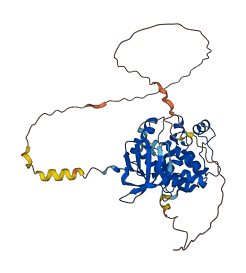
The autoinhibited protein was predicted that may have potential autoinhibitory elements via cis-regPred.
Autoinhibitory domains (AIDs)
Target domain |
|
Relief mechanism |
|
Assay |
cis-regPred |
Accessory elements
273-294 (Activation loop from InterPro)
Target domain |
133-383 (Protein kinase domain) |
Relief mechanism |
|
Assay |
|
Autoinhibited structure

Activated structure
1 structures for A5GFW1
| Entry ID | Method | Resolution | Chain | Position | Source |
|---|---|---|---|---|---|
| AF-A5GFW1-F1 | Predicted | AlphaFoldDB |
9 variants for A5GFW1
| Variant ID(s) | Position | Change | Description | Diseaes Association | Provenance |
|---|---|---|---|---|---|
| rs321932500 | 36 | L>P | No | EVA | |
| rs790708856 | 38 | S>T | No | EVA | |
| rs342865287 | 39 | A>T | No | EVA | |
| rs334418838 | 61 | T>M | No | EVA | |
| rs713130120 | 114 | A>V | No | EVA | |
| rs333023738 | 115 | A>V | No | EVA | |
| rs697222811 | 276 | G>R | No | EVA | |
| rs698254211 | 349 | P>T | No | EVA | |
| rs705717771 | 402 | P>H | No | EVA |
No associated diseases with A5GFW1
4 regional properties for A5GFW1
Functions
| Description | ||
|---|---|---|
| EC Number | 2.7.11.1 | Protein-serine/threonine kinases |
| Subcellular Localization |
|
|
| PANTHER Family | ||
| PANTHER Subfamily | ||
| PANTHER Protein Class | ||
| PANTHER Pathway Category | No pathway information available | |
10 GO annotations of cellular component
| Name | Definition |
|---|---|
| centriole | A cellular organelle, found close to the nucleus in many eukaryotic cells, consisting of a small cylinder with microtubular walls, 300-500 nm long and 150-250 nm in diameter. It contains nine short, parallel, peripheral microtubular fibrils, each fibril consisting of one complete microtubule fused to two incomplete microtubules. Cells usually have two centrioles, lying at right angles to each other. At division, each pair of centrioles generates another pair and the twin pairs form the pole of the mitotic spindle. |
| centrosome | A structure comprised of a core structure (in most organisms, a pair of centrioles) and peripheral material from which a microtubule-based structure, such as a spindle apparatus, is organized. Centrosomes occur close to the nucleus during interphase in many eukaryotic cells, though in animal cells it changes continually during the cell-division cycle. |
| chromosome passenger complex | A eukaryotically conserved protein complex that localizes to kinetochores in early mitosis, the spindle mid-zone in anaphase B and to the telophase midbody. It has been proposed that the passenger complex coordinates various events based on its location to different structures during the course of mitosis. Complex members include the BIR-domain-containing protein Survivin, Aurora kinase, INCENP and Borealin. |
| ciliary basal body | A membrane-tethered, short cylindrical array of microtubules and associated proteins found at the base of a eukaryotic cilium (also called flagellum) that is similar in structure to a centriole and derives from it. The cilium basal body is the site of assembly and remodelling of the cilium and serves as a nucleation site for axoneme growth. As well as anchoring the cilium, it is thought to provide a selective gateway regulating the entry of ciliary proteins and vesicles by intraflagellar transport. |
| cytoplasm | The contents of a cell excluding the plasma membrane and nucleus, but including other subcellular structures. |
| mitotic spindle pole | Either of the ends of a mitotic spindle, a spindle that forms as part of mitosis, where spindle microtubules are organized; usually contains a microtubule organizing center and accessory molecules, spindle microtubules and astral microtubules. |
| neuron projection | A prolongation or process extending from a nerve cell, e.g. an axon or dendrite. |
| spindle microtubule | Any microtubule that is part of a mitotic or meiotic spindle; anchored at one spindle pole. |
| spindle midzone | The area in the center of the spindle where the spindle microtubules from opposite poles overlap. |
| spindle pole centrosome | A centrosome from which one pole of a mitotic or meiotic spindle is organized. |
4 GO annotations of molecular function
| Name | Definition |
|---|---|
| ATP binding | Binding to ATP, adenosine 5'-triphosphate, a universally important coenzyme and enzyme regulator. |
| histone serine kinase activity | Catalysis of the transfer of a phosphate group to a serine residue of a histone. |
| protein kinase activity | Catalysis of the phosphorylation of an amino acid residue in a protein, usually according to the reaction: a protein + ATP = a phosphoprotein + ADP. |
| protein serine kinase activity | Catalysis of the reactions: ATP + protein serine = ADP + protein serine phosphate. |
9 GO annotations of biological process
| Name | Definition |
|---|---|
| cell division | The process resulting in division and partitioning of components of a cell to form more cells; may or may not be accompanied by the physical separation of a cell into distinct, individually membrane-bounded daughter cells. |
| cilium disassembly | A cellular process that results in the breakdown of a cilium. |
| meiotic spindle organization | A process that is carried out at the cellular level which results in the assembly, arrangement of constituent parts, or disassembly of the microtubule spindle during a meiotic cell cycle. |
| mitotic centrosome separation | Separation of duplicated centrosome components at the beginning of mitosis. The centriole pair within each centrosome becomes part of a separate microtubule organizing center that nucleates a radial array of microtubules called an aster. The two asters move to opposite sides of the nucleus to form the two poles of the mitotic spindle. |
| mitotic spindle organization | A process that is carried out at the cellular level which results in the assembly, arrangement of constituent parts, or disassembly of the microtubule spindle during a mitotic cell cycle. |
| positive regulation of meiotic cell cycle process involved in oocyte maturation | Any process that activates or increases the frequency, rate or extent of meiotic cell cycle process involved in oocyte maturation. |
| positive regulation of translation | Any process that activates or increases the frequency, rate or extent of the chemical reactions and pathways resulting in the formation of proteins by the translation of mRNA or circRNA. |
| protein phosphorylation | The process of introducing a phosphate group on to a protein. |
| regulation of cytokinesis | Any process that modulates the frequency, rate or extent of the division of the cytoplasm of a cell and its separation into two daughter cells. |
15 homologous proteins in AiPD
| UniProt AC | Gene Name | Protein Name | Species | Evidence Code |
|---|---|---|---|---|
| P38991 | IPL1 | Spindle assembly checkpoint kinase | Saccharomyces cerevisiae (strain ATCC 204508 / S288c) (Baker's yeast) | PR |
| Q7YRC6 | AURKB | Aurora kinase B | Bos taurus (Bovine) | PR |
| Q2TA06 | AURKA | Aurora kinase A | Bos taurus (Bovine) | PR |
| Q9VKN7 | aurB | Aurora kinase B | Drosophila melanogaster (Fruit fly) | PR |
| Q96GD4 | AURKB | Aurora kinase B | Homo sapiens (Human) | PR |
| Q9UQB9 | AURKC | Aurora kinase C | Homo sapiens (Human) | PR |
| O14965 | AURKA | Aurora kinase A | Homo sapiens (Human) | PR |
| O70126 | Aurkb | Aurora kinase B | Mus musculus (Mouse) | PR |
| O88445 | Aurkc | Aurora kinase C | Mus musculus (Mouse) | PR |
| P97477 | Aurka | Aurora kinase A | Mus musculus (Mouse) | PR |
| Q9N0X0 | AURKB | Aurora kinase B | Sus scrofa (Pig) | PR |
| O55099 | Aurkb | Aurora kinase B | Rattus norvegicus (Rat) | PR |
| O01427 | air-2 | Aurora/IPL1-related protein kinase 2 | Caenorhabditis elegans | PR |
| A4IGM9 | aurkb | Aurora kinase B | Xenopus tropicalis (Western clawed frog) (Silurana tropicalis) | PR |
| Q6NW76 | aurkb | Aurora kinase B | Danio rerio (Zebrafish) (Brachydanio rerio) | PR |
| 10 | 20 | 30 | 40 | 50 | 60 |
| MDKCKENCIS | GLKTTVPPGD | GPKRVPVTQH | FPAQHLPSAN | SGQAQRVLCP | SNSSQRLPSH |
| 70 | 80 | 90 | 100 | 110 | 120 |
| TQKLVSSHKP | VQNLKQKQSQ | ATSGPRPVSR | PLSNTQQSEQ | PQPAAPGNNP | EKEAASKQKN |
| 130 | 140 | 150 | 160 | 170 | 180 |
| EESKKRQWAL | EDFEIGRPLG | KGKFGNVYLA | REKQSKFILA | LKVLFKTQLE | KAGVEHQLRR |
| 190 | 200 | 210 | 220 | 230 | 240 |
| EVEIQSHLRH | PNILRLYGYF | HDATRVYLIL | EYAPLGAVYR | ELQKLSKFDE | QRTATYITEL |
| 250 | 260 | 270 | 280 | 290 | 300 |
| ANALSYCHSK | RVIHRDIKPE | NLLLGSAGEL | KIADFGWSVH | APSSRRTTLC | GTLDYLPPEM |
| 310 | 320 | 330 | 340 | 350 | 360 |
| IEGRMHDEKV | DLWSLGVLCY | EFLVGKPPFE | ANTYQETYKR | ISRVEFTFPD | FVPEGARDLI |
| 370 | 380 | 390 | 400 | ||
| SRLLKHNPSH | RPTLKEVLEH | PWITANSKPA | SSHKKESTSK | QP |