Q63341
Gene name |
Mmp12 (Mmel) |
Protein name |
Macrophage metalloelastase |
Names |
MME, Matrix metalloproteinase-12, MMP-12 |
Species |
Rattus norvegicus (Rat) |
KEGG Pathway |
rno:117033 |
EC number |
3.4.24.65: Metalloendopeptidases |
Protein Class |
|
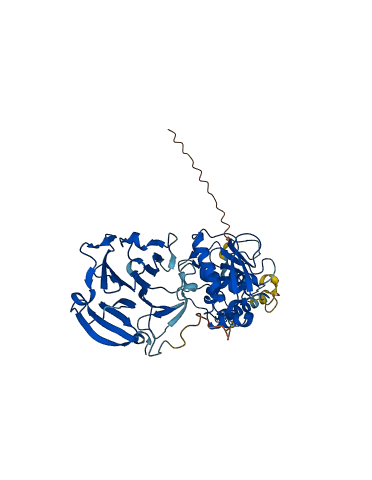
Descriptions
The autoinhibited protein was predicted that may have potential autoinhibitory elements via cis-regPred.
Autoinhibitory domains (AIDs)
Target domain |
|
Relief mechanism |
|
Assay |
cis-regPred |
Accessory elements
No accessory elements
Autoinhibited structure

Activated structure
1 structures for Q63341
| Entry ID | Method | Resolution | Chain | Position | Source |
|---|---|---|---|---|---|
| AF-Q63341-F1 | Predicted | AlphaFoldDB |
No variants for Q63341
| Variant ID(s) | Position | Change | Description | Diseaes Association | Provenance |
|---|---|---|---|---|---|
| No variants for Q63341 | |||||
No associated diseases with Q63341
10 regional properties for Q63341
| Type | Name | Position | InterPro Accession |
|---|---|---|---|
| domain | Hemopexin-like domain | 281 - 465 | IPR000585 |
| domain | Peptidase M10, metallopeptidase | 104 - 259 | IPR001818 |
| domain | Peptidoglycan binding-like | 22 - 83 | IPR002477 |
| domain | Peptidase, metallopeptidase | 101 - 260 | IPR006026 |
| conserved_site | Hemopexin, conserved site | 317 - 332 | IPR018486 |
| repeat | Hemopexin-like repeats | 281 - 326 | IPR018487-1 |
| repeat | Hemopexin-like repeats | 325 - 371 | IPR018487-2 |
| repeat | Hemopexin-like repeats | 373 - 423 | IPR018487-3 |
| repeat | Hemopexin-like repeats | 422 - 465 | IPR018487-4 |
| domain | Peptidase M10A, catalytic domain | 104 - 259 | IPR033739 |
Functions
| Description | ||
|---|---|---|
| EC Number | 3.4.24.65 | Metalloendopeptidases |
| Subcellular Localization |
|
|
| PANTHER Family | ||
| PANTHER Subfamily | ||
| PANTHER Protein Class | ||
| PANTHER Pathway Category | No pathway information available | |
4 GO annotations of cellular component
| Name | Definition |
|---|---|
| cytoplasm | The contents of a cell excluding the plasma membrane and nucleus, but including other subcellular structures. |
| extracellular matrix | A structure lying external to one or more cells, which provides structural support, biochemical or biomechanical cues for cells or tissues. |
| extracellular space | That part of a multicellular organism outside the cells proper, usually taken to be outside the plasma membranes, and occupied by fluid. |
| nucleus | A membrane-bounded organelle of eukaryotic cells in which chromosomes are housed and replicated. In most cells, the nucleus contains all of the cell's chromosomes except the organellar chromosomes, and is the site of RNA synthesis and processing. In some species, or in specialized cell types, RNA metabolism or DNA replication may be absent. |
6 GO annotations of molecular function
| Name | Definition |
|---|---|
| calcium ion binding | Binding to a calcium ion (Ca2+). |
| collagen binding | Binding to collagen, a group of fibrous proteins of very high tensile strength that form the main component of connective tissue in animals. Collagen is highly enriched in glycine (some regions are 33% glycine) and proline, occurring predominantly as 3-hydroxyproline (about 20%). |
| core promoter sequence-specific DNA binding | Binding to a sequence of DNA that is part of a core promoter region. The core promoter is composed of the transcription start site and binding sites for the RNA polymerase and the basal transcription machinery. The transcribed region might be described as a gene, cistron, or operon. |
| metalloendopeptidase activity | Catalysis of the hydrolysis of internal, alpha-peptide bonds in a polypeptide chain by a mechanism in which water acts as a nucleophile, one or two metal ions hold the water molecule in place, and charged amino acid side chains are ligands for the metal ions. |
| sequence-specific DNA binding | Binding to DNA of a specific nucleotide composition, e.g. GC-rich DNA binding, or with a specific sequence motif or type of DNA e.g. promotor binding or rDNA binding. |
| zinc ion binding | Binding to a zinc ion (Zn). |
23 GO annotations of biological process
| Name | Definition |
|---|---|
| bronchiole development | The biological process whose specific outcome is the progression of a bronchiole from an initial condition to its mature state. This process begins with the formation of the bronchiole and ends with the mature structure. A bronchiole is the first airway branch that no longer contains cartilage; it is a branch of the bronchi. |
| cellular response to virus | Any process that results in a change in state or activity of a cell (in terms of movement, secretion, enzyme production, gene expression, etc.) as a result of a stimulus from a virus. |
| collagen catabolic process | The proteolytic chemical reactions and pathways resulting in the breakdown of collagen in the extracellular matrix, usually carried out by proteases secreted by nearby cells. |
| elastin catabolic process | The chemical reactions and pathways resulting in the breakdown of elastin. Elastin is a glycoprotein which is randomly coiled and crosslinked to form elastic fibers that are found in connective tissue. |
| extracellular matrix organization | A process that is carried out at the cellular level which results in the assembly, arrangement of constituent parts, or disassembly of an extracellular matrix. |
| lung alveolus development | The process whose specific outcome is the progression of the alveolus over time, from its formation to the mature structure. The alveolus is a sac for holding air in the lungs; formed by the terminal dilation of air passageways. |
| negative regulation of endothelial cell-matrix adhesion via fibronectin | Any process that stops, prevents or reduces the frequency, rate or extent of endothelial cell-matrix adhesion via fibronectin. |
| negative regulation of transcription by RNA polymerase II | Any process that stops, prevents, or reduces the frequency, rate or extent of transcription mediated by RNA polymerase II. |
| negative regulation of type I interferon-mediated signaling pathway | Any process that decreases the rate, frequency or extent of a type I interferon-mediated signaling pathway. |
| positive regulation of epithelial cell proliferation | Any process that activates or increases the rate or extent of epithelial cell proliferation. |
| positive regulation of epithelial cell proliferation involved in wound healing | Any process that activates or increases the rate or extent of epithelial cell proliferation, contributing to the restoration of integrity to a damaged tissue following an injury. |
| positive regulation of gene expression | Any process that increases the frequency, rate or extent of gene expression. Gene expression is the process in which a gene's coding sequence is converted into a mature gene product (protein or RNA). |
| positive regulation of interferon-alpha production | Any process that activates or increases the frequency, rate, or extent of interferon-alpha production. |
| positive regulation of transcription by RNA polymerase II | Any process that activates or increases the frequency, rate or extent of transcription from an RNA polymerase II promoter. |
| positive regulation of type I interferon-mediated signaling pathway | Any process that increases the rate, frequency or extent of a type I interferon-mediated signaling pathway. |
| protein import into nucleus | The directed movement of a protein from the cytoplasm to the nucleus. |
| proteolysis | The hydrolysis of proteins into smaller polypeptides and/or amino acids by cleavage of their peptide bonds. |
| regulation of defense response to virus by host | Any host process that modulates the frequency, rate, or extent of the antiviral response of a host cell or organism. |
| regulation of trophoblast cell migration | Any process that modulates the frequency, rate or extent of trophoblast cell migration. |
| response to hypoxia | Any process that results in a change in state or activity of a cell or an organism (in terms of movement, secretion, enzyme production, gene expression, etc.) as a result of a stimulus indicating lowered oxygen tension. Hypoxia, defined as a decline in O2 levels below normoxic levels of 20.8 - 20.95%, results in metabolic adaptation at both the cellular and organismal level. |
| response to organic cyclic compound | Any process that results in a change in state or activity of a cell or an organism (in terms of movement, secretion, enzyme production, gene expression, etc.) as a result of an organic cyclic compound stimulus. |
| response to xenobiotic stimulus | Any process that results in a change in state or activity of a cell or an organism (in terms of movement, secretion, enzyme production, gene expression, etc.) as a result of a stimulus from a xenobiotic, a compound foreign to the organim exposed to it. It may be synthesized by another organism (like ampicilin) or it can be a synthetic chemical. |
| wound healing, spreading of epidermal cells | The migration of an epidermal cell along or through a wound gap that contributes to the reestablishment of a continuous epidermis. |
18 homologous proteins in AiPD
| UniProt AC | Gene Name | Protein Name | Species | Evidence Code |
|---|---|---|---|---|
| Q3SZV7 | HPX | Hemopexin | Bos taurus (Bovine) | PR |
| O77656 | MMP13 | Collagenase 3 | Bos taurus (Bovine) | PR |
| Q9GLE5 | MMP2 | 72 kDa type IV collagenase | Bos taurus (Bovine) | PR |
| Q90611 | MMP2 | 72 kDa type IV collagenase | Gallus gallus (Chicken) | PR |
| Q8MPP3 | Mmp2 | Matrix metalloproteinase-2 | Drosophila melanogaster (Fruit fly) | PR |
| P04004 | VTN | Vitronectin | Homo sapiens (Human) | PR |
| P45452 | MMP13 | Collagenase 3 | Homo sapiens (Human) | PR |
| Q99542 | MMP19 | Matrix metalloproteinase-19 | Homo sapiens (Human) | PR |
| Q9NPA2 | MMP25 | Matrix metalloproteinase-25 | Homo sapiens (Human) | PR |
| Q9H239 | MMP28 | Matrix metalloproteinase-28 | Homo sapiens (Human) | PR |
| P33435 | Mmp13 | Collagenase 3 | Mus musculus (Mouse) | PR |
| P33434 | Mmp2 | 72 kDa type IV collagenase | Mus musculus (Mouse) | PR |
| P28862 | Mmp3 | Stromelysin-1 | Mus musculus (Mouse) | PR |
| P34960 | Mmp12 | Macrophage metalloelastase | Mus musculus (Mouse) | PR |
| P33436 | Mmp2 | 72 kDa type IV collagenase | Rattus norvegicus (Rat) | PR |
| P23097 | Mmp13 | Collagenase 3 | Rattus norvegicus (Rat) | PR |
| P03957 | Mmp3 | Stromelysin-1 | Rattus norvegicus (Rat) | PR |
| Q6PHG2 | hpx | Hemopexin | Danio rerio (Zebrafish) (Brachydanio rerio) | PR |
| 10 | 20 | 30 | 40 | 50 | 60 |
| MKFLLVLVLL | VSLQVSACGA | APMNESEFAE | WYLSRFFDYQ | GDRIPMTKTK | TNRNLLEEKL |
| 70 | 80 | 90 | 100 | 110 | 120 |
| QEMQQFFGLE | VTGQLDTSTL | KIMHTSRCGV | PDVQHLRAVP | QRSRWMKRYL | TYRIYNYTPD |
| 130 | 140 | 150 | 160 | 170 | 180 |
| MKRADVDYIF | QKAFQVWSDV | TPLRFRKIHK | GEADITILFA | FGDHGDFYDF | DGKGGTLAHA |
| 190 | 200 | 210 | 220 | 230 | 240 |
| FYPGPGIQGD | AHFDEAETWT | KSFQGTNLFL | VAVHELGHSL | GLRHSNNPKS | IMYPTYRYLH |
| 250 | 260 | 270 | 280 | 290 | 300 |
| PNTFRLSADD | IHSIQSLYGA | PVKNPSLTNP | GSPPSTVCHQ | SLSFDAVTTV | GDKIFFFKDW |
| 310 | 320 | 330 | 340 | 350 | 360 |
| FFWWRLPGSP | ATNITSISSM | WPTIPSGIQA | AYEIGGRNQL | FLFKDEKYWL | INNLVPEPHY |
| 370 | 380 | 390 | 400 | 410 | 420 |
| PRSIHSLGFP | ASVKKIDAAV | FDPLRQKVYF | FVDKQYWRYD | VRQELMDAAY | PKLISTHFPG |
| 430 | 440 | 450 | 460 | ||
| IRPKIDAVLY | FKRHYYIFQG | AYQLEYDPLL | DRVTKTLSST | SWFGC |