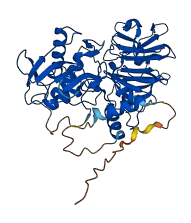
Descriptions
The autoinhibited protein was predicted that may have potential autoinhibitory elements via cis-regPred.
Autoinhibitory domains (AIDs)
Target domain |
|
Relief mechanism |
|
Assay |
cis-regPred |
Accessory elements
No accessory elements
Autoinhibited structure

Activated structure
1 structures for P23097
| Entry ID | Method | Resolution | Chain | Position | Source |
|---|---|---|---|---|---|
| AF-P23097-F1 | Predicted | AlphaFoldDB |
No variants for P23097
| Variant ID(s) | Position | Change | Description | Diseaes Association | Provenance |
|---|---|---|---|---|---|
| No variants for P23097 | |||||
No associated diseases with P23097
11 regional properties for P23097
| Type | Name | Position | InterPro Accession |
|---|---|---|---|
| domain | Hemopexin-like domain | 276 - 466 | IPR000585 |
| domain | Peptidase M10, metallopeptidase | 107 - 262 | IPR001818 |
| domain | Peptidoglycan binding-like | 28 - 86 | IPR002477 |
| domain | Peptidase, metallopeptidase | 104 - 263 | IPR006026 |
| conserved_site | Hemopexin, conserved site | 318 - 333 | IPR018486 |
| repeat | Hemopexin-like repeats | 276 - 327 | IPR018487-1 |
| repeat | Hemopexin-like repeats | 326 - 372 | IPR018487-2 |
| repeat | Hemopexin-like repeats | 374 - 424 | IPR018487-3 |
| repeat | Hemopexin-like repeats | 423 - 466 | IPR018487-4 |
| binding_site | Peptidase M10A, cysteine switch, zinc binding site | 89 - 96 | IPR021158 |
| domain | Peptidase M10A, catalytic domain | 107 - 262 | IPR033739 |
6 GO annotations of cellular component
| Name | Definition |
|---|---|
| extracellular matrix | A structure lying external to one or more cells, which provides structural support, biochemical or biomechanical cues for cells or tissues. |
| extracellular region | The space external to the outermost structure of a cell. For cells without external protective or external encapsulating structures this refers to space outside of the plasma membrane. This term covers the host cell environment outside an intracellular parasite. |
| extracellular space | That part of a multicellular organism outside the cells proper, usually taken to be outside the plasma membranes, and occupied by fluid. |
| Golgi apparatus | A membrane-bound cytoplasmic organelle of the endomembrane system that further processes the core oligosaccharides (e.g. N-glycans) added to proteins in the endoplasmic reticulum and packages them into membrane-bound vesicles. The Golgi apparatus operates at the intersection of the secretory, lysosomal, and endocytic pathways. |
| intercellular canaliculus | An extremely narrow tubular channel located between adjacent cells. An instance of this is the secretory canaliculi occurring between adjacent parietal cells in the gastric mucosa of vertebrates. |
| lysosome | A small lytic vacuole that has cell cycle-independent morphology found in most animal cells and that contains a variety of hydrolases, most of which have their maximal activities in the pH range 5-6. The contained enzymes display latency if properly isolated. About 40 different lysosomal hydrolases are known and lysosomes have a great variety of morphologies and functions. |
10 GO annotations of molecular function
| Name | Definition |
|---|---|
| calcium ion binding | Binding to a calcium ion (Ca2+). |
| calcium-dependent protein binding | Binding to a protein or protein complex in the presence of calcium. |
| collagen binding | Binding to collagen, a group of fibrous proteins of very high tensile strength that form the main component of connective tissue in animals. Collagen is highly enriched in glycine (some regions are 33% glycine) and proline, occurring predominantly as 3-hydroxyproline (about 20%). |
| endopeptidase activity | Catalysis of the hydrolysis of internal, alpha-peptide bonds in a polypeptide chain. |
| fibronectin binding | Binding to a fibronectin, a group of related adhesive glycoproteins of high molecular weight found on the surface of animal cells, connective tissue matrices, and in extracellular fluids. |
| low-density lipoprotein particle receptor binding | Binding to a low-density lipoprotein receptor. |
| metalloendopeptidase activity | Catalysis of the hydrolysis of internal, alpha-peptide bonds in a polypeptide chain by a mechanism in which water acts as a nucleophile, one or two metal ions hold the water molecule in place, and charged amino acid side chains are ligands for the metal ions. |
| peptidase activity | Catalysis of the hydrolysis of a peptide bond. A peptide bond is a covalent bond formed when the carbon atom from the carboxyl group of one amino acid shares electrons with the nitrogen atom from the amino group of a second amino acid. |
| serine-type endopeptidase activity | Catalysis of the hydrolysis of internal, alpha-peptide bonds in a polypeptide chain by a catalytic mechanism that involves a catalytic triad consisting of a serine nucleophile that is activated by a proton relay involving an acidic residue (e.g. aspartate or glutamate) and a basic residue (usually histidine). |
| zinc ion binding | Binding to a zinc ion (Zn). |
25 GO annotations of biological process
| Name | Definition |
|---|---|
| bone mineralization | The deposition of hydroxyapatite, a form of calcium phosphate with the formula Ca10(PO4)6(OH)2, in bone tissue. |
| bone morphogenesis | The process in which bones are generated and organized. |
| cartilage development | The process whose specific outcome is the progression of a cartilage element over time, from its formation to the mature structure. Cartilage elements are skeletal elements that consist of connective tissue dominated by extracellular matrix containing collagen type II and large amounts of proteoglycan, particularly chondroitin sulfate. |
| cellular response to fluid shear stress | Any process that results in a change in state or activity of a cell (in terms of movement, secretion, enzyme production, gene expression, etc.) as a result of a fluid shear stress stimulus. Fluid shear stress is the force acting on an object in a system where the fluid is moving across a solid surface. |
| collagen catabolic process | The proteolytic chemical reactions and pathways resulting in the breakdown of collagen in the extracellular matrix, usually carried out by proteases secreted by nearby cells. |
| embryonic hindlimb morphogenesis | The process, occurring in the embryo, by which the anatomical structures of the hindlimbs are generated and organized. The hindlimbs are the posterior limbs of an animal. |
| endochondral ossification | Replacement ossification wherein bone tissue replaces cartilage. |
| estrous cycle | A type of ovulation cycle, which occurs in most mammalian therian females, where the endometrium is resorbed if pregnancy does not occur. |
| extracellular matrix disassembly | A process that results in the breakdown of the extracellular matrix. |
| extracellular matrix organization | A process that is carried out at the cellular level which results in the assembly, arrangement of constituent parts, or disassembly of an extracellular matrix. |
| growth plate cartilage development | The process whose specific outcome is the progression of the cartilage that will provide a scaffold for mineralization of endochondral bones as they elongate or grow. |
| heart development | The process whose specific outcome is the progression of the heart over time, from its formation to the mature structure. The heart is a hollow, muscular organ, which, by contracting rhythmically, keeps up the circulation of the blood. |
| luteolysis | The lysis or structural demise of the corpus luteum. During normal luteolysis, two closely related events occur. First, there is loss of the capacity to synthesize and secrete progesterone (functional luteolysis) followed by loss of the cells that comprise the corpus luteum (structural luteolysis). Preventing luteolysis is crucial to maintain pregnancy. |
| ossification | The formation of bone or of a bony substance, or the conversion of fibrous tissue or of cartilage into bone or a bony substance. |
| osteoblast differentiation | The process whereby a relatively unspecialized cell acquires the specialized features of an osteoblast, a mesodermal or neural crest cell that gives rise to bone. |
| parturition | The reproductive process in which the parent is separated from its offspring either by giving birth to live young or by laying eggs. |
| positive regulation of pancreatic trypsinogen secretion | Any process that activates or increases the frequency, rate or extent of pancreatic trypsinogen secretion. |
| protein catabolic process | The chemical reactions and pathways resulting in the breakdown of a protein by the destruction of the native, active configuration, with or without the hydrolysis of peptide bonds. |
| protein metabolic process | The chemical reactions and pathways involving a protein. Includes protein modification. |
| proteolysis | The hydrolysis of proteins into smaller polypeptides and/or amino acids by cleavage of their peptide bonds. |
| response to estrogen | Any process that results in a change in state or activity of a cell or an organism (in terms of movement, secretion, enzyme production, gene expression, etc.) as a result of stimulus by an estrogen, C18 steroid hormones that can stimulate the development of female sexual characteristics. |
| response to hormone | Any process that results in a change in state or activity of a cell or an organism (in terms of movement, secretion, enzyme production, gene expression, etc.) as a result of a hormone stimulus. |
| response to hypoxia | Any process that results in a change in state or activity of a cell or an organism (in terms of movement, secretion, enzyme production, gene expression, etc.) as a result of a stimulus indicating lowered oxygen tension. Hypoxia, defined as a decline in O2 levels below normoxic levels of 20.8 - 20.95%, results in metabolic adaptation at both the cellular and organismal level. |
| response to mechanical stimulus | Any process that results in a change in state or activity of a cell or an organism (in terms of movement, secretion, enzyme production, gene expression, etc.) as a result of a mechanical stimulus. |
| response to xenobiotic stimulus | Any process that results in a change in state or activity of a cell or an organism (in terms of movement, secretion, enzyme production, gene expression, etc.) as a result of a stimulus from a xenobiotic, a compound foreign to the organim exposed to it. It may be synthesized by another organism (like ampicilin) or it can be a synthetic chemical. |
18 homologous proteins in AiPD
| UniProt AC | Gene Name | Protein Name | Species | Evidence Code |
|---|---|---|---|---|
| Q3SZV7 | HPX | Hemopexin | Bos taurus (Bovine) | PR |
| Q9GLE5 | MMP2 | 72 kDa type IV collagenase | Bos taurus (Bovine) | PR |
| O77656 | MMP13 | Collagenase 3 | Bos taurus (Bovine) | PR |
| Q90611 | MMP2 | 72 kDa type IV collagenase | Gallus gallus (Chicken) | PR |
| Q8MPP3 | Mmp2 | Matrix metalloproteinase-2 | Drosophila melanogaster (Fruit fly) | PR |
| P04004 | VTN | Vitronectin | Homo sapiens (Human) | PR |
| Q99542 | MMP19 | Matrix metalloproteinase-19 | Homo sapiens (Human) | PR |
| Q9NPA2 | MMP25 | Matrix metalloproteinase-25 | Homo sapiens (Human) | PR |
| Q9H239 | MMP28 | Matrix metalloproteinase-28 | Homo sapiens (Human) | PR |
| P45452 | MMP13 | Collagenase 3 | Homo sapiens (Human) | PR |
| P34960 | Mmp12 | Macrophage metalloelastase | Mus musculus (Mouse) | PR |
| P33434 | Mmp2 | 72 kDa type IV collagenase | Mus musculus (Mouse) | PR |
| P28862 | Mmp3 | Stromelysin-1 | Mus musculus (Mouse) | PR |
| P33435 | Mmp13 | Collagenase 3 | Mus musculus (Mouse) | PR |
| P33436 | Mmp2 | 72 kDa type IV collagenase | Rattus norvegicus (Rat) | PR |
| Q63341 | Mmp12 | Macrophage metalloelastase | Rattus norvegicus (Rat) | PR |
| P03957 | Mmp3 | Stromelysin-1 | Rattus norvegicus (Rat) | PR |
| Q6PHG2 | hpx | Hemopexin | Danio rerio (Zebrafish) (Brachydanio rerio) | PR |
| 10 | 20 | 30 | 40 | 50 | 60 |
| ATFFLLSWTH | CWSLPLPYGD | DDDDDLSEED | LEFAEHYLKS | YYHPVTLAGI | LKKSTVTSTV |
| 70 | 80 | 90 | 100 | 110 | 120 |
| DRLREMQSFF | GLDVTGKLDD | PTLDIMRKPR | CGVPDVGVYN | VFPRTLKWSQ | TNLTYRIVNY |
| 130 | 140 | 150 | 160 | 170 | 180 |
| TPDISHSEVE | KAFRKAFKVW | SDVTPLNFTR | IHDGTADIMI | SFGTKEHGDF | YPFDGPSGLL |
| 190 | 200 | 210 | 220 | 230 | 240 |
| AHAFPPGPNL | GGDAHFDDDE | TWTSSSKGYN | LFIVAAHELG | HSLGLDHSKD | PGALMFPIYT |
| 250 | 260 | 270 | 280 | 290 | 300 |
| YTGKSHFMLP | DDDVQGIQSL | YGPGDEDPNP | KHPKTPEKCD | PALSLDAITS | LRGETMIFKD |
| 310 | 320 | 330 | 340 | 350 | 360 |
| RFFWRLHPQQ | VEPELFLTKS | FWPELPNHVD | AAYEHPSRDL | MFIFRGRKFW | ALNGYDIMEG |
| 370 | 380 | 390 | 400 | 410 | 420 |
| YPRKISDLGF | PKEVKRLSAA | VHFEDTGKTL | FFSGNHVWSY | DDANQTMDKD | YPRLIEEEFP |
| 430 | 440 | 450 | 460 | ||
| GIGDKVDAVY | EKNGYIYFFN | GPIQFEYSIW | SNRIVRVMPT | NSLLWC |