P03957
Gene name |
Mmp3 |
Protein name |
Stromelysin-1 |
Names |
SL-1, Matrix metalloproteinase-3, MMP-3, PTR1 protein, Transin-1 |
Species |
Rattus norvegicus (Rat) |
KEGG Pathway |
|
EC number |
3.4.24.17: Metalloendopeptidases |
Protein Class |
|
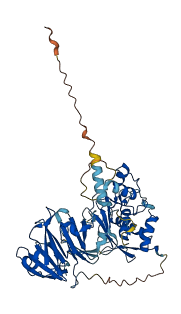
Descriptions
The autoinhibited protein was predicted that may have potential autoinhibitory elements via cis-regPred.
Autoinhibitory domains (AIDs)
Target domain |
|
Relief mechanism |
|
Assay |
cis-regPred |
Accessory elements
No accessory elements
Autoinhibited structure

Activated structure
1 structures for P03957
| Entry ID | Method | Resolution | Chain | Position | Source |
|---|---|---|---|---|---|
| AF-P03957-F1 | Predicted | AlphaFoldDB |
No variants for P03957
| Variant ID(s) | Position | Change | Description | Diseaes Association | Provenance |
|---|---|---|---|---|---|
| No variants for P03957 | |||||
No associated diseases with P03957
11 regional properties for P03957
| Type | Name | Position | InterPro Accession |
|---|---|---|---|
| domain | Hemopexin-like domain | 288 - 475 | IPR000585 |
| domain | Peptidase M10, metallopeptidase | 106 - 262 | IPR001818 |
| domain | Peptidoglycan binding-like | 27 - 85 | IPR002477 |
| domain | Peptidase, metallopeptidase | 103 - 263 | IPR006026 |
| conserved_site | Hemopexin, conserved site | 327 - 342 | IPR018486 |
| repeat | Hemopexin-like repeats | 285 - 336 | IPR018487-1 |
| repeat | Hemopexin-like repeats | 335 - 381 | IPR018487-2 |
| repeat | Hemopexin-like repeats | 383 - 433 | IPR018487-3 |
| repeat | Hemopexin-like repeats | 432 - 475 | IPR018487-4 |
| binding_site | Peptidase M10A, cysteine switch, zinc binding site | 88 - 95 | IPR021158 |
| domain | Peptidase M10A, catalytic domain | 106 - 262 | IPR033739 |
Functions
| Description | ||
|---|---|---|
| EC Number | 3.4.24.17 | Metalloendopeptidases |
| Subcellular Localization |
|
|
| PANTHER Family | ||
| PANTHER Subfamily | ||
| PANTHER Protein Class | ||
| PANTHER Pathway Category | No pathway information available | |
8 GO annotations of cellular component
| Name | Definition |
|---|---|
| cell body | The portion of a cell bearing surface projections such as axons, dendrites, cilia, or flagella that includes the nucleus, but excludes all cell projections. |
| cytosol | The part of the cytoplasm that does not contain organelles but which does contain other particulate matter, such as protein complexes. |
| dendrite | A neuron projection that has a short, tapering, morphology. Dendrites receive and integrate signals from other neurons or from sensory stimuli, and conduct nerve impulses towards the axon or the cell body. In most neurons, the impulse is conveyed from dendrites to axon via the cell body, but in some types of unipolar neuron, the impulse does not travel via the cell body. |
| extracellular matrix | A structure lying external to one or more cells, which provides structural support, biochemical or biomechanical cues for cells or tissues. |
| extracellular space | That part of a multicellular organism outside the cells proper, usually taken to be outside the plasma membranes, and occupied by fluid. |
| mitochondrion | A semiautonomous, self replicating organelle that occurs in varying numbers, shapes, and sizes in the cytoplasm of virtually all eukaryotic cells. It is notably the site of tissue respiration. |
| nucleus | A membrane-bounded organelle of eukaryotic cells in which chromosomes are housed and replicated. In most cells, the nucleus contains all of the cell's chromosomes except the organellar chromosomes, and is the site of RNA synthesis and processing. In some species, or in specialized cell types, RNA metabolism or DNA replication may be absent. |
| protein-containing complex | A stable assembly of two or more macromolecules, i.e. proteins, nucleic acids, carbohydrates or lipids, in which at least one component is a protein and the constituent parts function together. |
6 GO annotations of molecular function
| Name | Definition |
|---|---|
| endopeptidase activity | Catalysis of the hydrolysis of internal, alpha-peptide bonds in a polypeptide chain. |
| metalloendopeptidase activity | Catalysis of the hydrolysis of internal, alpha-peptide bonds in a polypeptide chain by a mechanism in which water acts as a nucleophile, one or two metal ions hold the water molecule in place, and charged amino acid side chains are ligands for the metal ions. |
| metallopeptidase activity | Catalysis of the hydrolysis of peptide bonds by a mechanism in which water acts as a nucleophile, one or two metal ions hold the water molecule in place, and charged amino acid side chains are ligands for the metal ions. |
| peptidase activity | Catalysis of the hydrolysis of a peptide bond. A peptide bond is a covalent bond formed when the carbon atom from the carboxyl group of one amino acid shares electrons with the nitrogen atom from the amino group of a second amino acid. |
| protein-containing complex binding | Binding to a macromolecular complex. |
| zinc ion binding | Binding to a zinc ion (Zn). |
24 GO annotations of biological process
| Name | Definition |
|---|---|
| cellular response to amino acid stimulus | Any process that results in a change in state or activity of a cell (in terms of movement, secretion, enzyme production, gene expression, etc.) as a result of an amino acid stimulus. An amino acid is a carboxylic acids containing one or more amino groups. |
| cellular response to cell-matrix adhesion | Any process that results in a change in state or activity of a cell (in terms of movement, secretion, enzyme production, gene expression, etc.) as a result of cell-matrix adhesion. |
| cellular response to interleukin-1 | Any process that results in a change in state or activity of a cell (in terms of movement, secretion, enzyme production, gene expression, etc.) as a result of an interleukin-1 stimulus. |
| cellular response to UV-A | Any process that results in a change in state or activity of a cell (in terms of movement, secretion, enzyme production, gene expression, etc.) as a result of a UV-A radiation stimulus. UV-A radiation (UV-A light) spans the wavelengths 315 to 400 nm. |
| collagen catabolic process | The proteolytic chemical reactions and pathways resulting in the breakdown of collagen in the extracellular matrix, usually carried out by proteases secreted by nearby cells. |
| extracellular matrix organization | A process that is carried out at the cellular level which results in the assembly, arrangement of constituent parts, or disassembly of an extracellular matrix. |
| female pregnancy | The set of physiological processes that allow an embryo or foetus to develop within the body of a female animal. It covers the time from fertilization of a female ovum by a male spermatozoon until birth. |
| negative regulation of hydrogen peroxide metabolic process | Any process that decreases the frequency, rate or extent of the chemical reactions and pathways involving hydrogen peroxide. |
| negative regulation of protein kinase B signaling | Any process that stops, prevents, or reduces the frequency, rate or extent of protein kinase B signaling, a series of reactions mediated by the intracellular serine/threonine kinase protein kinase B. |
| positive regulation of cell migration | Any process that activates or increases the frequency, rate or extent of cell migration. |
| positive regulation of oxidative stress-induced cell death | Any process that activates or increases the frequency, rate or extent of oxidative stress-induced cell death. |
| positive regulation of protein-containing complex assembly | Any process that activates or increases the frequency, rate or extent of protein complex assembly. |
| protein catabolic process | The chemical reactions and pathways resulting in the breakdown of a protein by the destruction of the native, active configuration, with or without the hydrolysis of peptide bonds. |
| proteolysis | The hydrolysis of proteins into smaller polypeptides and/or amino acids by cleavage of their peptide bonds. |
| regulation of cell migration | Any process that modulates the frequency, rate or extent of cell migration. |
| response to amino acid | Any process that results in a change in state or activity of a cell or an organism (in terms of movement, secretion, enzyme production, gene expression, etc.) as a result of an amino acid stimulus. An amino acid is a carboxylic acids containing one or more amino groups. |
| response to cytokine | Any process that results in a change in state or activity of a cell or an organism (in terms of movement, secretion, enzyme production, gene expression, etc.) as a result of a cytokine stimulus. |
| response to estradiol | Any process that results in a change in state or activity of a cell or an organism (in terms of movement, secretion, enzyme production, gene expression, etc.) as a result of stimulus by estradiol, a C18 steroid hormone hydroxylated at C3 and C17 that acts as a potent estrogen. |
| response to hypoxia | Any process that results in a change in state or activity of a cell or an organism (in terms of movement, secretion, enzyme production, gene expression, etc.) as a result of a stimulus indicating lowered oxygen tension. Hypoxia, defined as a decline in O2 levels below normoxic levels of 20.8 - 20.95%, results in metabolic adaptation at both the cellular and organismal level. |
| response to interleukin-1 | Any process that results in a change in state or activity of a cell or an organism (in terms of movement, secretion, enzyme production, gene expression, etc.) as a result of an interleukin-1 stimulus. |
| response to lipopolysaccharide | Any process that results in a change in state or activity of an organism (in terms of movement, secretion, enzyme production, gene expression, etc.) as a result of a lipopolysaccharide stimulus; lipopolysaccharide is a major component of the cell wall of gram-negative bacteria. |
| response to mechanical stimulus | Any process that results in a change in state or activity of a cell or an organism (in terms of movement, secretion, enzyme production, gene expression, etc.) as a result of a mechanical stimulus. |
| response to tumor necrosis factor | Any process that results in a change in state or activity of a cell or an organism (in terms of movement, secretion, enzyme production, gene expression, etc.) as a result of a tumor necrosis factor stimulus. |
| wound healing | The series of events that restore integrity to a damaged tissue, following an injury. |
4 homologous proteins in AiPD
| 10 | 20 | 30 | 40 | 50 | 60 |
| MKGLPVLLWL | CTAVCSSYPL | HGSEEDAGME | VLQKYLENYY | GLEKDVKQFT | KKKDSSPVVK |
| 70 | 80 | 90 | 100 | 110 | 120 |
| KIQEMQKFLG | LKMTGKLDSN | TMELMHKPRC | GVPDVGGFST | FPGSPKWRKN | HISYRIVNYT |
| 130 | 140 | 150 | 160 | 170 | 180 |
| LDLPRESVDS | AIERALKVWE | EVTPLTFSRI | SEGEADIMIS | FAVEEHGDFI | PFDGPGMVLA |
| 190 | 200 | 210 | 220 | 230 | 240 |
| HAYAPGPGTN | GDAHFDDDER | WTDDVTGTNL | FLVAAHELGH | SLGLFHSANA | EALMYPVYKS |
| 250 | 260 | 270 | 280 | 290 | 300 |
| STDLARFHLS | QDDVDGIQSL | YGPPTESPDV | LVVPTKSNSL | DPETLPMCSS | ALSFDAVSTL |
| 310 | 320 | 330 | 340 | 350 | 360 |
| RGEVLFFKDR | HFWRKSLRTP | EPGFYLISSF | WPSLPSNMDA | AYEVTNRDTV | FILKGNQIWA |
| 370 | 380 | 390 | 400 | 410 | 420 |
| IRGHEELAGY | PKSIHTLGLP | ETVQKIDAAI | SLKDQKKTYF | FVEDKFWRFD | EKKQSMDPEF |
| 430 | 440 | 450 | 460 | 470 | |
| PRKIAENFPG | IGTKVDAVFE | AFGFLYFFSG | SSQLEFDPNA | GKVTHILKSN | SWFNC |