Q90611
Gene name |
MMP2 |
Protein name |
72 kDa type IV collagenase |
Names |
72 kDa gelatinase, Gelatinase A, Matrix metalloproteinase-2, MMP-2 |
Species |
Gallus gallus (Chicken) |
KEGG Pathway |
gga:386583 |
EC number |
3.4.24.24: Metalloendopeptidases |
Protein Class |
|
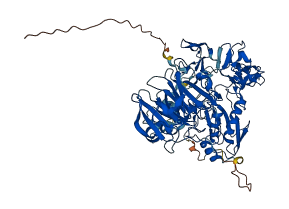
Descriptions
The autoinhibited protein was predicted that may have potential autoinhibitory elements via cis-regPred.
Autoinhibitory domains (AIDs)
Target domain |
|
Relief mechanism |
|
Assay |
cis-regPred |
Accessory elements
No accessory elements
Autoinhibited structure

Activated structure
1 structures for Q90611
| Entry ID | Method | Resolution | Chain | Position | Source |
|---|---|---|---|---|---|
| AF-Q90611-F1 | Predicted | AlphaFoldDB |
2 variants for Q90611
| Variant ID(s) | Position | Change | Description | Diseaes Association | Provenance |
|---|---|---|---|---|---|
| rs317873483 | 465 | G>V | No | Ensembl | |
| rs315106000 | 593 | K>R | No | Ensembl |
No associated diseases with Q90611
14 regional properties for Q90611
| Type | Name | Position | InterPro Accession |
|---|---|---|---|
| domain | Fibronectin type II domain | 223 - 273 | IPR000562-1 |
| domain | Fibronectin type II domain | 281 - 331 | IPR000562-2 |
| domain | Fibronectin type II domain | 339 - 389 | IPR000562-3 |
| domain | Hemopexin-like domain | 469 - 663 | IPR000585 |
| domain | Peptidase M10, metallopeptidase | 115 - 442 | IPR001818 |
| domain | Peptidoglycan binding-like | 45 - 94 | IPR002477 |
| domain | Peptidase, metallopeptidase | 112 - 444 | IPR006026 |
| conserved_site | Hemopexin, conserved site | 609 - 624 | IPR018486 |
| repeat | Hemopexin-like repeats | 475 - 521 | IPR018487-1 |
| repeat | Hemopexin-like repeats | 520 - 566 | IPR018487-2 |
| repeat | Hemopexin-like repeats | 568 - 618 | IPR018487-3 |
| repeat | Hemopexin-like repeats | 617 - 663 | IPR018487-4 |
| binding_site | Peptidase M10A, cysteine switch, zinc binding site | 97 - 104 | IPR021158 |
| domain | Peptidase M10A, catalytic domain | 115 - 442 | IPR033739 |
Functions
| Description | ||
|---|---|---|
| EC Number | 3.4.24.24 | Metalloendopeptidases |
| Subcellular Localization |
|
|
| PANTHER Family | ||
| PANTHER Subfamily | ||
| PANTHER Protein Class | ||
| PANTHER Pathway Category | No pathway information available | |
5 GO annotations of cellular component
| Name | Definition |
|---|---|
| basement membrane | A collagen-containing extracellular matrix consisting of a thin layer of dense material found in various animal tissues interposed between the cells and the adjacent connective tissue. It consists of the basal lamina plus an associated layer of reticulin fibers. |
| collagen-containing extracellular matrix | An extracellular matrix consisting mainly of proteins (especially collagen) and glycosaminoglycans (mostly as proteoglycans) that provides not only essential physical scaffolding for the cellular constituents but can also initiate crucial biochemical and biomechanical cues required for tissue morphogenesis, differentiation and homeostasis. The components are secreted by cells in the vicinity and form a sheet underlying or overlying cells such as endothelial and epithelial cells. |
| extracellular space | That part of a multicellular organism outside the cells proper, usually taken to be outside the plasma membranes, and occupied by fluid. |
| plasma membrane | The membrane surrounding a cell that separates the cell from its external environment. It consists of a phospholipid bilayer and associated proteins. |
| sarcomere | The repeating unit of a myofibril in a muscle cell, composed of an array of overlapping thick and thin filaments between two adjacent Z discs. |
2 GO annotations of molecular function
| Name | Definition |
|---|---|
| metalloendopeptidase activity | Catalysis of the hydrolysis of internal, alpha-peptide bonds in a polypeptide chain by a mechanism in which water acts as a nucleophile, one or two metal ions hold the water molecule in place, and charged amino acid side chains are ligands for the metal ions. |
| zinc ion binding | Binding to a zinc ion (Zn). |
21 GO annotations of biological process
| Name | Definition |
|---|---|
| blood vessel maturation | A developmental process, independent of morphogenetic (shape) change, that is required for a blood vessel to attain its fully functional state. |
| bone trabecula formation | The process of creating a trabecula in the bone. A trabecula is a tissue element in the form of a small beam, strut or rod. |
| cellular response to amino acid stimulus | Any process that results in a change in state or activity of a cell (in terms of movement, secretion, enzyme production, gene expression, etc.) as a result of an amino acid stimulus. An amino acid is a carboxylic acids containing one or more amino groups. |
| cellular response to insulin-like growth factor stimulus | Any process that results in a change in state or activity of a cell (in terms of movement, secretion, enzyme production, gene expression, etc.) as a result of an insulin-like growth factor stimulus. |
| cellular response to reactive oxygen species | Any process that results in a change in state or activity of a cell (in terms of movement, secretion, enzyme production, gene expression, etc.) as a result of a reactive oxygen species stimulus. Reactive oxygen species include singlet oxygen, superoxide, and oxygen free radicals. |
| cellular response to UV-A | Any process that results in a change in state or activity of a cell (in terms of movement, secretion, enzyme production, gene expression, etc.) as a result of a UV-A radiation stimulus. UV-A radiation (UV-A light) spans the wavelengths 315 to 400 nm. |
| collagen catabolic process | The proteolytic chemical reactions and pathways resulting in the breakdown of collagen in the extracellular matrix, usually carried out by proteases secreted by nearby cells. |
| endodermal cell differentiation | The process in which a relatively unspecialized cell acquires the specialized features of an endoderm cell, a cell of the inner of the three germ layers of the embryo. |
| extracellular matrix organization | A process that is carried out at the cellular level which results in the assembly, arrangement of constituent parts, or disassembly of an extracellular matrix. |
| face morphogenesis | The process in which the anatomical structures of the face are generated and organized. The face is the ventral division of the head. |
| intramembranous ossification | Direct ossification that occurs within mesenchyme or an accumulation of relatively unspecialized cells. |
| negative regulation of cartilage condensation | Any process that stops, prevents or reduces the frequency, rate or extent of cartilage condensation. |
| negative regulation of cartilage development | Any process that decreases the rate, frequency, or extent of cartilage development, the process whose specific outcome is the progression of the cartilage over time, from its formation to the mature structure. Cartilage is a connective tissue dominated by extracellular matrix containing collagen type II and large amounts of proteoglycan, particularly chondroitin sulfate. |
| negative regulation of focal adhesion assembly | Any process that stops, prevents, or reduces the frequency, rate or extent of focal adhesion assembly, the establishment and maturation of focal adhesions. |
| negative regulation of protein phosphorylation | Any process that stops, prevents or reduces the rate of addition of phosphate groups to amino acids within a protein. |
| positive regulation of vascular associated smooth muscle cell proliferation | Any process that activates or increases the frequency, rate or extent of vascular smooth muscle cell proliferation. |
| proteolysis | The hydrolysis of proteins into smaller polypeptides and/or amino acids by cleavage of their peptide bonds. |
| regulation of MAPK cascade | Any process that modulates the frequency, rate or extent of signal transduction mediated by the MAP kinase (MAPK) cascade. |
| response to amyloid-beta | Any process that results in a change in state or activity of a cell or an organism (in terms of movement, secretion, enzyme production, gene expression, etc.) as a result of a amyloid-beta stimulus. |
| response to hypoxia | Any process that results in a change in state or activity of a cell or an organism (in terms of movement, secretion, enzyme production, gene expression, etc.) as a result of a stimulus indicating lowered oxygen tension. Hypoxia, defined as a decline in O2 levels below normoxic levels of 20.8 - 20.95%, results in metabolic adaptation at both the cellular and organismal level. |
| tissue remodeling | The reorganization or renovation of existing tissues. This process can either change the characteristics of a tissue such as in blood vessel remodeling, or result in the dynamic equilibrium of a tissue such as in bone remodeling. |
17 homologous proteins in AiPD
| UniProt AC | Gene Name | Protein Name | Species | Evidence Code |
|---|---|---|---|---|
| Q3SZV7 | HPX | Hemopexin | Bos taurus (Bovine) | PR |
| O77656 | MMP13 | Collagenase 3 | Bos taurus (Bovine) | PR |
| Q9GLE5 | MMP2 | 72 kDa type IV collagenase | Bos taurus (Bovine) | PR |
| Q8MPP3 | Mmp2 | Matrix metalloproteinase-2 | Drosophila melanogaster (Fruit fly) | PR |
| P04004 | VTN | Vitronectin | Homo sapiens (Human) | PR |
| P45452 | MMP13 | Collagenase 3 | Homo sapiens (Human) | PR |
| Q99542 | MMP19 | Matrix metalloproteinase-19 | Homo sapiens (Human) | PR |
| Q9NPA2 | MMP25 | Matrix metalloproteinase-25 | Homo sapiens (Human) | PR |
| Q9H239 | MMP28 | Matrix metalloproteinase-28 | Homo sapiens (Human) | PR |
| P34960 | Mmp12 | Macrophage metalloelastase | Mus musculus (Mouse) | PR |
| P33435 | Mmp13 | Collagenase 3 | Mus musculus (Mouse) | PR |
| P28862 | Mmp3 | Stromelysin-1 | Mus musculus (Mouse) | PR |
| P33434 | Mmp2 | 72 kDa type IV collagenase | Mus musculus (Mouse) | PR |
| P23097 | Mmp13 | Collagenase 3 | Rattus norvegicus (Rat) | PR |
| Q63341 | Mmp12 | Macrophage metalloelastase | Rattus norvegicus (Rat) | PR |
| P33436 | Mmp2 | 72 kDa type IV collagenase | Rattus norvegicus (Rat) | PR |
| Q6PHG2 | hpx | Hemopexin | Danio rerio (Zebrafish) (Brachydanio rerio) | PR |
| 10 | 20 | 30 | 40 | 50 | 60 |
| MKTHSVFGFF | FKVLLIQVYL | FNKTLAAPSP | IIKFPGDSTP | KTDKELAVQY | LNKYYGCPKD |
| 70 | 80 | 90 | 100 | 110 | 120 |
| NCNLFVLKDT | LKKMQKFFGL | PETGDLDQNT | IETMKKPRCG | NPDVANYNFF | PRKPKWEKNH |
| 130 | 140 | 150 | 160 | 170 | 180 |
| ITYRIIGYTP | DLDPETVDDA | FARAFKVWSD | VTPLRFNRIN | DGEADIMINF | GRWEHGDGYP |
| 190 | 200 | 210 | 220 | 230 | 240 |
| FDGKDGLLAH | AFAPGPGIGG | DSHFDDDELW | TLGEGQVVRV | KYGNADGEYC | KFPFWFNGKE |
| 250 | 260 | 270 | 280 | 290 | 300 |
| YNSCTDAGRN | DGFLWCSTTK | DFDADGKYGF | CPHESLFTMG | GNGDGQPCKF | PFKFQGQSYD |
| 310 | 320 | 330 | 340 | 350 | 360 |
| QCTTEGRTDG | YRWCGTTEDY | DRDKKYGFCP | ETAMSTVGGN | SEGAPCVFPF | IFLGNKYDSC |
| 370 | 380 | 390 | 400 | 410 | 420 |
| TSAGRNDGKL | WCASTSSYDD | DRKWGFCPDQ | GYSLFLVAAH | EFGHAMGLEH | SEDPGALMAP |
| 430 | 440 | 450 | 460 | 470 | 480 |
| IYTYTKNFRL | SQDDIKGIQE | LYEVSPDVEP | GPGPGPGPGP | RPTLGPVTPE | LCKHDIVFDG |
| 490 | 500 | 510 | 520 | 530 | 540 |
| VAQIRGEIFF | FKDRFMWRTV | NPRGKPTGPL | LVATFWPDLP | EKIDAVYESP | QDEKAVFFAG |
| 550 | 560 | 570 | 580 | 590 | 600 |
| NEYWVYTASN | LDRGYPKKLT | SLGLPPDVQR | IDAAFNWGRN | KKTYIFSGDR | YWKYNEEKKK |
| 610 | 620 | 630 | 640 | 650 | 660 |
| MELATPKFIA | DSWNGVPDNL | DAVLGLTDSG | YTYFFKDQYY | LQMEDKSLKI | VKIGKISSDW |
| LGC |