Q8MPP3
Gene name |
Mmp2 |
Protein name |
Matrix metalloproteinase-2 |
Names |
Dm2-MMP |
Species |
Drosophila melanogaster (Fruit fly) |
KEGG Pathway |
dme:Dmel_CG1794 |
EC number |
|
Protein Class |
|
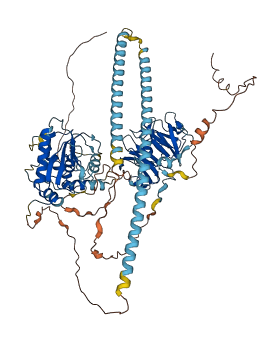
Descriptions
The autoinhibited protein was predicted that may have potential autoinhibitory elements via cis-regPred.
Autoinhibitory domains (AIDs)
Target domain |
|
Relief mechanism |
|
Assay |
cis-regPred |
Accessory elements
No accessory elements
Autoinhibited structure

Activated structure
1 structures for Q8MPP3
| Entry ID | Method | Resolution | Chain | Position | Source |
|---|---|---|---|---|---|
| AF-Q8MPP3-F1 | Predicted | AlphaFoldDB |
No variants for Q8MPP3
| Variant ID(s) | Position | Change | Description | Diseaes Association | Provenance |
|---|---|---|---|---|---|
| No variants for Q8MPP3 | |||||
No associated diseases with Q8MPP3
9 regional properties for Q8MPP3
| Type | Name | Position | InterPro Accession |
|---|---|---|---|
| domain | Hemopexin-like domain | 513 - 707 | IPR000585 |
| domain | Peptidase M10, metallopeptidase | 143 - 301 | IPR001818 |
| domain | Peptidoglycan binding-like | 52 - 101 | IPR002477 |
| domain | Peptidase, metallopeptidase | 140 - 302 | IPR006026 |
| repeat | Hemopexin-like repeats | 513 - 563 | IPR018487-1 |
| repeat | Hemopexin-like repeats | 565 - 610 | IPR018487-2 |
| repeat | Hemopexin-like repeats | 612 - 661 | IPR018487-3 |
| repeat | Hemopexin-like repeats | 660 - 707 | IPR018487-4 |
| domain | Peptidase M10A, catalytic domain | 143 - 301 | IPR033739 |
6 GO annotations of cellular component
| Name | Definition |
|---|---|
| dendrite | A neuron projection that has a short, tapering, morphology. Dendrites receive and integrate signals from other neurons or from sensory stimuli, and conduct nerve impulses towards the axon or the cell body. In most neurons, the impulse is conveyed from dendrites to axon via the cell body, but in some types of unipolar neuron, the impulse does not travel via the cell body. |
| external side of plasma membrane | The leaflet of the plasma membrane that faces away from the cytoplasm and any proteins embedded or anchored in it or attached to its surface. |
| extracellular matrix | A structure lying external to one or more cells, which provides structural support, biochemical or biomechanical cues for cells or tissues. |
| extracellular space | That part of a multicellular organism outside the cells proper, usually taken to be outside the plasma membranes, and occupied by fluid. |
| integral component of membrane | The component of a membrane consisting of the gene products and protein complexes having at least some part of their peptide sequence embedded in the hydrophobic region of the membrane. |
| plasma membrane | The membrane surrounding a cell that separates the cell from its external environment. It consists of a phospholipid bilayer and associated proteins. |
3 GO annotations of molecular function
| Name | Definition |
|---|---|
| endopeptidase activity | Catalysis of the hydrolysis of internal, alpha-peptide bonds in a polypeptide chain. |
| metalloendopeptidase activity | Catalysis of the hydrolysis of internal, alpha-peptide bonds in a polypeptide chain by a mechanism in which water acts as a nucleophile, one or two metal ions hold the water molecule in place, and charged amino acid side chains are ligands for the metal ions. |
| zinc ion binding | Binding to a zinc ion (Zn). |
26 GO annotations of biological process
| Name | Definition |
|---|---|
| activation of innate immune response | Any process that initiates an innate immune response. Innate immune responses are defense responses mediated by germline encoded components that directly recognize components of potential pathogens. Examples of this process include activation of the hypersensitive response of Arabidopsis thaliana and activation of any NOD or TLR signaling pathway in vertebrate species. |
| adult fat body development | The process whose specific outcome is the progression of the adult fat body over time, from its formation to the mature structure. Larval fat body cells that remain at eclosion degenerate in the first 2 to 4 days of adult life, leaving behind the smaller cells of the adult fat body. |
| basement membrane disassembly | The controlled breakdown of the basement membrane in the context of a normal process such as imaginal disc eversion. |
| basement membrane organization | A process that is carried out at the cellular level which results in the assembly, arrangement of constituent parts, or disassembly of the basement membrane. |
| cardioblast migration to the midline involved in heart rudiment formation | The orderly movement of a cardioblast toward the midline that contributes to the initial appearance of the heart rudiment. |
| cell-cell junction organization | A process that is carried out at the cellular level which results in the assembly, arrangement of constituent parts, or disassembly of a cell-cell junction. A cell-cell junction is a specialized region of connection between two cells. |
| collagen catabolic process | The proteolytic chemical reactions and pathways resulting in the breakdown of collagen in the extracellular matrix, usually carried out by proteases secreted by nearby cells. |
| embryonic heart tube formation | The process that gives rise to the embryonic heart tube. This process pertains to the initial formation of a structure from unspecified parts. The embryonic heart tube is an epithelial tube that will give rise to the mature heart. |
| extracellular matrix organization | A process that is carried out at the cellular level which results in the assembly, arrangement of constituent parts, or disassembly of an extracellular matrix. |
| fasciculation of motor neuron axon | The collection of motor neuron axons into a bundle of rods, known as a fascicle. |
| imaginal disc eversion | The eversion (turning inside out) of imaginal discs from their peripodial sacs, resulting in movement of the epithelium to the outside of the larval epidermis. |
| imaginal disc fusion, thorax closure | The joining of the parts of the wing imaginal discs, giving rise to the adult thorax. |
| lateral inhibition | Signaling between cells of equivalent developmental potential that results in these cells adopting different developmental fates. An example is the suppression by cells with a particular fate of the adoption of the same fate by surrounding cells. |
| motor neuron axon guidance | The process in which the migration of an axon growth cone of a motor neuron is directed to a specific target site in response to a combination of attractive and repulsive cues. |
| negative regulation of canonical Wnt signaling pathway | Any process that decreases the rate, frequency, or extent of the Wnt signaling pathway through beta-catenin, the series of molecular signals initiated by binding of a Wnt protein to a frizzled family receptor on the surface of the target cell, followed by propagation of the signal via beta-catenin, and ending with a change in transcription of target genes. |
| negative regulation of extracellular matrix assembly | Any process that stops, prevents or reduces the frequency, rate or extent of extracellular matrix assembly. |
| negative regulation of fibroblast growth factor receptor signaling pathway | Any process that stops, prevents, or reduces the frequency, rate or extent of fibroblast growth factor receptor signaling pathway activity. |
| negative regulation of stem cell proliferation | Any process that stops, prevents or reduces the frequency, rate or extent of stem cell proliferation. |
| open tracheal system development | The process whose specific outcome is the progression of an open tracheal system over time, from its formation to the mature structure. An open tracheal system is a respiratory system, a branched network of epithelial tubes that supplies oxygen to target tissues via spiracles. An example of this is found in Drosophila melanogaster. |
| ovulation | The release of a mature ovum/oocyte from an ovary. |
| protein processing | Any protein maturation process achieved by the cleavage of a peptide bond or bonds within a protein. Protein maturation is the process leading to the attainment of the full functional capacity of a protein. |
| substrate-dependent cell migration | The orderly movement of a cell from one site to another along a substrate such as the extracellular matrix; the migrating cell forms a protrusion that attaches to the substrate. |
| tracheal outgrowth, open tracheal system | The projection of branches of an open tracheal system towards their target tissues. An example of this is found in Drosophila melanogaster. |
| tracheal pit formation in open tracheal system | Formation of the tracheal pits, the first tube-like structures to form in the open tracheal system. Once cells are determined to their tracheal cell fate, the tracheal pits arise by invagination of each ectodermal cluster of tracheal placode cells, between 5 and 7 hours after egg laying. An example of this is found in Drosophila melanogaster. |
| ventral cord development | The process whose specific outcome is the progression of the ventral cord over time, from its formation to the mature structure. The ventral cord is one of the distinguishing traits of the central nervous system of all arthropods (such as insects, crustaceans and arachnids) as well as many other invertebrates, such as the annelid worms. |
| wound healing | The series of events that restore integrity to a damaged tissue, following an injury. |
17 homologous proteins in AiPD
| UniProt AC | Gene Name | Protein Name | Species | Evidence Code |
|---|---|---|---|---|
| Q3SZV7 | HPX | Hemopexin | Bos taurus (Bovine) | PR |
| O77656 | MMP13 | Collagenase 3 | Bos taurus (Bovine) | PR |
| Q9GLE5 | MMP2 | 72 kDa type IV collagenase | Bos taurus (Bovine) | PR |
| Q90611 | MMP2 | 72 kDa type IV collagenase | Gallus gallus (Chicken) | PR |
| P04004 | VTN | Vitronectin | Homo sapiens (Human) | PR |
| P45452 | MMP13 | Collagenase 3 | Homo sapiens (Human) | PR |
| Q99542 | MMP19 | Matrix metalloproteinase-19 | Homo sapiens (Human) | PR |
| Q9H239 | MMP28 | Matrix metalloproteinase-28 | Homo sapiens (Human) | PR |
| Q9NPA2 | MMP25 | Matrix metalloproteinase-25 | Homo sapiens (Human) | PR |
| P34960 | Mmp12 | Macrophage metalloelastase | Mus musculus (Mouse) | PR |
| P33435 | Mmp13 | Collagenase 3 | Mus musculus (Mouse) | PR |
| P33434 | Mmp2 | 72 kDa type IV collagenase | Mus musculus (Mouse) | PR |
| P28862 | Mmp3 | Stromelysin-1 | Mus musculus (Mouse) | PR |
| P23097 | Mmp13 | Collagenase 3 | Rattus norvegicus (Rat) | PR |
| Q63341 | Mmp12 | Macrophage metalloelastase | Rattus norvegicus (Rat) | PR |
| P33436 | Mmp2 | 72 kDa type IV collagenase | Rattus norvegicus (Rat) | PR |
| Q6PHG2 | hpx | Hemopexin | Danio rerio (Zebrafish) (Brachydanio rerio) | PR |
| 10 | 20 | 30 | 40 | 50 | 60 |
| MFSKYVLATL | LALFAQSMCI | QELSLPPEGS | HSTAATRSKK | AKTAISEDIM | YNYLMQFDYL |
| 70 | 80 | 90 | 100 | 110 | 120 |
| PKSDLETGAL | RTEDQLKEAI | RSLQSFGNIT | VTGEIDSATA | RLIQKPRCGV | GDRRSADSFS |
| 130 | 140 | 150 | 160 | 170 | 180 |
| PDNLYHEIGS | NVRVRRFALQ | GPKWSRTDLT | WSMVNRSMPD | ASKVERMVQT | ALDVWANHSK |
| 190 | 200 | 210 | 220 | 230 | 240 |
| LTFREVYSDQ | ADIQILFARR | AHGDGYKFDG | PGQVLAHAFY | PGEGRGGDAH | FDADETWNFD |
| 250 | 260 | 270 | 280 | 290 | 300 |
| GESDDSHGTN | FLNVALHELG | HSLGLAHSAI | PDAVMFPWYQ | NNEVAGNLPD | DDRYGIQQLY |
| 310 | 320 | 330 | 340 | 350 | 360 |
| GTKEKTWGPY | KPQTTTTTTT | TTTMRAMIYR | ADKPAYWPWN | NPSNNPNNDR | NRARERQEEE |
| 370 | 380 | 390 | 400 | 410 | 420 |
| RRRQEKERRR | QEEERRHQEE | ERRRQVEERQ | RQEEERWRQE | QERQEEENRR | RKIEHKSQWE |
| 430 | 440 | 450 | 460 | 470 | 480 |
| RNPSKERNRP | RERQEMERRR | QEQERQEQER | QEQEDRRRER | ERDRQLEWER | RNRNGAREPV |
| 490 | 500 | 510 | 520 | 530 | 540 |
| TPTANTTPRP | TNKPYPTVHR | QHHHHNKPRK | PKPDSCMTYY | DAISIIRGEL | FIFRGPYLWR |
| 550 | 560 | 570 | 580 | 590 | 600 |
| IGTSGLYNGY | PTEIRRHWSA | LPENLTKVDA | VYENKQRQIV | FFIGREYYVF | NSVMLAPGFP |
| 610 | 620 | 630 | 640 | 650 | 660 |
| KPLASLGLPP | TLTHIDASFV | WGHNNRTYMT | SGTLYWRIDD | YTGQVELDYP | RDMSIWSGVG |
| 670 | 680 | 690 | 700 | 710 | 720 |
| YNIDAAFQYL | DGKTYFFKNL | GYWEFNDDRM | KVAHARAKLS | ARRWMQCARS | ANEVDDEQRW |
| 730 | 740 | 750 | |||
| TASLVSEGEE | TGRSGSRELR | INHFILSILL | LAIANWRS |