P38445
Gene name |
Acvr2b (Actriib) |
Protein name |
Activin receptor type-2B |
Names |
Activin receptor type IIB, ACTR-IIB |
Species |
Rattus norvegicus (Rat) |
KEGG Pathway |
rno:25366 |
EC number |
2.7.11.30: Protein-serine/threonine kinases |
Protein Class |
|
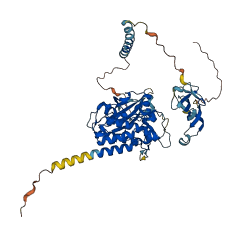
Descriptions
The autoinhibited protein was predicted that may have potential autoinhibitory elements via cis-regPred.
Autoinhibitory domains (AIDs)
Target domain |
|
Relief mechanism |
|
Assay |
cis-regPred |
Accessory elements
339-364 (Activation loop from InterPro)
Target domain |
190-481 (Protein kinase domain) |
Relief mechanism |
|
Assay |
|
Autoinhibited structure

Activated structure
4 structures for P38445
| Entry ID | Method | Resolution | Chain | Position | Source |
|---|---|---|---|---|---|
| 1NYS | X-ray | 305 A | A/C | 19-119 | PDB |
| 1NYU | X-ray | 310 A | A/C | 19-119 | PDB |
| 6MAC | X-ray | 234 A | C | 26-120 | PDB |
| AF-P38445-F1 | Predicted | AlphaFoldDB |
No variants for P38445
| Variant ID(s) | Position | Change | Description | Diseaes Association | Provenance |
|---|---|---|---|---|---|
| No variants for P38445 | |||||
No associated diseases with P38445
Functions
| Description | ||
|---|---|---|
| EC Number | 2.7.11.30 | Protein-serine/threonine kinases |
| Subcellular Localization |
|
|
| PANTHER Family | ||
| PANTHER Subfamily | ||
| PANTHER Protein Class | ||
| PANTHER Pathway Category | No pathway information available | |
5 GO annotations of cellular component
| Name | Definition |
|---|---|
| activin receptor complex | A protein complex that acts as an activin receptor. Heterodimeric activin receptors, comprising one Type I activin receptor and one Type II receptor polypeptide, and heterotrimeric receptors have been observed. |
| cytoplasm | The contents of a cell excluding the plasma membrane and nucleus, but including other subcellular structures. |
| plasma membrane | The membrane surrounding a cell that separates the cell from its external environment. It consists of a phospholipid bilayer and associated proteins. |
| protein-containing complex | A stable assembly of two or more macromolecules, i.e. proteins, nucleic acids, carbohydrates or lipids, in which at least one component is a protein and the constituent parts function together. |
| receptor complex | Any protein complex that undergoes combination with a hormone, neurotransmitter, drug or intracellular messenger to initiate a change in cell function. |
9 GO annotations of molecular function
| Name | Definition |
|---|---|
| activin binding | Binding to activin, a dimer of inhibin-beta subunits. |
| activin receptor activity | Combining with activin and transmitting the signal from one side of the membrane to the other to initiate a change in cell activity. Activin is one of two gonadal glycoproteins related to transforming growth factor beta. |
| ATP binding | Binding to ATP, adenosine 5'-triphosphate, a universally important coenzyme and enzyme regulator. |
| growth factor binding | Binding to a growth factor, proteins or polypeptides that stimulate a cell or organism to grow or proliferate. |
| inhibin binding | Binding to an inhibin monomer, any of the polypeptides that combine to form activin and inhibin dimers. |
| metal ion binding | Binding to a metal ion. |
| protein serine/threonine kinase activity | Catalysis of the reactions: ATP + protein serine = ADP + protein serine phosphate, and ATP + protein threonine = ADP + protein threonine phosphate. |
| protein serine/threonine/tyrosine kinase activity | Catalysis of the reactions: ATP + a protein serine = ADP + protein serine phosphate; ATP + a protein threonine = ADP + protein threonine phosphate; and ATP + a protein tyrosine = ADP + protein tyrosine phosphate. |
| transmembrane receptor protein serine/threonine kinase activity | Combining with a signal and transmitting the signal from one side of the membrane to the other to initiate a change in cell activity by catalysis of the reaction: ATP protein serine = ADP + protein serine phosphate, and ATP + protein threonine = ADP + protein threonine phosphate. |
40 GO annotations of biological process
| Name | Definition |
|---|---|
| activation of protein kinase activity | Any process that initiates the activity of an inactive protein kinase. |
| activin receptor signaling pathway | The series of molecular signals initiated by an extracellular ligand binding to an activin receptor on the surface of a target cell, and ending with the regulation of a downstream cellular process, e.g. transcription. |
| adrenal gland development | The process whose specific outcome is the progression of the adrenal gland over time, from its formation to the mature structure. This gland can either be a discrete structure located bilaterally above each kidney, or a cluster of cells in the head kidney that perform the functions of the adrenal gland. In either case, this organ consists of two cells types, aminergic chromaffin cells and steroidogenic cortical cells. |
| anterior/posterior pattern specification | The regionalization process in which specific areas of cell differentiation are determined along the anterior-posterior axis. The anterior-posterior axis is defined by a line that runs from the head or mouth of an organism to the tail or opposite end of the organism. |
| artery development | The progression of the artery over time, from its initial formation to the mature structure. An artery is a blood vessel that carries blood away from the heart to a capillary bed. |
| blood vessel remodeling | The reorganization or renovation of existing blood vessels. |
| BMP signaling pathway | The series of molecular signals initiated by the binding of a member of the BMP (bone morphogenetic protein) family to a receptor on the surface of a target cell, and ending with the regulation of a downstream cellular process, e.g. transcription. |
| cellular response to growth factor stimulus | Any process that results in a change in state or activity of a cell (in terms of movement, secretion, enzyme production, gene expression, etc.) as a result of a growth factor stimulus. |
| determination of left/right symmetry | The establishment of an organism's body plan or part of an organism with respect to the left and right halves. The pattern can either be symmetric, such that the halves are mirror images, or asymmetric where the pattern deviates from this symmetry. |
| embryonic foregut morphogenesis | The process in which the anatomical structures of the foregut are generated and organized, during the embryonic phase. |
| gastrulation with mouth forming second | A gastrulation process in which the initial invagination becomes the anus and the mouth forms second. |
| heart development | The process whose specific outcome is the progression of the heart over time, from its formation to the mature structure. The heart is a hollow, muscular organ, which, by contracting rhythmically, keeps up the circulation of the blood. |
| insulin secretion | The regulated release of proinsulin from secretory granules accompanied by cleavage of proinsulin to form mature insulin. In vertebrates, insulin is secreted from B granules in the B cells of the vertebrate pancreas and from insulin-producing cells in insects. |
| kidney development | The process whose specific outcome is the progression of the kidney over time, from its formation to the mature structure. The kidney is an organ that filters the blood and/or excretes the end products of body metabolism in the form of urine. |
| lung development | The process whose specific outcome is the progression of the lung over time, from its formation to the mature structure. In all air-breathing vertebrates the lungs are developed from the ventral wall of the oesophagus as a pouch which divides into two sacs. In amphibians and many reptiles the lungs retain very nearly this primitive sac-like character, but in the higher forms the connection with the esophagus becomes elongated into the windpipe and the inner walls of the sacs become more and more divided, until, in the mammals, the air spaces become minutely divided into tubes ending in small air cells, in the walls of which the blood circulates in a fine network of capillaries. In mammals the lungs are more or less divided into lobes, and each lung occupies a separate cavity in the thorax. |
| lymphangiogenesis | Lymph vessel formation when new vessels emerge from the proliferation of pre-existing vessels. |
| lymphatic endothelial cell differentiation | The process in which a venous blood vessel endothelial cell acquires specialized features of a lymphatic vessel endothelial cell, a thin flattened cell that lines the inside surfaces of lymph vessels. |
| mesoderm development | The process whose specific outcome is the progression of the mesoderm over time, from its formation to the mature structure. The mesoderm is the middle germ layer that develops into muscle, bone, cartilage, blood and connective tissue. |
| negative regulation of cold-induced thermogenesis | Any process that stops, prevents, or reduces the rate of cold-induced thermogenesis. |
| negative regulation of transcription by RNA polymerase II | Any process that stops, prevents, or reduces the frequency, rate or extent of transcription mediated by RNA polymerase II. |
| odontogenesis of dentin-containing tooth | The process whose specific outcome is the progression of a dentin-containing tooth over time, from its formation to the mature structure. A dentin-containing tooth is a hard, bony organ borne on the jaw or other bone of a vertebrate, and is composed mainly of dentin, a dense calcified substance, covered by a layer of enamel. |
| organ growth | The increase in size or mass of an organ. Organs are commonly observed as visibly distinct structures, but may also exist as loosely associated clusters of cells that function together as to perform a specific function. |
| pancreas development | The process whose specific outcome is the progression of the pancreas over time, from its formation to the mature structure. The pancreas is an endoderm derived structure that produces precursors of digestive enzymes and blood glucose regulating enzymes. |
| pattern specification process | Any developmental process that results in the creation of defined areas or spaces within an organism to which cells respond and eventually are instructed to differentiate. |
| positive regulation of activin receptor signaling pathway | Any process that activates or increases the frequency, rate or extent of the activity of any activin receptor signaling pathway. |
| positive regulation of bone mineralization | Any process that activates or increases the frequency, rate or extent of bone mineralization. |
| positive regulation of osteoblast differentiation | Any process that activates or increases the frequency, rate or extent of osteoblast differentiation. |
| post-embryonic development | The process whose specific outcome is the progression of the organism over time, from the completion of embryonic development to the mature structure. See embryonic development. |
| protein phosphorylation | The process of introducing a phosphate group on to a protein. |
| regulation of DNA-templated transcription | Any process that modulates the frequency, rate or extent of cellular DNA-templated transcription. |
| regulation of signal transduction | Any process that modulates the frequency, rate or extent of signal transduction. |
| response to activity | Any process that results in a change in state or activity of a cell or an organism (in terms of movement, secretion, enzyme production, gene expression, etc.) as a result of an activity stimulus. |
| response to glucose | Any process that results in a change in state or activity of a cell or an organism (in terms of movement, secretion, enzyme production, gene expression, etc.) as a result of a glucose stimulus. |
| retina vasculature development in camera-type eye | The process whose specific outcome is the progression of the vasculature of the retina over time, from its formation to the mature structure. |
| roof of mouth development | The biological process whose specific outcome is the progression of the roof of the mouth from an initial condition to its mature state. This process begins with the formation of the structure and ends with the mature structure. The roof of the mouth is the partition that separates the nasal and oral cavities. |
| sexual reproduction | A type of reproduction that combines the genetic material of two gametes (such as a sperm or egg cell or fungal spores). The gametes have an haploid genome (with a single set of chromosomes, the product of a meiotic division) and combines with one another to produce a zygote (diploid). |
| signal transduction | The cellular process in which a signal is conveyed to trigger a change in the activity or state of a cell. Signal transduction begins with reception of a signal (e.g. a ligand binding to a receptor or receptor activation by a stimulus such as light), or for signal transduction in the absence of ligand, signal-withdrawal or the activity of a constitutively active receptor. Signal transduction ends with regulation of a downstream cellular process, e.g. regulation of transcription or regulation of a metabolic process. Signal transduction covers signaling from receptors located on the surface of the cell and signaling via molecules located within the cell. For signaling between cells, signal transduction is restricted to events at and within the receiving cell. |
| skeletal system development | The process whose specific outcome is the progression of the skeleton over time, from its formation to the mature structure. The skeleton is the bony framework of the body in vertebrates (endoskeleton) or the hard outer envelope of insects (exoskeleton or dermoskeleton). |
| skeletal system morphogenesis | The process in which the anatomical structures of the skeleton are generated and organized. |
| venous blood vessel development | The progression of the venous blood vessel over time from its initial formation to the mature structure. Venous blood vessels carry blood back to the heart after the capillary bed. |
14 homologous proteins in AiPD
| UniProt AC | Gene Name | Protein Name | Species | Evidence Code |
|---|---|---|---|---|
| Q95126 | ACVR2B | Activin receptor type-2B | Bos taurus (Bovine) | PR |
| Q90999 | TGFBR2 | TGF-beta receptor type-2 | Gallus gallus (Chicken) | PR |
| Q90670 | ACVR2B | Activin receptor type-2B | Gallus gallus (Chicken) | PR |
| P37173 | TGFBR2 | TGF-beta receptor type-2 | Homo sapiens (Human) | PR |
| Q13705 | ACVR2B | Activin receptor type-2B | Homo sapiens (Human) | PR |
| Q8K592 | Amhr2 | Anti-Muellerian hormone type-2 receptor | Mus musculus (Mouse) | PR |
| Q62312 | Tgfbr2 | TGF-beta receptor type-2 | Mus musculus (Mouse) | PR |
| P27040 | Acvr2b | Activin receptor type-2B | Mus musculus (Mouse) | PR |
| Q66T47 | ACVR2B | Activin receptor type-2B | Sus scrofa (Pig) | PR |
| Q62893 | Amhr2 | Anti-Muellerian hormone type-2 receptor | Rattus norvegicus (Rat) | PR |
| P38438 | Tgfbr2 | TGF-beta receptor type-2 | Rattus norvegicus (Rat) | PR |
| P80201 | Acvr1 | Activin receptor type-1 | Rattus norvegicus (Rat) | PR |
| P70539 | Acvr1c | Activin receptor type-1C | Rattus norvegicus (Rat) | PR |
| P50488 | daf-4 | Cell surface receptor daf-4 | Caenorhabditis elegans | PR |
| 10 | 20 | 30 | 40 | 50 | 60 |
| MTAPWAALAL | LWGSLCAGSG | RGEAETRECI | YYNANWELER | TNQSGLERCE | GEQDKRLHCY |
| 70 | 80 | 90 | 100 | 110 | 120 |
| ASWRNSSGTI | ELVKKGCWLD | DFNCYDRQEC | VATEENPQVY | FCCCEGNFCN | ERFTHLPEPG |
| 130 | 140 | 150 | 160 | 170 | 180 |
| GPEVTYEPPP | TAPTLLTVLA | YSLLPIGGLS | LIVLLAFWMY | RHRKPPYGHV | DIHEDPGPPP |
| 190 | 200 | 210 | 220 | 230 | 240 |
| PSPLVGLKPL | QLLEIKARGR | FGCVWKAQLM | NDFVAVKIFP | LQDKQSWQSE | REIFSTPGMK |
| 250 | 260 | 270 | 280 | 290 | 300 |
| HENLLQFIAA | EKRGCSNLEV | ELWLITAFHD | KGSLTDYLKG | NIITWNELCH | VAETMSRGLS |
| 310 | 320 | 330 | 340 | 350 | 360 |
| YLHEDVPWCR | GEGHKPSIAH | RDFKSKNVLL | KSDLTAVLAD | FGLAVRFEPG | KPPGDTHGQV |
| 370 | 380 | 390 | 400 | 410 | 420 |
| GTRRYMAPEV | LEGAINFQRD | AFLRIDMYAM | GLVLWELVSR | CKAADGPVDE | YMLPFEEEIG |
| 430 | 440 | 450 | 460 | 470 | 480 |
| QHPSLEELQE | VVVHKKMRPT | IKDHWLKHPG | LAQLCVTIEE | CWDHDAEARL | SAGCVEERVS |
| 490 | 500 | 510 | |||
| LIRRSVNSST | SDCLVSLVTS | VTNVDLLPKE | SSI |