P70539
Gene name |
Acvr1c |
Protein name |
Activin receptor type-1C |
Names |
Activin receptor type IC, ACTR-IC, Activin receptor-like kinase 7, ALK-7 |
Species |
Rattus norvegicus (Rat) |
KEGG Pathway |
rno:245921 |
EC number |
2.7.11.30: Protein-serine/threonine kinases |
Protein Class |
|
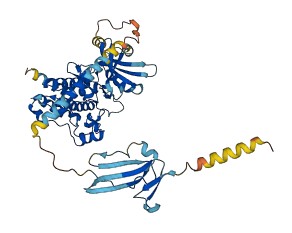
Descriptions
The autoinhibited protein was predicted that may have potential autoinhibitory elements via cis-regPred.
Autoinhibitory domains (AIDs)
Target domain |
|
Relief mechanism |
|
Assay |
cis-regPred |
Accessory elements
340-367 (Activation loop from InterPro)
Target domain |
195-487 (Protein kinase domain) |
Relief mechanism |
|
Assay |
|
Autoinhibited structure

Activated structure
1 structures for P70539
| Entry ID | Method | Resolution | Chain | Position | Source |
|---|---|---|---|---|---|
| AF-P70539-F1 | Predicted | AlphaFoldDB |
No variants for P70539
| Variant ID(s) | Position | Change | Description | Diseaes Association | Provenance |
|---|---|---|---|---|---|
| No variants for P70539 | |||||
No associated diseases with P70539
4 regional properties for P70539
| Type | Name | Position | InterPro Accession |
|---|---|---|---|
| conserved_site | Aldo/keto reductase, conserved site | 39 - 56 | IPR018170-1 |
| conserved_site | Aldo/keto reductase, conserved site | 145 - 162 | IPR018170-2 |
| conserved_site | Aldo/keto reductase, conserved site | 261 - 276 | IPR018170-3 |
| domain | NADP-dependent oxidoreductase domain | 17 - 291 | IPR023210 |
Functions
| Description | ||
|---|---|---|
| EC Number | 2.7.11.30 | Protein-serine/threonine kinases |
| Subcellular Localization |
|
|
| PANTHER Family | ||
| PANTHER Subfamily | ||
| PANTHER Protein Class | ||
| PANTHER Pathway Category | No pathway information available | |
5 GO annotations of cellular component
| Name | Definition |
|---|---|
| activin receptor complex | A protein complex that acts as an activin receptor. Heterodimeric activin receptors, comprising one Type I activin receptor and one Type II receptor polypeptide, and heterotrimeric receptors have been observed. |
| cell surface | The external part of the cell wall and/or plasma membrane. |
| cytoplasm | The contents of a cell excluding the plasma membrane and nucleus, but including other subcellular structures. |
| plasma membrane | The membrane surrounding a cell that separates the cell from its external environment. It consists of a phospholipid bilayer and associated proteins. |
| receptor complex | Any protein complex that undergoes combination with a hormone, neurotransmitter, drug or intracellular messenger to initiate a change in cell function. |
9 GO annotations of molecular function
| Name | Definition |
|---|---|
| activin binding | Binding to activin, a dimer of inhibin-beta subunits. |
| activin receptor activity, type I | Combining with activin-bound type II activin receptor to initiate a change in cell activity; upon binding, acts as a downstream transducer of activin signals. |
| ATP binding | Binding to ATP, adenosine 5'-triphosphate, a universally important coenzyme and enzyme regulator. |
| BMP receptor binding | Binding to a BMP receptor. |
| growth factor binding | Binding to a growth factor, proteins or polypeptides that stimulate a cell or organism to grow or proliferate. |
| metal ion binding | Binding to a metal ion. |
| nodal binding | Binding to a nodal protein, a member of the transforming growth factor-beta superfamily. |
| protein serine/threonine kinase activity | Catalysis of the reactions: ATP + protein serine = ADP + protein serine phosphate, and ATP + protein threonine = ADP + protein threonine phosphate. |
| SMAD binding | Binding to a SMAD signaling protein. |
27 GO annotations of biological process
| Name | Definition |
|---|---|
| activin receptor signaling pathway | The series of molecular signals initiated by an extracellular ligand binding to an activin receptor on the surface of a target cell, and ending with the regulation of a downstream cellular process, e.g. transcription. |
| apoptotic nuclear changes | Alterations undergone by nuclei at the molecular and morphological level as part of the execution phase of apoptosis. |
| cell differentiation | The process in which relatively unspecialized cells, e.g. embryonic or regenerative cells, acquire specialized structural and/or functional features that characterize the cells, tissues, or organs of the mature organism or some other relatively stable phase of the organism's life history. Differentiation includes the processes involved in commitment of a cell to a specific fate and its subsequent development to the mature state. |
| cellular response to growth factor stimulus | Any process that results in a change in state or activity of a cell (in terms of movement, secretion, enzyme production, gene expression, etc.) as a result of a growth factor stimulus. |
| cerebellum development | The process whose specific outcome is the progression of the cerebellum over time, from its formation to the mature structure. The cerebellum is the portion of the brain in the back of the head between the cerebrum and the pons. In mice, the cerebellum controls balance for walking and standing, modulates the force and range of movement and is involved in the learning of motor skills. |
| hippocampus development | The progression of the hippocampus over time from its initial formation until its mature state. |
| insulin secretion | The regulated release of proinsulin from secretory granules accompanied by cleavage of proinsulin to form mature insulin. In vertebrates, insulin is secreted from B granules in the B cells of the vertebrate pancreas and from insulin-producing cells in insects. |
| lipid storage | The accumulation and maintenance in cells or tissues of lipids, compounds soluble in organic solvents but insoluble or sparingly soluble in aqueous solvents. Lipid reserves can be accumulated during early developmental stages for mobilization and utilization at later stages of development. |
| midbrain development | The process whose specific outcome is the progression of the midbrain over time, from its formation to the mature structure. The midbrain is the middle division of the three primary divisions of the developing chordate brain or the corresponding part of the adult brain (in vertebrates, includes a ventral part containing the cerebral peduncles and a dorsal tectum containing the corpora quadrigemina and that surrounds the aqueduct of Sylvius connecting the third and fourth ventricles). |
| negative regulation of chorionic trophoblast cell proliferation | Any process that stops, prevents or reduces the frequency, rate or extent of chorionic trophoblast cell proliferation. |
| negative regulation of insulin secretion | Any process that stops, prevents, or reduces the frequency, rate or extent of the regulated release of insulin. |
| negative regulation of trophoblast cell migration | Any process that stops, prevents or reduces the frequency, rate or extent of trophoblast cell migration. |
| nervous system development | The process whose specific outcome is the progression of nervous tissue over time, from its formation to its mature state. |
| nodal signaling pathway | The series of molecular signals initiated by nodal protein binding to an activin receptor on the surface of a target cell, and ending with the regulation of a downstream cellular process, e.g. transcription. |
| ovarian follicle development | The process whose specific outcome is the progression of the ovarian follicle over time, from its formation to the mature structure. |
| positive regulation of apoptotic process | Any process that activates or increases the frequency, rate or extent of cell death by apoptotic process. |
| positive regulation of cysteine-type endopeptidase activity involved in apoptotic process | Any process that activates or increases the activity of a cysteine-type endopeptidase involved in the apoptotic process. |
| protein phosphorylation | The process of introducing a phosphate group on to a protein. |
| regulation of apoptotic process | Any process that modulates the occurrence or rate of cell death by apoptotic process. |
| response to dietary excess | The physiological process in which dietary excess is sensed by the central nervous system, resulting in a reduction in food intake and increased energy expenditure. |
| response to glucose | Any process that results in a change in state or activity of a cell or an organism (in terms of movement, secretion, enzyme production, gene expression, etc.) as a result of a glucose stimulus. |
| response to insulin | Any process that results in a change in state or activity of a cell or an organism (in terms of movement, secretion, enzyme production, gene expression, etc.) as a result of an insulin stimulus. Insulin is a polypeptide hormone produced by the islets of Langerhans of the pancreas in mammals, and by the homologous organs of other organisms. |
| response to lipid | Any process that results in a change in state or activity of a cell or an organism (in terms of movement, secretion, enzyme production, gene expression, etc.) as a result of a lipid stimulus. |
| response to organic cyclic compound | Any process that results in a change in state or activity of a cell or an organism (in terms of movement, secretion, enzyme production, gene expression, etc.) as a result of an organic cyclic compound stimulus. |
| response to xenobiotic stimulus | Any process that results in a change in state or activity of a cell or an organism (in terms of movement, secretion, enzyme production, gene expression, etc.) as a result of a stimulus from a xenobiotic, a compound foreign to the organim exposed to it. It may be synthesized by another organism (like ampicilin) or it can be a synthetic chemical. |
| transforming growth factor beta receptor complex assembly | The aggregation, arrangement and bonding together of a ligand-bound type II transforming growth factor beta (TGF-beta) receptor dimer with a type I TGF-beta receptor dimer, following ligand binding, to form a heterotetrameric TGF-beta receptor complex. |
| trophectodermal cell proliferation | The proliferation of cells in the trophectoderm. |
11 homologous proteins in AiPD
| UniProt AC | Gene Name | Protein Name | Species | Evidence Code |
|---|---|---|---|---|
| P36897 | TGFBR1 | TGF-beta receptor type-1 | Homo sapiens (Human) | PR |
| Q8NER5 | ACVR1C | Activin receptor type-1C | Homo sapiens (Human) | PR |
| Q61288 | Acvrl1 | Serine/threonine-protein kinase receptor R3 | Mus musculus (Mouse) | PR |
| Q64729 | Tgfbr1 | TGF-beta receptor type-1 | Mus musculus (Mouse) | PR |
| Q8K348 | Acvr1c | Activin receptor type-1C | Mus musculus (Mouse) | PR |
| Q5CD18 | TGFBR1 | TGF-beta receptor type-1 | Sus scrofa (Pig) | PR |
| Q62893 | Amhr2 | Anti-Muellerian hormone type-2 receptor | Rattus norvegicus (Rat) | PR |
| P38438 | Tgfbr2 | TGF-beta receptor type-2 | Rattus norvegicus (Rat) | PR |
| P38445 | Acvr2b | Activin receptor type-2B | Rattus norvegicus (Rat) | PR |
| P80201 | Acvr1 | Activin receptor type-1 | Rattus norvegicus (Rat) | PR |
| P20792 | daf-1 | Cell surface receptor daf-1 | Caenorhabditis elegans | PR |
| 10 | 20 | 30 | 40 | 50 | 60 |
| MTPARRSALS | LALLLVALAS | DLAAGLKCVC | LLCDSSNFTC | QTEGACWASV | MLTNGKEQVS |
| 70 | 80 | 90 | 100 | 110 | 120 |
| KSCVSLPELN | AQVFCHSSNN | VTKTECCFTD | FCNNITQHLP | TASPDAPRLG | PTELTVVITV |
| 130 | 140 | 150 | 160 | 170 | 180 |
| PVCLLSIAAM | LTIWACQDRQ | CTYRKTKRHN | VEEPLAEYSL | VNAGKTLKDL | IYDATASGSG |
| 190 | 200 | 210 | 220 | 230 | 240 |
| SGPPLLVQRT | IARTIVLQEI | VGKGRFGEVW | HGRWCGEDVA | VKIFSSRDER | SWFREAEIYQ |
| 250 | 260 | 270 | 280 | 290 | 300 |
| TVMLRHENIL | GFIAADNKDN | GTWTQLWLVS | EYHEQGSLYD | YLNRNIVTVA | GMVKLALSIA |
| 310 | 320 | 330 | 340 | 350 | 360 |
| SGLAHLHMEI | VGTQGKPAIA | HRDIKSKNIL | VKKCDTCAIA | DLGLAVKHDS | IMNTIDIPQN |
| 370 | 380 | 390 | 400 | 410 | 420 |
| PKVGTKRYMA | PEMLDDTMNV | NIFESFKRAD | IYSVGLVYWE | IARRCSVGGL | VEEYQLPYYD |
| 430 | 440 | 450 | 460 | 470 | 480 |
| MVPSDPSIEE | MRKVVCDQKL | RPNLPNQWQS | CEALRVMGRI | MRECWYANGA | ARLTALRVKK |
| 490 | |||||
| TISQLCVKED | CKA |