Q61288
Gene name |
Acvrl1 (Acvrlk1, Alk-1) |
Protein name |
Serine/threonine-protein kinase receptor R3 |
Names |
SKR3, Activin receptor-like kinase 1, ALK-1, TGF-B superfamily receptor type I, TSR-I |
Species |
Mus musculus (Mouse) |
KEGG Pathway |
mmu:11482 |
EC number |
2.7.11.30: Protein-serine/threonine kinases |
Protein Class |
|
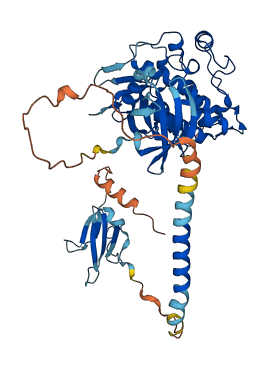
Descriptions
The autoinhibited protein was predicted that may have potential autoinhibitory elements via cis-regPred.
Autoinhibitory domains (AIDs)
Target domain |
|
Relief mechanism |
|
Assay |
cis-regPred |
Accessory elements
346-373 (Activation loop from InterPro)
Target domain |
201-502 (Protein kinase domain) |
Relief mechanism |
|
Assay |
|
Autoinhibited structure

Activated structure
1 structures for Q61288
| Entry ID | Method | Resolution | Chain | Position | Source |
|---|---|---|---|---|---|
| AF-Q61288-F1 | Predicted | AlphaFoldDB |
17 variants for Q61288
| Variant ID(s) | Position | Change | Description | Diseaes Association | Provenance |
|---|---|---|---|---|---|
| rs3406888956 | 2 | T>S | No | EVA | |
| rs3406509487 | 4 | G>E | No | EVA | |
| rs31638155 | 17 | F>L | No | EVA | |
| rs3389389986 | 39 | H>L | No | EVA | |
| rs1135309035 | 117 | H>Y | No | EVA | |
| rs233885531 | 150 | R>W | No | EVA | |
| rs3389407825 | 213 | G>D | No | EVA | |
| rs3389388888 | 216 | W>* | No | EVA | |
| rs3389401459 | 251 | R>K | No | EVA | |
| rs3389341512 | 277 | H>N | No | EVA | |
| rs3389341512 | 277 | H>Y | No | EVA | |
| rs3389382220 | 287 | F>L | No | EVA | |
| rs3405621317 | 353 | M>I | No | EVA | |
| rs47187608 | 358 | S>N | No | EVA | |
| rs251884872 | 383 | H>Q | No | EVA | |
| rs3389385311 | 470 | C>Y | No | EVA | |
| rs3389388960 | 474 | N>S | No | EVA |
No associated diseases with Q61288
Functions
| Description | ||
|---|---|---|
| EC Number | 2.7.11.30 | Protein-serine/threonine kinases |
| Subcellular Localization |
|
|
| PANTHER Family | ||
| PANTHER Subfamily | ||
| PANTHER Protein Class | ||
| PANTHER Pathway Category | No pathway information available | |
7 GO annotations of cellular component
| Name | Definition |
|---|---|
| BMP receptor complex | A protein complex that acts as a receptor for bone morphogenetic proteins (BMPs); a homo- or heterodimer of type I and/or type II BMP receptor subunits. |
| cell surface | The external part of the cell wall and/or plasma membrane. |
| dendrite | A neuron projection that has a short, tapering, morphology. Dendrites receive and integrate signals from other neurons or from sensory stimuli, and conduct nerve impulses towards the axon or the cell body. In most neurons, the impulse is conveyed from dendrites to axon via the cell body, but in some types of unipolar neuron, the impulse does not travel via the cell body. |
| integral component of plasma membrane | The component of the plasma membrane consisting of the gene products and protein complexes having at least some part of their peptide sequence embedded in the hydrophobic region of the membrane. |
| neuronal cell body | The portion of a neuron that includes the nucleus, but excludes cell projections such as axons and dendrites. |
| plasma membrane | The membrane surrounding a cell that separates the cell from its external environment. It consists of a phospholipid bilayer and associated proteins. |
| receptor complex | Any protein complex that undergoes combination with a hormone, neurotransmitter, drug or intracellular messenger to initiate a change in cell function. |
11 GO annotations of molecular function
| Name | Definition |
|---|---|
| activin binding | Binding to activin, a dimer of inhibin-beta subunits. |
| activin receptor activity, type I | Combining with activin-bound type II activin receptor to initiate a change in cell activity; upon binding, acts as a downstream transducer of activin signals. |
| ATP binding | Binding to ATP, adenosine 5'-triphosphate, a universally important coenzyme and enzyme regulator. |
| BMP receptor activity | Combining with a member of the bone morphogenetic protein (BMP) family, and transmitting a signal across the plasma membrane to initiate a change in cell activity. |
| metal ion binding | Binding to a metal ion. |
| protein kinase binding | Binding to a protein kinase, any enzyme that catalyzes the transfer of a phosphate group, usually from ATP, to a protein substrate. |
| protein serine/threonine kinase activity | Catalysis of the reactions: ATP + protein serine = ADP + protein serine phosphate, and ATP + protein threonine = ADP + protein threonine phosphate. |
| SMAD binding | Binding to a SMAD signaling protein. |
| transforming growth factor beta binding | Binding to TGF-beta, transforming growth factor beta, a multifunctional peptide that controls proliferation, differentiation and other functions in many cell types. |
| transforming growth factor beta receptor activity | Combining with a transforming growth factor beta (TGFbeta) and transmitting the signal from one side of the membrane to the other to initiate a change in cell activity by catalysis of the reaction: ATP protein serine = ADP + protein serine phosphate, and ATP + protein threonine = ADP + protein threonine phosphate. |
| transforming growth factor beta receptor activity, type I | Combining with a complex of transforming growth factor beta and a type II TGF-beta receptor to initiate a change in cell activity; upon binding, acts as a downstream transducer of TGF-beta signals. |
45 GO annotations of biological process
| Name | Definition |
|---|---|
| angiogenesis | Blood vessel formation when new vessels emerge from the proliferation of pre-existing blood vessels. |
| artery development | The progression of the artery over time, from its initial formation to the mature structure. An artery is a blood vessel that carries blood away from the heart to a capillary bed. |
| blood circulation | The flow of blood through the body of an animal, enabling the transport of nutrients to the tissues and the removal of waste products. |
| blood vessel morphogenesis | The process in which the anatomical structures of blood vessels are generated and organized. The blood vessel is the vasculature carrying blood. |
| blood vessel remodeling | The reorganization or renovation of existing blood vessels. |
| BMP signaling pathway | The series of molecular signals initiated by the binding of a member of the BMP (bone morphogenetic protein) family to a receptor on the surface of a target cell, and ending with the regulation of a downstream cellular process, e.g. transcription. |
| cellular response to BMP stimulus | Any process that results in a change in state or activity of a cell (in terms of movement, secretion, enzyme production, gene expression, etc.) as a result of a bone morphogenetic protein (BMP) stimulus. |
| cellular response to growth factor stimulus | Any process that results in a change in state or activity of a cell (in terms of movement, secretion, enzyme production, gene expression, etc.) as a result of a growth factor stimulus. |
| cellular response to transforming growth factor beta stimulus | Any process that results in a change in state or activity of a cell (in terms of movement, secretion, enzyme production, gene expression, etc.) as a result of a transforming growth factor beta stimulus. |
| dorsal aorta morphogenesis | The process in which the anatomical structures of the dorsal aorta are generated and organized. The dorsal aorta is a blood vessel in a single-pass circulatory system that carries oxygenated blood from the gills to the rest of the body. In a single-pass circulatory system blood passes once through the heart to supply the body once. |
| dorsal/ventral pattern formation | The regionalization process in which the areas along the dorsal/ventral axis are established that will lead to differences in cell differentiation. The dorsal/ventral axis is defined by a line that runs orthogonal to both the anterior/posterior and left/right axes. The dorsal end is defined by the upper or back side of an organism. The ventral end is defined by the lower or front side of an organism. |
| endocardial cushion morphogenesis | The process in which the anatomical structure of the endocardial cushion is generated and organized. The endocardial cushion is a specialized region of mesenchymal cells that will give rise to the heart septa and valves. |
| endothelial cell activation | The change in morphology and behavior of an endothelial cell resulting from exposure to a cytokine, chemokine, cellular ligand, or soluble factor. |
| endothelial tube morphogenesis | The process in which the anatomical structures of a tube are generated and organized from an endothelium. Endothelium refers to the layer of cells lining blood vessels, lymphatics, the heart, and serous cavities, and is derived from bone marrow or mesoderm. Corneal endothelium is a special case, derived from neural crest cells. |
| heart development | The process whose specific outcome is the progression of the heart over time, from its formation to the mature structure. The heart is a hollow, muscular organ, which, by contracting rhythmically, keeps up the circulation of the blood. |
| in utero embryonic development | The process whose specific outcome is the progression of the embryo in the uterus over time, from formation of the zygote in the oviduct, to birth. An example of this process is found in Mus musculus. |
| lymphangiogenesis | Lymph vessel formation when new vessels emerge from the proliferation of pre-existing vessels. |
| lymphatic endothelial cell differentiation | The process in which a venous blood vessel endothelial cell acquires specialized features of a lymphatic vessel endothelial cell, a thin flattened cell that lines the inside surfaces of lymph vessels. |
| negative regulation of blood vessel endothelial cell migration | Any process that stops, prevents, or reduces the frequency, rate or extent of the migration of the endothelial cells of blood vessels. |
| negative regulation of cell adhesion | Any process that stops, prevents, or reduces the frequency, rate or extent of cell adhesion. |
| negative regulation of cell growth | Any process that stops, prevents, or reduces the frequency, rate, extent or direction of cell growth. |
| negative regulation of cell migration | Any process that stops, prevents, or reduces the frequency, rate or extent of cell migration. |
| negative regulation of cell population proliferation | Any process that stops, prevents or reduces the rate or extent of cell proliferation. |
| negative regulation of DNA biosynthetic process | Any process that stops, prevents or reduces the frequency, rate or extent of DNA biosynthetic process. |
| negative regulation of endothelial cell differentiation | Any process that stops, prevents, or reduces the frequency, rate or extent of endothelial cell differentiation. |
| negative regulation of endothelial cell migration | Any process that decreases the rate, frequency, or extent of the orderly movement of an endothelial cell into the extracellular matrix to form an endothelium. |
| negative regulation of endothelial cell proliferation | Any process that stops, prevents, or reduces the rate or extent of endothelial cell proliferation. |
| negative regulation of focal adhesion assembly | Any process that stops, prevents, or reduces the frequency, rate or extent of focal adhesion assembly, the establishment and maturation of focal adhesions. |
| negative regulation of gene expression | Any process that decreases the frequency, rate or extent of gene expression. Gene expression is the process in which a gene's coding sequence is converted into a mature gene product (protein or RNA). |
| positive regulation of angiogenesis | Any process that activates or increases angiogenesis. |
| positive regulation of BMP signaling pathway | Any process that activates or increases the frequency, rate or extent of BMP signaling pathway activity. |
| positive regulation of DNA-templated transcription | Any process that activates or increases the frequency, rate or extent of cellular DNA-templated transcription. |
| positive regulation of endothelial cell differentiation | Any process that activates or increases the frequency, rate or extent of endothelial cell differentiation. |
| positive regulation of endothelial cell proliferation | Any process that activates or increases the rate or extent of endothelial cell proliferation. |
| positive regulation of pathway-restricted SMAD protein phosphorylation | Any process that increases the rate, frequency or extent of pathway-restricted SMAD protein phosphorylation. Pathway-restricted SMAD proteins and common-partner SMAD proteins are involved in the transforming growth factor beta receptor signaling pathways. |
| positive regulation of transcription by RNA polymerase II | Any process that activates or increases the frequency, rate or extent of transcription from an RNA polymerase II promoter. |
| protein phosphorylation | The process of introducing a phosphate group on to a protein. |
| regulation of blood pressure | Any process that modulates the force with which blood travels through the circulatory system. The process is controlled by a balance of processes that increase pressure and decrease pressure. |
| regulation of DNA-templated transcription | Any process that modulates the frequency, rate or extent of cellular DNA-templated transcription. |
| response to hypoxia | Any process that results in a change in state or activity of a cell or an organism (in terms of movement, secretion, enzyme production, gene expression, etc.) as a result of a stimulus indicating lowered oxygen tension. Hypoxia, defined as a decline in O2 levels below normoxic levels of 20.8 - 20.95%, results in metabolic adaptation at both the cellular and organismal level. |
| retina vasculature development in camera-type eye | The process whose specific outcome is the progression of the vasculature of the retina over time, from its formation to the mature structure. |
| signal transduction | The cellular process in which a signal is conveyed to trigger a change in the activity or state of a cell. Signal transduction begins with reception of a signal (e.g. a ligand binding to a receptor or receptor activation by a stimulus such as light), or for signal transduction in the absence of ligand, signal-withdrawal or the activity of a constitutively active receptor. Signal transduction ends with regulation of a downstream cellular process, e.g. regulation of transcription or regulation of a metabolic process. Signal transduction covers signaling from receptors located on the surface of the cell and signaling via molecules located within the cell. For signaling between cells, signal transduction is restricted to events at and within the receiving cell. |
| transforming growth factor beta receptor signaling pathway | The series of molecular signals initiated by an extracellular ligand binding to a transforming growth factor beta receptor on the surface of a target cell, and ending with the regulation of a downstream cellular process, e.g. transcription. |
| venous blood vessel development | The progression of the venous blood vessel over time from its initial formation to the mature structure. Venous blood vessels carry blood back to the heart after the capillary bed. |
| wound healing, spreading of epidermal cells | The migration of an epidermal cell along or through a wound gap that contributes to the reestablishment of a continuous epidermis. |
11 homologous proteins in AiPD
| UniProt AC | Gene Name | Protein Name | Species | Evidence Code |
|---|---|---|---|---|
| Q8NER5 | ACVR1C | Activin receptor type-1C | Homo sapiens (Human) | PR |
| P36897 | TGFBR1 | TGF-beta receptor type-1 | Homo sapiens (Human) | PR |
| Q8K348 | Acvr1c | Activin receptor type-1C | Mus musculus (Mouse) | PR |
| Q8K592 | Amhr2 | Anti-Muellerian hormone type-2 receptor | Mus musculus (Mouse) | PR |
| Q62312 | Tgfbr2 | TGF-beta receptor type-2 | Mus musculus (Mouse) | PR |
| P27040 | Acvr2b | Activin receptor type-2B | Mus musculus (Mouse) | PR |
| Q64729 | Tgfbr1 | TGF-beta receptor type-1 | Mus musculus (Mouse) | PR |
| Q5CD18 | TGFBR1 | TGF-beta receptor type-1 | Sus scrofa (Pig) | PR |
| P80201 | Acvr1 | Activin receptor type-1 | Rattus norvegicus (Rat) | PR |
| P70539 | Acvr1c | Activin receptor type-1C | Rattus norvegicus (Rat) | PR |
| P20792 | daf-1 | Cell surface receptor daf-1 | Caenorhabditis elegans | PR |
| 10 | 20 | 30 | 40 | 50 | 60 |
| MTLGSFRRGL | LMLSVAFGLT | RGDLAKPSKL | VNCTCESPHC | KRPFCQGSWC | TVVLVREQGR |
| 70 | 80 | 90 | 100 | 110 | 120 |
| HPQVYRGCGS | LNQELCLGRP | TEFLNHHCCY | RSFCNHNVSL | MLEATQTPSE | EPEVDAHLPL |
| 130 | 140 | 150 | 160 | 170 | 180 |
| ILGPVLALPV | LVALGALGLW | RVRRRQEKQR | DLHSDLGESS | LILKASEQAD | SMLGDFLDSD |
| 190 | 200 | 210 | 220 | 230 | 240 |
| CTTGSGSGLP | FLVQRTVARQ | VALVECVGKG | RYGEVWRGSW | HGESVAVKIF | SSRDEQSWFR |
| 250 | 260 | 270 | 280 | 290 | 300 |
| ETEIYNTVLL | RHDNILGFIA | SDMTSRNSST | QLWLITHYHE | HGSLYDFLQR | QTLEPQLALR |
| 310 | 320 | 330 | 340 | 350 | 360 |
| LAVSAACGLA | HLHVEIFGTQ | GKPAIAHRDL | KSRNVLVKSN | LQCCIADLGL | AVMHSQSSDY |
| 370 | 380 | 390 | 400 | 410 | 420 |
| LDIGNNPRVG | TKRYMAPEVL | DEHIRTDCFE | SYKWTDIWAF | GLVLWEIARR | TIINGIVEDY |
| 430 | 440 | 450 | 460 | 470 | 480 |
| RPPFYDMVPN | DPSFEDMKKV | VCVDQQTPTI | PNRLAADPVL | SGLAQMMREC | WYPNPSARLT |
| 490 | 500 | ||||
| ALRIKKTLQK | LSHNPEKPKV | IH |