Q90999
Gene name |
TGFBR2 |
Protein name |
TGF-beta receptor type-2 |
Names |
TGFR-2, TGF-beta type II receptor, Transforming growth factor-beta receptor type II, TGF-beta receptor type II, TbetaR-II |
Species |
Gallus gallus (Chicken) |
KEGG Pathway |
gga:396399 |
EC number |
2.7.11.30: Protein-serine/threonine kinases |
Protein Class |
|
Descriptions
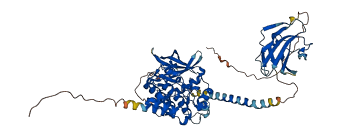
The autoinhibited protein was predicted that may have potential autoinhibitory elements via cis-regPred.
Autoinhibitory domains (AIDs)
Target domain |
|
Relief mechanism |
|
Assay |
cis-regPred |
Accessory elements
386-413 (Activation loop from InterPro)
Target domain |
234-537 (Protein kinase domain) |
Relief mechanism |
|
Assay |
|
Autoinhibited structure

Activated structure
2 structures for Q90999
| Entry ID | Method | Resolution | Chain | Position | Source |
|---|---|---|---|---|---|
| 1KS6 | NMR | - | A | 36-142 | PDB |
| AF-Q90999-F1 | Predicted | AlphaFoldDB |
11 variants for Q90999
| Variant ID(s) | Position | Change | Description | Diseaes Association | Provenance |
|---|---|---|---|---|---|
| rs1059240663 | 27 | H>Y | No | Ensembl | |
| rs733781237 | 50 | T>A | No | Ensembl | |
| rs733326008 | 53 | N>S | No | Ensembl | |
| rs1060109100 | 58 | K>N | No | Ensembl | |
| rs1058718297 | 135 | D>N | No | Ensembl | |
| rs1058946492 | 432 | F>L | No | Ensembl | |
| rs740591262 | 490 | I>T | No | Ensembl | |
| rs1058218471 | 491 | P>S | No | Ensembl | |
| rs1060456426 | 519 | L>F | No | Ensembl | |
| rs739235809 | 526 | E>G | No | Ensembl | |
| rs735766231 | 527 | R>G | No | Ensembl |
No associated diseases with Q90999
5 regional properties for Q90999
| Type | Name | Position | InterPro Accession |
|---|---|---|---|
| domain | Protein kinase domain | 234 - 537 | IPR000719 |
| domain | Serine-threonine/tyrosine-protein kinase, catalytic domain | 235 - 526 | IPR001245 |
| active_site | Serine/threonine-protein kinase, active site | 365 - 377 | IPR008271 |
| domain | Transforming growth factor beta receptor 2 ectodomain | 39 - 142 | IPR015013 |
| binding_site | Protein kinase, ATP binding site | 240 - 267 | IPR017441 |
Functions
| Description | ||
|---|---|---|
| EC Number | 2.7.11.30 | Protein-serine/threonine kinases |
| Subcellular Localization |
|
|
| PANTHER Family | ||
| PANTHER Subfamily | ||
| PANTHER Protein Class | ||
| PANTHER Pathway Category | No pathway information available | |
8 GO annotations of cellular component
| Name | Definition |
|---|---|
| caveola | A membrane raft that forms small pit, depression, or invagination that communicates with the outside of a cell and extends inward, indenting the cytoplasm and the cell membrane. Examples include flask-shaped invaginations of the plasma membrane in adipocytes associated with caveolin proteins, and minute pits or incuppings of the cell membrane formed during pinocytosis. Caveolae may be pinched off to form free vesicles within the cytoplasm. |
| external side of plasma membrane | The leaflet of the plasma membrane that faces away from the cytoplasm and any proteins embedded or anchored in it or attached to its surface. |
| extracellular matrix | A structure lying external to one or more cells, which provides structural support, biochemical or biomechanical cues for cells or tissues. |
| integral component of membrane | The component of a membrane consisting of the gene products and protein complexes having at least some part of their peptide sequence embedded in the hydrophobic region of the membrane. |
| membrane | A lipid bilayer along with all the proteins and protein complexes embedded in it an attached to it. |
| membrane raft | Any of the small (10-200 nm), heterogeneous, highly dynamic, sterol- and sphingolipid-enriched membrane domains that compartmentalize cellular processes. Small rafts can sometimes be stabilized to form larger platforms through protein-protein and protein-lipid interactions. |
| plasma membrane | The membrane surrounding a cell that separates the cell from its external environment. It consists of a phospholipid bilayer and associated proteins. |
| receptor complex | Any protein complex that undergoes combination with a hormone, neurotransmitter, drug or intracellular messenger to initiate a change in cell function. |
13 GO annotations of molecular function
| Name | Definition |
|---|---|
| activin binding | Binding to activin, a dimer of inhibin-beta subunits. |
| activin receptor activity | Combining with activin and transmitting the signal from one side of the membrane to the other to initiate a change in cell activity. Activin is one of two gonadal glycoproteins related to transforming growth factor beta. |
| ATP binding | Binding to ATP, adenosine 5'-triphosphate, a universally important coenzyme and enzyme regulator. |
| glycosaminoglycan binding | Binding to a glycan (polysaccharide) containing a substantial proportion of aminomonosaccharide residues. |
| metal ion binding | Binding to a metal ion. |
| protein serine/threonine kinase activity | Catalysis of the reactions: ATP + protein serine = ADP + protein serine phosphate, and ATP + protein threonine = ADP + protein threonine phosphate. |
| SMAD binding | Binding to a SMAD signaling protein. |
| transforming growth factor beta binding | Binding to TGF-beta, transforming growth factor beta, a multifunctional peptide that controls proliferation, differentiation and other functions in many cell types. |
| transforming growth factor beta receptor activity | Combining with a transforming growth factor beta (TGFbeta) and transmitting the signal from one side of the membrane to the other to initiate a change in cell activity by catalysis of the reaction: ATP protein serine = ADP + protein serine phosphate, and ATP + protein threonine = ADP + protein threonine phosphate. |
| transforming growth factor beta receptor activity, type II | Combining with transforming growth factor beta to initiate a change in cell activity; upon ligand binding, binds to and catalyzes the phosphorylation of a type I TGF-beta receptor. |
| transmembrane receptor protein serine/threonine kinase activity | Combining with a signal and transmitting the signal from one side of the membrane to the other to initiate a change in cell activity by catalysis of the reaction: ATP protein serine = ADP + protein serine phosphate, and ATP + protein threonine = ADP + protein threonine phosphate. |
| type I transforming growth factor beta receptor binding | Binding to a type I transforming growth factor beta receptor. |
| type III transforming growth factor beta receptor binding | Binding to a type III transforming growth factor beta receptor. |
27 GO annotations of biological process
| Name | Definition |
|---|---|
| apoptotic process | A programmed cell death process which begins when a cell receives an internal (e.g. DNA damage) or external signal (e.g. an extracellular death ligand), and proceeds through a series of biochemical events (signaling pathway phase) which trigger an execution phase. The execution phase is the last step of an apoptotic process, and is typically characterized by rounding-up of the cell, retraction of pseudopodes, reduction of cellular volume (pyknosis), chromatin condensation, nuclear fragmentation (karyorrhexis), plasma membrane blebbing and fragmentation of the cell into apoptotic bodies. When the execution phase is completed, the cell has died. |
| cardiac epithelial to mesenchymal transition | A transition where a cardiac epithelial cell loses apical/basolateral polarity, severs intercellular adhesive junctions, degrades basement membrane components and becomes a migratory mesenchymal cell. |
| cell activation | A change in the morphology or behavior of a cell resulting from exposure to an activating factor such as a cellular or soluble ligand. |
| cell migration | The controlled self-propelled movement of a cell from one site to a destination guided by molecular cues. Cell migration is a central process in the development and maintenance of multicellular organisms. |
| cell-cell junction organization | A process that is carried out at the cellular level which results in the assembly, arrangement of constituent parts, or disassembly of a cell-cell junction. A cell-cell junction is a specialized region of connection between two cells. |
| cellular response to growth factor stimulus | Any process that results in a change in state or activity of a cell (in terms of movement, secretion, enzyme production, gene expression, etc.) as a result of a growth factor stimulus. |
| detection of hypoxia | The series of events in which a stimulus indicating lowered oxygen tension is received by a cell and converted into a molecular signal. Hypoxia, defined as a decline in O2 levels below normoxic levels of 20.8 - 20.95%, results in metabolic adaptation at both the cellular and organismal level. |
| embryonic organ development | Development, taking place during the embryonic phase, of a tissue or tissues that work together to perform a specific function or functions. Development pertains to the process whose specific outcome is the progression of a structure over time, from its formation to the mature structure. Organs are commonly observed as visibly distinct structures, but may also exist as loosely associated clusters of cells that work together to perform a specific function or functions. |
| eye development | The process whose specific outcome is the progression of the eye over time, from its formation to the mature structure. The eye is the organ of sight. |
| face morphogenesis | The process in which the anatomical structures of the face are generated and organized. The face is the ventral division of the head. |
| heart development | The process whose specific outcome is the progression of the heart over time, from its formation to the mature structure. The heart is a hollow, muscular organ, which, by contracting rhythmically, keeps up the circulation of the blood. |
| lung development | The process whose specific outcome is the progression of the lung over time, from its formation to the mature structure. In all air-breathing vertebrates the lungs are developed from the ventral wall of the oesophagus as a pouch which divides into two sacs. In amphibians and many reptiles the lungs retain very nearly this primitive sac-like character, but in the higher forms the connection with the esophagus becomes elongated into the windpipe and the inner walls of the sacs become more and more divided, until, in the mammals, the air spaces become minutely divided into tubes ending in small air cells, in the walls of which the blood circulates in a fine network of capillaries. In mammals the lungs are more or less divided into lobes, and each lung occupies a separate cavity in the thorax. |
| mesenchymal cell differentiation | The process in which a relatively unspecialized cell acquires specialized features of a mesenchymal cell. A mesenchymal cell is a loosely associated cell that is part of the connective tissue in an organism. Mesenchymal cells give rise to more mature connective tissue cell types. |
| negative regulation of macrophage cytokine production | Any process that decreases the rate, frequency or extent of macrophage cytokine production. Macrophage cytokine production is the appearance of a chemokine due to biosynthesis or secretion following a cellular stimulus, resulting in an increase in its intracellular or extracellular levels. |
| positive regulation of cell migration | Any process that activates or increases the frequency, rate or extent of cell migration. |
| positive regulation of epithelial to mesenchymal transition | Any process that increases the rate, frequency, or extent of epithelial to mesenchymal transition. Epithelial to mesenchymal transition is where an epithelial cell loses apical/basolateral polarity, severs intercellular adhesive junctions, degrades basement membrane components and becomes a migratory mesenchymal cell. |
| positive regulation of gene expression | Any process that increases the frequency, rate or extent of gene expression. Gene expression is the process in which a gene's coding sequence is converted into a mature gene product (protein or RNA). |
| positive regulation of protein secretion | Any process that activates or increases the frequency, rate or extent of the controlled release of a protein from a cell. |
| positive regulation of reactive oxygen species metabolic process | Any process that activates or increases the frequency, rate or extent of reactive oxygen species metabolic process. |
| positive regulation of stress fiber assembly | Any process that activates or increases the frequency, rate or extent of the assembly of a stress fiber, a bundle of microfilaments and other proteins found in fibroblasts. |
| positive regulation of tight junction disassembly | Any process that activates or increases the frequency, rate or extent of tight junction disassembly. |
| protein phosphorylation | The process of introducing a phosphate group on to a protein. |
| response to cholesterol | Any process that results in a change in state or activity of a cell or an organism (in terms of movement, secretion, enzyme production, gene expression, etc.) as a result of a cholesterol stimulus. |
| response to hypoxia | Any process that results in a change in state or activity of a cell or an organism (in terms of movement, secretion, enzyme production, gene expression, etc.) as a result of a stimulus indicating lowered oxygen tension. Hypoxia, defined as a decline in O2 levels below normoxic levels of 20.8 - 20.95%, results in metabolic adaptation at both the cellular and organismal level. |
| response to progesterone | Any process that results in a change in state or activity of a cell or an organism (in terms of movement, secretion, enzyme production, gene expression, etc.) as a result of a progesterone stimulus. |
| response to xenobiotic stimulus | Any process that results in a change in state or activity of a cell or an organism (in terms of movement, secretion, enzyme production, gene expression, etc.) as a result of a stimulus from a xenobiotic, a compound foreign to the organim exposed to it. It may be synthesized by another organism (like ampicilin) or it can be a synthetic chemical. |
| transforming growth factor beta receptor signaling pathway | The series of molecular signals initiated by an extracellular ligand binding to a transforming growth factor beta receptor on the surface of a target cell, and ending with the regulation of a downstream cellular process, e.g. transcription. |
12 homologous proteins in AiPD
| UniProt AC | Gene Name | Protein Name | Species | Evidence Code |
|---|---|---|---|---|
| Q95126 | ACVR2B | Activin receptor type-2B | Bos taurus (Bovine) | PR |
| Q90670 | ACVR2B | Activin receptor type-2B | Gallus gallus (Chicken) | PR |
| Q13705 | ACVR2B | Activin receptor type-2B | Homo sapiens (Human) | PR |
| P37173 | TGFBR2 | TGF-beta receptor type-2 | Homo sapiens (Human) | PR |
| Q8K592 | Amhr2 | Anti-Muellerian hormone type-2 receptor | Mus musculus (Mouse) | PR |
| P27040 | Acvr2b | Activin receptor type-2B | Mus musculus (Mouse) | PR |
| Q62312 | Tgfbr2 | TGF-beta receptor type-2 | Mus musculus (Mouse) | PR |
| Q66T47 | ACVR2B | Activin receptor type-2B | Sus scrofa (Pig) | PR |
| P38445 | Acvr2b | Activin receptor type-2B | Rattus norvegicus (Rat) | PR |
| Q62893 | Amhr2 | Anti-Muellerian hormone type-2 receptor | Rattus norvegicus (Rat) | PR |
| P38438 | Tgfbr2 | TGF-beta receptor type-2 | Rattus norvegicus (Rat) | PR |
| P50488 | daf-4 | Cell surface receptor daf-4 | Caenorhabditis elegans | PR |
| 10 | 20 | 30 | 40 | 50 | 60 |
| MPPRLRPLLL | RVSLWVLVGS | SSPALLHDRS | KENGLQLPRL | CKFCDVKATT | CSNQDQCKSN |
| 70 | 80 | 90 | 100 | 110 | 120 |
| CNITSICEKN | NEVCAAVWRR | NDENVTLETI | CHDPQKRLYG | HMLDDSSSEQ | CVMKEKKDDG |
| 130 | 140 | 150 | 160 | 170 | 180 |
| GLMFMCSCTG | EECNDVLIFS | AIDPHKPEEK | DEISKVTIIS | LVPLLVISVA | VIVIFYAYRT |
| 190 | 200 | 210 | 220 | 230 | 240 |
| HKKRKLNKAW | EKNVKPKKHK | DCSDVCAIML | DDDHSDISST | CANNINHNTE | LLPIELDIVV |
| 250 | 260 | 270 | 280 | 290 | 300 |
| GKGRFAEVYK | AKLKQNTSEQ | YETVAVKIFP | YEEYASWKTE | KDIFSDVNLK | HENILQFLTA |
| 310 | 320 | 330 | 340 | 350 | 360 |
| EERKTDLGKQ | YWLITAFHAR | GNLQEYLTRH | IISWEDLWKL | GGSLARGIAH | LHSDHTPCGR |
| 370 | 380 | 390 | 400 | 410 | 420 |
| PKTPIVHRDL | KSSNILVKND | LTCCLCDFGL | SLRLDPSLSV | DDLANSGQVG | TARYMAPEVL |
| 430 | 440 | 450 | 460 | 470 | 480 |
| ESRMNLENME | SFKQTDVYSM | ALVLWEMTSR | CNGVGEVKEY | EPPFGSKVRE | HPCVESMKDN |
| 490 | 500 | 510 | 520 | 530 | 540 |
| VLRDRGRPEI | PSSWLNHQGI | QMVCETLIEC | WDHDPEARLT | AQCVAERFSE | FKHHDKLSGR |
| 550 | |||||
| SCSEEKIPED | GSVTTAK |