P30628
Gene name |
unc-32 |
Protein name |
V-type proton ATPase 116 kDa subunit a 1 |
Names |
V-ATPase 116 kDa isoform a 1, Uncoordinated protein 32, Vacuolar proton translocating ATPase 116 kDa subunit a 1 |
Species |
Caenorhabditis elegans |
KEGG Pathway |
cel:CELE_ZK637.8 |
EC number |
|
Protein Class |
|
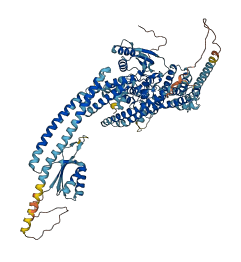
Descriptions
The autoinhibited protein was predicted that may have potential autoinhibitory elements via cis-regPred.
Autoinhibitory domains (AIDs)
Target domain |
|
Relief mechanism |
|
Assay |
cis-regPred |
Accessory elements
No accessory elements
Autoinhibited structure

Activated structure
1 structures for P30628
| Entry ID | Method | Resolution | Chain | Position | Source |
|---|---|---|---|---|---|
| AF-P30628-F1 | Predicted | AlphaFoldDB |
No variants for P30628
| Variant ID(s) | Position | Change | Description | Diseaes Association | Provenance |
|---|---|---|---|---|---|
| No variants for P30628 | |||||
No associated diseases with P30628
2 regional properties for P30628
| Type | Name | Position | InterPro Accession |
|---|---|---|---|
| repeat | Mitochondrial substrate/solute carrier | 42 - 195 | IPR018108-1 |
| repeat | Mitochondrial substrate/solute carrier | 318 - 419 | IPR018108-2 |
5 GO annotations of cellular component
| Name | Definition |
|---|---|
| integral component of membrane | The component of a membrane consisting of the gene products and protein complexes having at least some part of their peptide sequence embedded in the hydrophobic region of the membrane. |
| plasma membrane | The membrane surrounding a cell that separates the cell from its external environment. It consists of a phospholipid bilayer and associated proteins. |
| synapse | The junction between an axon of one neuron and a dendrite of another neuron, a muscle fiber or a glial cell. As the axon approaches the synapse it enlarges into a specialized structure, the presynaptic terminal bouton, which contains mitochondria and synaptic vesicles. At the tip of the terminal bouton is the presynaptic membrane; facing it, and separated from it by a minute cleft (the synaptic cleft) is a specialized area of membrane on the receiving cell, known as the postsynaptic membrane. In response to the arrival of nerve impulses, the presynaptic terminal bouton secretes molecules of neurotransmitters into the synaptic cleft. These diffuse across the cleft and transmit the signal to the postsynaptic membrane. |
| vacuolar proton-transporting V-type ATPase complex | A proton-transporting two-sector ATPase complex found in the vacuolar membrane, where it acts as a proton pump to mediate acidification of the vacuolar lumen. |
| vacuolar proton-transporting V-type ATPase, V0 domain | The V0 domain of a proton-transporting V-type ATPase found in the vacuolar membrane. |
2 GO annotations of molecular function
| Name | Definition |
|---|---|
| ATPase binding | Binding to an ATPase, any enzyme that catalyzes the hydrolysis of ATP. |
| proton-transporting ATPase activity, rotational mechanism | Enables the transfer of protons from one side of a membrane to the other according to the reaction: ATP + H2O + H+(in) = ADP + phosphate + H+(out), by a rotational mechanism. |
11 GO annotations of biological process
| Name | Definition |
|---|---|
| defense response to Gram-positive bacterium | Reactions triggered in response to the presence of a Gram-positive bacterium that act to protect the cell or organism. |
| embryo development ending in birth or egg hatching | The process whose specific outcome is the progression of an embryo over time, from zygote formation until the end of the embryonic life stage. The end of the embryonic life stage is organism-specific and may be somewhat arbitrary; for mammals it is usually considered to be birth, for insects the hatching of the first instar larva from the eggshell. |
| locomotion | Self-propelled movement of a cell or organism from one location to another. |
| negative regulation of locomotion | Any process that stops, prevents, or reduces the frequency, rate or extent of locomotion of a cell or organism. |
| nematode larval development | The process whose specific outcome is the progression of the nematode larva over time, from its formation to the mature structure. Nematode larval development begins with the newly hatched first-stage larva (L1) and ends with the end of the last larval stage (for example the fourth larval stage (L4) in C. elegans). Each stage of nematode larval development is characterized by proliferation of specific cell lineages and an increase in body size without alteration of the basic body plan. Nematode larval stages are separated by molts in which each stage-specific exoskeleton, or cuticle, is shed and replaced anew. |
| positive regulation of neurotransmitter secretion | Any process that activates or increases the frequency, rate or extent of the regulated release of a neurotransmitter. |
| positive regulation of programmed cell death | Any process that activates or increases the frequency, rate or extent of programmed cell death, cell death resulting from activation of endogenous cellular processes. |
| proton motive force-driven ATP synthesis | The transport of protons across a membrane to generate an electrochemical gradient (proton-motive force) that powers ATP synthesis. |
| response to hypoxia | Any process that results in a change in state or activity of a cell or an organism (in terms of movement, secretion, enzyme production, gene expression, etc.) as a result of a stimulus indicating lowered oxygen tension. Hypoxia, defined as a decline in O2 levels below normoxic levels of 20.8 - 20.95%, results in metabolic adaptation at both the cellular and organismal level. |
| synaptic transmission, cholinergic | The vesicular release of acetylcholine from a presynapse, across a chemical synapse, the subsequent activation of dopamine receptors at the postsynapse of a target cell (neuron, muscle, or secretory cell) and the effects of this activation on the postsynaptic membrane potential and ionic composition of the postsynaptic cytosol. This process encompasses both spontaneous and evoked release of neurotransmitter and all parts of synaptic vesicle exocytosis. Evoked transmission starts with the arrival of an action potential at the presynapse. |
| vacuolar acidification | Any process that reduces the pH of the vacuole, measured by the concentration of the hydrogen ion. |
16 homologous proteins in AiPD
| UniProt AC | Gene Name | Protein Name | Species | Evidence Code |
|---|---|---|---|---|
| P32563 | VPH1 | V-type proton ATPase subunit a, vacuolar isoform | Saccharomyces cerevisiae (strain ATCC 204508 / S288c) (Baker's yeast) | PR |
| O97681 | ATP6V0A2 | V-type proton ATPase 116 kDa subunit a 2 | Bos taurus (Bovine) | PR |
| Q29466 | ATP6V0A1 | V-type proton ATPase 116 kDa subunit a 1 | Bos taurus (Bovine) | PR |
| Q9I8D0 | ATP6V0A1 | V-type proton ATPase 116 kDa subunit a 1 | Gallus gallus (Chicken) | PR |
| Q9Y487 | ATP6V0A2 | V-type proton ATPase 116 kDa subunit a 2 | Homo sapiens (Human) | PR |
| Q13488 | TCIRG1 | V-type proton ATPase 116 kDa subunit a 3 | Homo sapiens (Human) | PR |
| Q9HBG4 | ATP6V0A4 | V-type proton ATPase 116 kDa subunit a 4 | Homo sapiens (Human) | PR |
| Q93050 | ATP6V0A1 | V-type proton ATPase 116 kDa subunit a 1 | Homo sapiens (Human) | PR |
| P15920 | Atp6v0a2 | V-type proton ATPase 116 kDa subunit a 2 | Mus musculus (Mouse) | PR |
| Q920R6 | Atp6v0a4 | V-type proton ATPase 116 kDa subunit a 4 | Mus musculus (Mouse) | PR |
| Q9Z1G4 | Atp6v0a1 | V-type proton ATPase 116 kDa subunit a 1 | Mus musculus (Mouse) | PR |
| P25286 | Atp6v0a1 | V-type proton ATPase 116 kDa subunit a 1 | Rattus norvegicus (Rat) | PR |
| Q8W4S4 | VHA-a3 | V-type proton ATPase subunit a3 | Arabidopsis thaliana (Mouse-ear cress) | PR |
| Q9SJT7 | VHA-a2 | V-type proton ATPase subunit a2 | Arabidopsis thaliana (Mouse-ear cress) | PR |
| Q8RWZ7 | VHA-a1 | V-type proton ATPase subunit a1 | Arabidopsis thaliana (Mouse-ear cress) | PR |
| A1A5G6 | atp6v0a1 | V-type proton ATPase 116 kDa subunit a 1 | Xenopus tropicalis (Western clawed frog) (Silurana tropicalis) | PR |
| 10 | 20 | 30 | 40 | 50 | 60 |
| MGDYVTPGEE | PPQPGIYRSE | QMCLAQLYLQ | SDASYQCVAE | LGELGLVQFR | DLNPDVSSFQ |
| 70 | 80 | 90 | 100 | 110 | 120 |
| RKYVNEVRRC | DEMERKLRYL | EREIKKDQIP | MLDTGENPDA | PLPREMIDLE | ATFEKLENEL |
| 130 | 140 | 150 | 160 | 170 | 180 |
| REVNKNEETL | KKNFSELTEL | KHILRKTQTF | FEEVDHDRWR | ILEGGSGRRG | RSTEREETRP |
| 190 | 200 | 210 | 220 | 230 | 240 |
| LIDIGDMDDD | SAARMSAQAA | MLRLGFVAGV | IQRERLPAFE | RLLWRACRGN | VFLRTSEIDD |
| 250 | 260 | 270 | 280 | 290 | 300 |
| VLNDTVTGDP | VNKCVFIIFF | QGDHLKTKVK | KICEGFRATL | YPCPDTPQER | REMSIGVMTR |
| 310 | 320 | 330 | 340 | 350 | 360 |
| IEDLKTVLGQ | TQDHRHRVLV | AASKNVRMWL | TKVRKIKSIY | HTLNLFNIDV | TQKCLIAEVW |
| 370 | 380 | 390 | 400 | 410 | 420 |
| CPIAELDRIK | MALKRGTDES | GSQVPSILNR | METNEAPPTY | NKTNKFTKGF | QNIVDAYGIA |
| 430 | 440 | 450 | 460 | 470 | 480 |
| TYREINPAPY | TMISFPFLFA | VMFGDMGHGA | IMLLAALFFI | LKEKQLEAAR | IKDEIFQTFF |
| 490 | 500 | 510 | 520 | 530 | 540 |
| GGRYVIFLMG | AFSIYTGFMY | NDVFSKSINT | FGSSWQNTIP | ESVIDYYLDD | EKRSESQLIL |
| 550 | 560 | 570 | 580 | 590 | 600 |
| PPETAFDGNP | YPIGVDPVWN | LAEGNKLSFL | NSMKMKMSVL | FGIAQMTFGV | LLSYQNFIYF |
| 610 | 620 | 630 | 640 | 650 | 660 |
| KSDLDIKYMF | IPQMIFLSSI | FIYLCIQILS | KWLFFGAVGG | TVLGYKYPGS | NCAPSLLIGL |
| 670 | 680 | 690 | 700 | 710 | 720 |
| INMFMMKSRN | AGFVDDSGET | YPQCYLSTWY | PGQATIEIIL | VVLALVQVPI | MLFAKPYFLY |
| 730 | 740 | 750 | 760 | 770 | 780 |
| RRDKQQSRYS | TLTAESNQHQ | SVRADINQDD | AEVVHAPEQT | PKPSGHGHGH | GDGPLEMGDV |
| 790 | 800 | 810 | 820 | 830 | 840 |
| MVYQAIHTIE | FVLGCVSHTA | SYLRLWALSL | AHAQLSDVLW | TMVFRNAFVL | DGYTGAIATY |
| 850 | 860 | 870 | 880 | 890 | 900 |
| ILFFIFGSLS | VFILVLMEGL | SAFLHALRLH | WVEFQSKFYG | GLGYEFAPFS | FEKILAEERE |
| AEENL |