P20152
Gene name |
Vim |
Protein name |
Vimentin |
Names |
|
Species |
Mus musculus (Mouse) |
KEGG Pathway |
mmu:22352 |
EC number |
|
Protein Class |
|
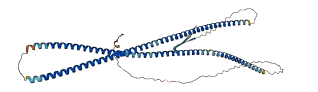
Descriptions
The autoinhibited protein was predicted that may have potential autoinhibitory elements via cis-regPred.
Autoinhibitory domains (AIDs)
Target domain |
|
Relief mechanism |
|
Assay |
cis-regPred |
Accessory elements
No accessory elements
Autoinhibited structure

Activated structure
1 structures for P20152
| Entry ID | Method | Resolution | Chain | Position | Source |
|---|---|---|---|---|---|
| AF-P20152-F1 | Predicted | AlphaFoldDB |
11 variants for P20152
| Variant ID(s) | Position | Change | Description | Diseaes Association | Provenance |
|---|---|---|---|---|---|
| rs3388531294 | 31 | V>E | No | EVA | |
| rs3388532083 | 53 | Y>C | No | EVA | |
| rs3388531285 | 100 | R>C | No | EVA | |
| rs3388531554 | 140 | G>V | No | EVA | |
| rs3388527679 | 194 | L>F | No | EVA | |
| rs3388526567 | 270 | R>C | No | EVA | |
| rs3391149887 | 335 | G>GTVSTEHGISPPLLL*YSQCL* | No | EVA | |
| rs3388531244 | 367 | D>V | No | EVA | |
| rs3388531173 | 375 | E>D | No | EVA | |
| rs3388531167 | 400 | Y>F | No | EVA | |
| rs3388529006 | 410 | R>W | No | EVA |
No associated diseases with P20152
6 regional properties for P20152
| Type | Name | Position | InterPro Accession |
|---|---|---|---|
| domain | Coagulation factor 5/8 C-terminal domain | 272 - 422 | IPR000421-1 |
| domain | Coagulation factor 5/8 C-terminal domain | 428 - 581 | IPR000421-2 |
| domain | CUB domain | 25 - 139 | IPR000859-1 |
| domain | CUB domain | 145 - 263 | IPR000859-2 |
| domain | MAM domain | 636 - 801 | IPR000998 |
| domain | Neuropilin, C-terminal | 836 - 914 | IPR022579 |
18 GO annotations of cellular component
| Name | Definition |
|---|---|
| axon | The long process of a neuron that conducts nerve impulses, usually away from the cell body to the terminals and varicosities, which are sites of storage and release of neurotransmitter. |
| cell body | The portion of a cell bearing surface projections such as axons, dendrites, cilia, or flagella that includes the nucleus, but excludes all cell projections. |
| cell leading edge | The area of a motile cell closest to the direction of movement. |
| cell projection | A prolongation or process extending from a cell, e.g. a flagellum or axon. |
| cytoplasm | The contents of a cell excluding the plasma membrane and nucleus, but including other subcellular structures. |
| cytoskeleton | A cellular structure that forms the internal framework of eukaryotic and prokaryotic cells. The cytoskeleton includes intermediate filaments, microfilaments, microtubules, the microtrabecular lattice, and other structures characterized by a polymeric filamentous nature and long-range order within the cell. The various elements of the cytoskeleton not only serve in the maintenance of cellular shape but also have roles in other cellular functions, including cellular movement, cell division, endocytosis, and movement of organelles. |
| cytosol | The part of the cytoplasm that does not contain organelles but which does contain other particulate matter, such as protein complexes. |
| intermediate filament | A cytoskeletal structure that forms a distinct elongated structure, characteristically 10 nm in diameter, that occurs in the cytoplasm of eukaryotic cells. Intermediate filaments form a fibrous system, composed of chemically heterogeneous subunits and involved in mechanically integrating the various components of the cytoplasmic space. Intermediate filaments may be divided into five chemically distinct classes: Type I, acidic keratins; Type II, basic keratins; Type III, including desmin, vimentin and others; Type IV, neurofilaments and related filaments; and Type V, lamins. |
| intermediate filament cytoskeleton | Cytoskeletal structure made from intermediate filaments, typically organized in the cytosol as an extended system that stretches from the nuclear envelope to the plasma membrane. Some intermediate filaments run parallel to the cell surface, while others traverse the cytosol; together they form an internal framework that helps support the shape and resilience of the cell. |
| neuron projection | A prolongation or process extending from a nerve cell, e.g. an axon or dendrite. |
| nuclear matrix | The dense fibrillar network lying on the inner side of the nuclear membrane. |
| perinuclear region of cytoplasm | Cytoplasm situated near, or occurring around, the nucleus. |
| peroxisome | A small organelle enclosed by a single membrane, and found in most eukaryotic cells. Contains peroxidases and other enzymes involved in a variety of metabolic processes including free radical detoxification, lipid catabolism and biosynthesis, and hydrogen peroxide metabolism. |
| phagocytic vesicle | A membrane-bounded intracellular vesicle that arises from the ingestion of particulate material by phagocytosis. |
| plasma membrane | The membrane surrounding a cell that separates the cell from its external environment. It consists of a phospholipid bilayer and associated proteins. |
| polysome | A multiribosomal structure representing a linear array of ribosomes held together by messenger RNA. They represent the active complexes in cellular protein synthesis and are able to incorporate amino acids into polypeptides both in vivo and in vitro. |
| ribonucleoprotein complex | A macromolecular complex that contains both RNA and protein molecules. |
| type III intermediate filament | A type of intermediate filament, typically made up of one or more of the proteins vimentin, desmin, glial fibrillary acidic protein (GFAP), and peripherin. Unlike the keratins, the type III proteins can form both homo- and heteropolymeric IF filaments. |
11 GO annotations of molecular function
| Name | Definition |
|---|---|
| double-stranded RNA binding | Binding to double-stranded RNA. |
| identical protein binding | Binding to an identical protein or proteins. |
| keratin filament binding | Binding to a keratin filament, an intermediate filament composed of acidic and basic keratins (types I and II), typically expressed in epithelial cells. |
| kinase binding | Binding to a kinase, any enzyme that catalyzes the transfer of a phosphate group. |
| protein domain specific binding | Binding to a specific domain of a protein. |
| protein phosphatase 2A binding | Binding to protein phosphatase 2A. |
| protein tyrosine kinase binding | Binding to protein tyrosine kinase. |
| RNA binding | Binding to an RNA molecule or a portion thereof. |
| scaffold protein binding | Binding to a scaffold protein. Scaffold proteins are crucial regulators of many key signaling pathways. Although not strictly defined in function, they are known to interact and/or bind with multiple members of a signaling pathway, tethering them into complexes. |
| structural constituent of cytoskeleton | The action of a molecule that contributes to the structural integrity of a cytoskeletal structure. |
| structural constituent of eye lens | The action of a molecule that contributes to the structural integrity of the lens of an eye. |
18 GO annotations of biological process
| Name | Definition |
|---|---|
| astrocyte development | The process aimed at the progression of an astrocyte over time, from initial commitment of the cell to a specific fate, to the fully functional differentiated cell. An astrocyte is the most abundant type of glial cell. Astrocytes provide support for neurons and regulate the environment in which they function. |
| Bergmann glial cell differentiation | The process in which neuroepithelial cells of the neural tube give rise to Brgmann glial cells, specialized bipotential progenitors cells of the cerebellum. Differentiation includes the processes involved in commitment of a cell to a specific fate. |
| cellular response to interferon-gamma | Any process that results in a change in state or activity of a cell (in terms of movement, secretion, enzyme production, gene expression, etc.) as a result of an interferon-gamma stimulus. Interferon gamma is the only member of the type II interferon found so far. |
| cellular response to lipopolysaccharide | Any process that results in a change in state or activity of a cell (in terms of movement, secretion, enzyme production, gene expression, etc.) as a result of a lipopolysaccharide stimulus; lipopolysaccharide is a major component of the cell wall of gram-negative bacteria. |
| cellular response to muramyl dipeptide | Any process that results in a change in state or activity of a cell (in terms of movement, secretion, enzyme production, gene expression, etc.) as a result of a muramyl dipeptide stimulus. Muramyl dipeptide is derived from peptidoglycan. |
| intermediate filament organization | Control of the spatial distribution of intermediate filaments; includes organizing filaments into meshworks, bundles, or other structures, as by cross-linking. |
| intermediate filament-based process | Any cellular process that depends upon or alters the intermediate filament cytoskeleton, that part of the cytoskeleton comprising intermediate filaments and their associated proteins. |
| lens fiber cell development | The process whose specific outcome is the progression of a lens fiber cell over time, from its formation to the mature structure. Cell development does not include the steps involved in committing a cell to a lens fiber cell fate. A lens fiber cell is any of the elongated, tightly packed cells that make up the bulk of the mature lens in a camera-type eye. |
| negative regulation of neuron projection development | Any process that decreases the rate, frequency or extent of neuron projection development. Neuron projection development is the process whose specific outcome is the progression of a neuron projection over time, from its formation to the mature structure. A neuron projection is any process extending from a neural cell, such as axons or dendrites (collectively called neurites). |
| neuron projection development | The process whose specific outcome is the progression of a neuron projection over time, from its formation to the mature structure. A neuron projection is any process extending from a neural cell, such as axons or dendrites (collectively called neurites). |
| positive regulation of collagen biosynthetic process | Any process that activates or increases the frequency, rate or extent of the chemical reactions and pathways resulting in the formation of collagen, any of a group of fibrous proteins of very high tensile strength that form the main component of connective tissue in animals. |
| positive regulation of gene expression | Any process that increases the frequency, rate or extent of gene expression. Gene expression is the process in which a gene's coding sequence is converted into a mature gene product (protein or RNA). |
| positive regulation of glial cell proliferation | Any process that activates or increases the rate or extent of glial cell proliferation. |
| positive regulation of translation | Any process that activates or increases the frequency, rate or extent of the chemical reactions and pathways resulting in the formation of proteins by the translation of mRNA or circRNA. |
| regulation of axonogenesis | Any process that modulates the frequency, rate or extent of axonogenesis, the generation of an axon, the long process of a neuron. |
| regulation of mRNA stability | Any process that modulates the propensity of mRNA molecules to degradation. Includes processes that both stabilize and destabilize mRNAs. |
| regulation of Schwann cell migration | Any process that modulates the frequency, rate or extent of Schwann cell migration. |
| SMAD protein signal transduction | The cascade of processes by which a signal interacts with a receptor, causing a change in the activity of a SMAD protein, and ultimately effecting a change in the functioning of the cell. |
13 homologous proteins in AiPD
| UniProt AC | Gene Name | Protein Name | Species | Evidence Code |
|---|---|---|---|---|
| P02545 | LMNA | Prelamin-A/C | Homo sapiens (Human) | PR |
| P08670 | VIM | Vimentin | Homo sapiens (Human) | PR |
| P17661 | DES | Desmin | Homo sapiens (Human) | PR |
| P41219 | PRPH | Peripherin | Homo sapiens (Human) | PR |
| P14733 | Lmnb1 | Lamin-B1 | Mus musculus (Mouse) | PR |
| P48678 | Lmna | Prelamin-A/C | Mus musculus (Mouse) | PR |
| P21619 | Lmnb2 | Lamin-B2 | Mus musculus (Mouse) | PR |
| P31001 | Des | Desmin | Mus musculus (Mouse) | PR |
| P03995 | Gfap | Glial fibrillary acidic protein | Mus musculus (Mouse) | PR |
| P15331 | Prph | Peripherin | Mus musculus (Mouse) | PR |
| P70615 | Lmnb1 | Lamin-B1 | Rattus norvegicus (Rat) | PR |
| P48679 | Lmna | Prelamin-A/C | Rattus norvegicus (Rat) | PR |
| Q21065 | ifa-3 | Intermediate filament protein ifa-3 | Caenorhabditis elegans | PR |
| 10 | 20 | 30 | 40 | 50 | 60 |
| MSTRSVSSSS | YRRMFGGSGT | SSRPSSNRSY | VTTSTRTYSL | GSALRPSTSR | SLYSSSPGGA |
| 70 | 80 | 90 | 100 | 110 | 120 |
| YVTRSSAVRL | RSSVPGVRLL | QDSVDFSLAD | AINTEFKNTR | TNEKVELQEL | NDRFANYIDK |
| 130 | 140 | 150 | 160 | 170 | 180 |
| VRFLEQQNKI | LLAELEQLKG | QGKSRLGDLY | EEEMRELRRQ | VDQLTNDKAR | VEVERDNLAE |
| 190 | 200 | 210 | 220 | 230 | 240 |
| DIMRLREKLQ | EEMLQREEAE | STLQSFRQDV | DNASLARLDL | ERKVESLQEE | IAFLKKLHDE |
| 250 | 260 | 270 | 280 | 290 | 300 |
| EIQELQAQIQ | EQHVQIDVDV | SKPDLTAALR | DVRQQYESVA | AKNLQEAEEW | YKSKFADLSE |
| 310 | 320 | 330 | 340 | 350 | 360 |
| AANRNNDALR | QAKQESNEYR | RQVQSLTCEV | DALKGTNESL | ERQMREMEEN | FALEAANYQD |
| 370 | 380 | 390 | 400 | 410 | 420 |
| TIGRLQDEIQ | NMKEEMARHL | REYQDLLNVK | MALDIEIATY | RKLLEGEESR | ISLPLPTFSS |
| 430 | 440 | 450 | 460 | ||
| LNLRETNLES | LPLVDTHSKR | TLLIKTVETR | DGQVINETSQ | HHDDLE |