Q21065
Gene name |
ifa-3 (F52E10.5) |
Protein name |
Intermediate filament protein ifa-3 |
Names |
Cel IF A3, Intermediate filament protein A3, IF-A3 |
Species |
Caenorhabditis elegans |
KEGG Pathway |
cel:CELE_F52E10.5 |
EC number |
|
Protein Class |
|
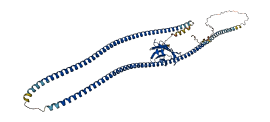
Descriptions
The autoinhibited protein was predicted that may have potential autoinhibitory elements via cis-regPred.
Autoinhibitory domains (AIDs)
Target domain |
|
Relief mechanism |
|
Assay |
cis-regPred |
Accessory elements
No accessory elements
Autoinhibited structure

Activated structure
1 structures for Q21065
| Entry ID | Method | Resolution | Chain | Position | Source |
|---|---|---|---|---|---|
| AF-Q21065-F1 | Predicted | AlphaFoldDB |
No variants for Q21065
| Variant ID(s) | Position | Change | Description | Diseaes Association | Provenance |
|---|---|---|---|---|---|
| No variants for Q21065 | |||||
No associated diseases with Q21065
4 GO annotations of cellular component
| Name | Definition |
|---|---|
| cytoplasm | The contents of a cell excluding the plasma membrane and nucleus, but including other subcellular structures. |
| intermediate filament | A cytoskeletal structure that forms a distinct elongated structure, characteristically 10 nm in diameter, that occurs in the cytoplasm of eukaryotic cells. Intermediate filaments form a fibrous system, composed of chemically heterogeneous subunits and involved in mechanically integrating the various components of the cytoplasmic space. Intermediate filaments may be divided into five chemically distinct classes: Type I, acidic keratins; Type II, basic keratins; Type III, including desmin, vimentin and others; Type IV, neurofilaments and related filaments; and Type V, lamins. |
| nuclear envelope | The double lipid bilayer enclosing the nucleus and separating its contents from the rest of the cytoplasm; includes the intermembrane space, a gap of width 20-40 nm (also called the perinuclear space). |
| nuclear lamina | The fibrous, electron-dense layer lying on the nucleoplasmic side of the inner membrane of a cell nucleus, composed of lamin filaments. The polypeptides of the lamina are thought to be concerned in the dissolution of the nuclear envelope and its re-formation during mitosis. The lamina is composed of lamin A and lamin C filaments cross-linked into an orthogonal lattice, which is attached via lamin B to the inner nuclear membrane through interactions with a lamin B receptor, an IFAP, in the membrane. |
1 GO annotations of molecular function
| Name | Definition |
|---|---|
| structural constituent of cytoskeleton | The action of a molecule that contributes to the structural integrity of a cytoskeletal structure. |
5 GO annotations of biological process
| Name | Definition |
|---|---|
| heterochromatin assembly | An epigenetic gene silencing mechanism in which chromatin is compacted into heterochromatin, resulting in a chromatin conformation refractory to transcription. This process starts with heterochromatin nucleation, its spreading, and ends with heterochromatin boundary formation. |
| nuclear envelope organization | A process that is carried out at the cellular level which results in the assembly, arrangement of constituent parts, or disassembly of the nuclear envelope. |
| nuclear migration | The directed movement of the nucleus to a specific location within a cell. |
| nuclear pore localization | Any process in which nuclear pores are transported to, or maintained in, a specific location. |
| protein localization to nuclear envelope | A process in which a protein is transported to, or maintained at, a location within a nuclear envelope. |
12 homologous proteins in AiPD
| UniProt AC | Gene Name | Protein Name | Species | Evidence Code |
|---|---|---|---|---|
| P17661 | DES | Desmin | Homo sapiens (Human) | PR |
| P08670 | VIM | Vimentin | Homo sapiens (Human) | PR |
| P02545 | LMNA | Prelamin-A/C | Homo sapiens (Human) | PR |
| P31001 | Des | Desmin | Mus musculus (Mouse) | PR |
| P20152 | Vim | Vimentin | Mus musculus (Mouse) | PR |
| P14733 | Lmnb1 | Lamin-B1 | Mus musculus (Mouse) | PR |
| P21619 | Lmnb2 | Lamin-B2 | Mus musculus (Mouse) | PR |
| P48678 | Lmna | Prelamin-A/C | Mus musculus (Mouse) | PR |
| P47819 | Gfap | Glial fibrillary acidic protein | Rattus norvegicus (Rat) | PR |
| P70615 | Lmnb1 | Lamin-B1 | Rattus norvegicus (Rat) | PR |
| P48679 | Lmna | Prelamin-A/C | Rattus norvegicus (Rat) | PR |
| P21807 | Prph | Peripherin | Rattus norvegicus (Rat) | PR |
| 10 | 20 | 30 | 40 | 50 | 60 |
| MADPDSYRSS | ITSRPAFNRT | VTSSTQNYGT | PASGNRVLKI | VTETHTSSVA | SGLSPYGQGA |
| 70 | 80 | 90 | 100 | 110 | 120 |
| ASTIRDDRER | EKKEITELND | RLASYIGKVR | FLAAQNRKLE | ADLNVLQSRF | GKSTGSVKIM |
| 130 | 140 | 150 | 160 | 170 | 180 |
| YEMEITTATN | VVKETGKDHE | EAEKEIGKIK | DQLDELRKKF | EEAQKGRAED | RLKIDELLVT |
| 190 | 200 | 210 | 220 | 230 | 240 |
| LSNLEAEINL | LKRRIALLEE | EVARLKKENF | RLTSELQRVR | SELDQETLLR | IDNQNKVTTI |
| 250 | 260 | 270 | 280 | 290 | 300 |
| LEEIDFMKRG | FETELKDLQA | QAARDTTSEN | REYFKNELMN | SIRDIRAEYD | RFMAGNRNDL |
| 310 | 320 | 330 | 340 | 350 | 360 |
| ESWSQIRVQE | INTQTNRQNA | EINHKRDEVK | RLHSQVSELK | SKHAELAARN | GLLEKQLEDL |
| 370 | 380 | 390 | 400 | 410 | 420 |
| NYQLEDDQRS | YEAALNDKDA | QVRKLREECQ | ALLVELQMLL | DTKQTLDGEL | KVYRRMLEGN |
| 430 | 440 | 450 | 460 | 470 | 480 |
| SEENGLRQLV | EKVVRTSAIN | EEVDTETMRV | VKGEHSSRTS | YQRSAKGNVS | IKEVSPEGKF |
| 490 | 500 | 510 | 520 | 530 | 540 |
| VILENTHRDK | EEPLGDWKLK | RKIDGKREIV | FTFPSDYILH | PVQTVKIFAR | GNGVANPPEV |
| 550 | 560 | 570 | 580 | ||
| LVFEGDDTFG | AGANVQTILY | NNSGEERATH | MQRQSQQTTT | S |