P48678
Gene name |
Lmna (Lmn1) |
Protein name |
Prelamin-A/C |
Names |
|
Species |
Mus musculus (Mouse) |
KEGG Pathway |
mmu:16905 |
EC number |
|
Protein Class |
|
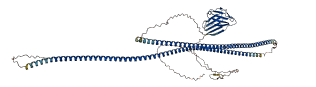
Descriptions
The autoinhibited protein was predicted that may have potential autoinhibitory elements via cis-regPred.
Autoinhibitory domains (AIDs)
Target domain |
|
Relief mechanism |
|
Assay |
cis-regPred |
Accessory elements
No accessory elements
Autoinhibited structure

Activated structure
2 structures for P48678
| Entry ID | Method | Resolution | Chain | Position | Source |
|---|---|---|---|---|---|
| 1UFG | NMR | - | A | 408-545 | PDB |
| AF-P48678-F1 | Predicted | AlphaFoldDB |
25 variants for P48678
| Variant ID(s) | Position | Change | Description | Diseaes Association | Provenance |
|---|---|---|---|---|---|
| rs3388640120 | 7 | R>W | No | EVA | |
| rs3388621889 | 124 | E>* | No | EVA | |
| rs3388633838 | 150 | T>I | No | EVA | |
| rs3388632392 | 236 | E>K | No | EVA | |
| rs3388633815 | 258 | Q>E | No | EVA | |
| rs13475278 | 299 | I>F | No | EVA | |
| rs3388643759 | 307 | S>I | No | EVA | |
| rs3388630046 | 315 | A>V | No | EVA | |
| rs3388629325 | 321 | R>C | No | EVA | |
| rs3388637744 | 339 | A>P | No | EVA | |
| rs3388639873 | 386 | R>T | No | EVA | |
| rs3388640457 | 406 | S>T | No | EVA | |
| rs3388637842 | 415 | V>F | No | EVA | |
| rs3388639938 | 418 | K>R | No | EVA | |
| rs3388629316 | 458 | S>Y | No | EVA | |
| rs32892174 | 475 | D>E | No | EVA | |
| rs3388629314 | 498 | W>C | No | EVA | |
| rs3388637360 | 513 | V>E | No | EVA | |
| rs3388629329 | 532 | N>K | No | EVA | |
| rs3388637800 | 588 | V>L | No | EVA | |
| rs3388643161 | 626 | S>R | No | EVA | |
| rs3388621855 | 629 | S>N | No | EVA | |
| rs3388629362 | 631 | G>R | No | EVA | |
| rs3388637900 | 634 | G>W | No | EVA | |
| rs3388640449 | 666 | M>K | No | EVA |
No associated diseases with P48678
6 regional properties for P48678
| Type | Name | Position | InterPro Accession |
|---|---|---|---|
| domain | Coagulation factor 5/8 C-terminal domain | 274 - 424 | IPR000421-1 |
| domain | Coagulation factor 5/8 C-terminal domain | 430 - 583 | IPR000421-2 |
| domain | CUB domain | 27 - 141 | IPR000859-1 |
| domain | CUB domain | 147 - 265 | IPR000859-2 |
| domain | MAM domain | 645 - 811 | IPR000998 |
| domain | Neuropilin, C-terminal | 845 - 923 | IPR022579 |
Functions
10 GO annotations of cellular component
| Name | Definition |
|---|---|
| lamin filament | Any of a group of intermediate-filament proteins that form the fibrous matrix on the inner surface of the nuclear envelope. They are classified as lamins A, B and C. |
| nuclear envelope | The double lipid bilayer enclosing the nucleus and separating its contents from the rest of the cytoplasm; includes the intermembrane space, a gap of width 20-40 nm (also called the perinuclear space). |
| nuclear lamina | The fibrous, electron-dense layer lying on the nucleoplasmic side of the inner membrane of a cell nucleus, composed of lamin filaments. The polypeptides of the lamina are thought to be concerned in the dissolution of the nuclear envelope and its re-formation during mitosis. The lamina is composed of lamin A and lamin C filaments cross-linked into an orthogonal lattice, which is attached via lamin B to the inner nuclear membrane through interactions with a lamin B receptor, an IFAP, in the membrane. |
| nuclear matrix | The dense fibrillar network lying on the inner side of the nuclear membrane. |
| nuclear membrane | Either of the lipid bilayers that surround the nucleus and form the nuclear envelope; excludes the intermembrane space. |
| nuclear speck | A discrete extra-nucleolar subnuclear domain, 20-50 in number, in which splicing factors are seen to be localized by immunofluorescence microscopy. |
| nucleoplasm | That part of the nuclear content other than the chromosomes or the nucleolus. |
| nucleus | A membrane-bounded organelle of eukaryotic cells in which chromosomes are housed and replicated. In most cells, the nucleus contains all of the cell's chromosomes except the organellar chromosomes, and is the site of RNA synthesis and processing. In some species, or in specialized cell types, RNA metabolism or DNA replication may be absent. |
| perinuclear region of cytoplasm | Cytoplasm situated near, or occurring around, the nucleus. |
| site of double-strand break | A region of a chromosome at which a DNA double-strand break has occurred. DNA damage signaling and repair proteins accumulate at the lesion to respond to the damage and repair the DNA to form a continuous DNA helix. |
3 GO annotations of molecular function
| Name | Definition |
|---|---|
| identical protein binding | Binding to an identical protein or proteins. |
| protein phosphatase 1 binding | Binding to a protein phosphatase 1. |
| structural constituent of cytoskeleton | The action of a molecule that contributes to the structural integrity of a cytoskeletal structure. |
29 GO annotations of biological process
| Name | Definition |
|---|---|
| cellular response to hypoxia | Any process that results in a change in state or activity of a cell (in terms of movement, secretion, enzyme production, gene expression, etc.) as a result of a stimulus indicating lowered oxygen tension. Hypoxia, defined as a decline in O2 levels below normoxic levels of 20.8 - 20.95%, results in metabolic adaptation at both the cellular and organismal level. |
| cellular senescence | A cell aging process stimulated in response to cellular stress, whereby normal cells lose the ability to divide through irreversible cell cycle arrest. |
| DNA double-strand break attachment to nuclear envelope | A process in which the DNA double-strand breaks are attached to the inner surface of the nuclear envelope proximal to the spindle pole body, or iMTOCs. |
| establishment of cell polarity | The specification and formation of anisotropic intracellular organization or cell growth patterns. |
| establishment or maintenance of microtubule cytoskeleton polarity | Any cellular process that results in the specification, formation or maintenance of polarized microtubule-based cytoskeletal structures. |
| heterochromatin assembly | An epigenetic gene silencing mechanism in which chromatin is compacted into heterochromatin, resulting in a chromatin conformation refractory to transcription. This process starts with heterochromatin nucleation, its spreading, and ends with heterochromatin boundary formation. |
| muscle organ development | The process whose specific outcome is the progression of the muscle over time, from its formation to the mature structure. The muscle is an organ consisting of a tissue made up of various elongated cells that are specialized to contract and thus to produce movement and mechanical work. |
| negative regulation of adipose tissue development | Any process that stops, prevents or reduces the frequency, rate or extent of adipose tissue development. |
| negative regulation of cardiac muscle hypertrophy in response to stress | Any process that stops, prevents or reduces the frequency, rate or extent of cardiac muscle hypertrophy in response to stress. |
| negative regulation of cell population proliferation | Any process that stops, prevents or reduces the rate or extent of cell proliferation. |
| negative regulation of extrinsic apoptotic signaling pathway | Any process that stops, prevents or reduces the frequency, rate or extent of extrinsic apoptotic signaling pathway. |
| negative regulation of mesenchymal cell proliferation | Any process that decreases the frequency, rate or extent of mesenchymal cell proliferation. A mesenchymal cell is a cell that normally gives rise to other cells that are organized as three-dimensional masses, rather than sheets. |
| negative regulation of release of cytochrome c from mitochondria | Any process that decreases the rate, frequency or extent of release of cytochrome c from mitochondria, the process in which cytochrome c is enabled to move from the mitochondrial intermembrane space into the cytosol, which is an early step in apoptosis and leads to caspase activation. |
| nuclear envelope organization | A process that is carried out at the cellular level which results in the assembly, arrangement of constituent parts, or disassembly of the nuclear envelope. |
| nuclear migration | The directed movement of the nucleus to a specific location within a cell. |
| nuclear pore localization | Any process in which nuclear pores are transported to, or maintained in, a specific location. |
| nucleus organization | A process that is carried out at the cellular level which results in the assembly, arrangement of constituent parts, or disassembly of the nucleus. |
| positive regulation of gene expression | Any process that increases the frequency, rate or extent of gene expression. Gene expression is the process in which a gene's coding sequence is converted into a mature gene product (protein or RNA). |
| positive regulation of histone H3-K9 trimethylation | Any process that activates or increases the frequency, rate or extent of histone H3-K9 trimethylation. |
| positive regulation of osteoblast differentiation | Any process that activates or increases the frequency, rate or extent of osteoblast differentiation. |
| protein import into nucleus | The directed movement of a protein from the cytoplasm to the nucleus. |
| protein localization | Any process in which a protein is transported to, or maintained in, a specific location. |
| protein localization to nuclear envelope | A process in which a protein is transported to, or maintained at, a location within a nuclear envelope. |
| protein localization to nucleus | A process in which a protein transports or maintains the localization of another protein to the nucleus. |
| regulation of cell migration | Any process that modulates the frequency, rate or extent of cell migration. |
| regulation of protein localization to nucleus | Any process that modulates the frequency, rate or extent of protein localization to nucleus. |
| regulation of protein stability | Any process that affects the structure and integrity of a protein, altering the likelihood of its degradation or aggregation. |
| regulation of telomere maintenance | Any process that modulates the frequency, rate or extent of a process that affects and monitors the activity of telomeric proteins and the length of telomeric DNA. |
| ventricular cardiac muscle cell development | The process whose specific outcome is the progression of a ventricular cardiac muscle cell over time, from its formation to the mature state. Cardiac muscle cells are striated muscle cells that are responsible for heart contraction. The ventricle is the part of the heart that pumps blood out of the organ. |
10 homologous proteins in AiPD
| UniProt AC | Gene Name | Protein Name | Species | Evidence Code |
|---|---|---|---|---|
| P17661 | DES | Desmin | Homo sapiens (Human) | PR |
| P08670 | VIM | Vimentin | Homo sapiens (Human) | PR |
| P02545 | LMNA | Prelamin-A/C | Homo sapiens (Human) | PR |
| P31001 | Des | Desmin | Mus musculus (Mouse) | PR |
| P20152 | Vim | Vimentin | Mus musculus (Mouse) | PR |
| P21619 | Lmnb2 | Lamin-B2 | Mus musculus (Mouse) | PR |
| P14733 | Lmnb1 | Lamin-B1 | Mus musculus (Mouse) | PR |
| P70615 | Lmnb1 | Lamin-B1 | Rattus norvegicus (Rat) | PR |
| P48679 | Lmna | Prelamin-A/C | Rattus norvegicus (Rat) | PR |
| Q21065 | ifa-3 | Intermediate filament protein ifa-3 | Caenorhabditis elegans | PR |
| 10 | 20 | 30 | 40 | 50 | 60 |
| METPSQRRAT | RSGAQASSTP | LSPTRITRLQ | EKEDLQELND | RLAVYIDRVR | SLETENAGLR |
| 70 | 80 | 90 | 100 | 110 | 120 |
| LRITESEEVV | SREVSGIKAA | YEAELGDARK | TLDSVAKERA | RLQLELSKVR | EEFKELKARN |
| 130 | 140 | 150 | 160 | 170 | 180 |
| TKKEGDLLAA | QARLKDLEAL | LNSKEAALST | ALSEKRTLEG | ELHDLRGQVA | KLEAALGEAK |
| 190 | 200 | 210 | 220 | 230 | 240 |
| KQLQDEMLRR | VDAENRLQTL | KEELDFQKNI | YSEELRETKR | RHETRLVEID | NGKQREFESR |
| 250 | 260 | 270 | 280 | 290 | 300 |
| LADALQELRA | QHEDQVEQYK | KELEKTYSAK | LDNARQSAER | NSNLVGAAHE | ELQQSRIRID |
| 310 | 320 | 330 | 340 | 350 | 360 |
| SLSAQLSQLQ | KQLAAKEAKL | RDLEDSLARE | RDTSRRLLAE | KEREMAEMRA | RMQQQLDEYQ |
| 370 | 380 | 390 | 400 | 410 | 420 |
| ELLDIKLALD | MEIHAYRKLL | EGEEERLRLS | PSPTSQRSRG | RASSHSSQSQ | GGGSVTKKRK |
| 430 | 440 | 450 | 460 | 470 | 480 |
| LESSESRSSF | SQHARTSGRV | AVEEVDEEGK | FVRLRNKSNE | DQSMGNWQIR | RQNGDDPLMT |
| 490 | 500 | 510 | 520 | 530 | 540 |
| YRFPPKFTLK | AGQVVTIWAS | GAGATHSPPT | DLVWKAQNTW | GCGSSLRTAL | INSTGEEVAM |
| 550 | 560 | 570 | 580 | 590 | 600 |
| RKLVRSLTMV | EDNEDDDEDG | EELLHHHRGS | HCSGSGDPAE | YNLRSRTVLC | GTCGQPADKA |
| 610 | 620 | 630 | 640 | 650 | 660 |
| AGGAGAQVGG | SISSGSSASS | VTVTRSFRSV | GGSGGGSFGD | NLVTRSYLLG | NSSPRSQSSQ |
| NCSIM |