P03995
Gene name |
Gfap |
Protein name |
Glial fibrillary acidic protein |
Names |
GFAP |
Species |
Mus musculus (Mouse) |
KEGG Pathway |
mmu:14580 |
EC number |
|
Protein Class |
|
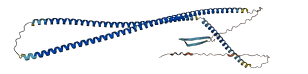
Descriptions
The autoinhibited protein was predicted that may have potential autoinhibitory elements via cis-regPred.
Autoinhibitory domains (AIDs)
Target domain |
|
Relief mechanism |
|
Assay |
cis-regPred |
Accessory elements
No accessory elements
Autoinhibited structure

Activated structure
1 structures for P03995
| Entry ID | Method | Resolution | Chain | Position | Source |
|---|---|---|---|---|---|
| AF-P03995-F1 | Predicted | AlphaFoldDB |
25 variants for P03995
| Variant ID(s) | Position | Change | Description | Diseaes Association | Provenance |
|---|---|---|---|---|---|
| rs3389221344 | 27 | Q>* | No | EVA | |
| rs3389206128 | 46 | R>M | No | EVA | |
| rs3402323372 | 47 | V>E | No | EVA | |
| rs3413125481 | 48 | D>N | No | EVA | |
| rs3389206447 | 131 | S>N | No | EVA | |
| rs3389182414 | 136 | V>* | No | EVA | |
| rs27037341 | 141 | F>L | No | EVA | |
| rs3389182403 | 143 | Q>* | No | EVA | |
| rs3389206521 | 152 | L>I | No | EVA | |
| rs3389142536 | 177 | T>I | No | EVA | |
| rs3389206525 | 208 | L>I | No | EVA | |
| rs3389207582 | 229 | T>R | No | EVA | |
| rs3389206069 | 273 | R>H | No | EVA | |
| rs3402323308 | 297 | R>C | No | EVA | |
| rs3389201669 | 300 | N>D | No | EVA | |
| rs3389534442 | 305 | R>Q | No | EVA | |
| rs220344741 | 314 | H>Y | No | EVA | |
| rs3389207595 | 330 | E>K | No | EVA | |
| rs3389195927 | 331 | E>D | No | EVA | |
| rs3389176746 | 338 | E>G | No | EVA | |
| rs3389207541 | 339 | M>V | No | EVA | |
| rs3389211925 | 354 | L>Q | No | EVA | |
| rs3389195914 | 381 | F>L | No | EVA | |
| rs27053896 | 420 | D>E | No | EVA | |
| rs221129607 | 429 | V>M | No | EVA |
No associated diseases with P03995
4 regional properties for P03995
| Type | Name | Position | InterPro Accession |
|---|---|---|---|
| domain | Regulator of K+ conductance, C-terminal | 198 - 283 | IPR006037-1 |
| domain | Regulator of K+ conductance, C-terminal | 285 - 369 | IPR006037-2 |
| domain | YidE/YbjL duplication | 11 - 187 | IPR006512-1 |
| domain | YidE/YbjL duplication | 382 - 554 | IPR006512-2 |
12 GO annotations of cellular component
| Name | Definition |
|---|---|
| astrocyte end-foot | Terminal process of astrocyte abutting non-neuronal surfaces in the brain. |
| astrocyte projection | A prolongation or process extending from the soma of an astrocyte and wrapping around neurons. |
| cell body | The portion of a cell bearing surface projections such as axons, dendrites, cilia, or flagella that includes the nucleus, but excludes all cell projections. |
| cell projection | A prolongation or process extending from a cell, e.g. a flagellum or axon. |
| cytoplasm | The contents of a cell excluding the plasma membrane and nucleus, but including other subcellular structures. |
| cytoplasmic side of lysosomal membrane | The side (leaflet) of the lysosomal membrane that faces the cytoplasm. |
| cytoskeleton | A cellular structure that forms the internal framework of eukaryotic and prokaryotic cells. The cytoskeleton includes intermediate filaments, microfilaments, microtubules, the microtrabecular lattice, and other structures characterized by a polymeric filamentous nature and long-range order within the cell. The various elements of the cytoskeleton not only serve in the maintenance of cellular shape but also have roles in other cellular functions, including cellular movement, cell division, endocytosis, and movement of organelles. |
| glial cell projection | A prolongation or process extending from a glial cell. |
| intermediate filament | A cytoskeletal structure that forms a distinct elongated structure, characteristically 10 nm in diameter, that occurs in the cytoplasm of eukaryotic cells. Intermediate filaments form a fibrous system, composed of chemically heterogeneous subunits and involved in mechanically integrating the various components of the cytoplasmic space. Intermediate filaments may be divided into five chemically distinct classes: Type I, acidic keratins; Type II, basic keratins; Type III, including desmin, vimentin and others; Type IV, neurofilaments and related filaments; and Type V, lamins. |
| intermediate filament cytoskeleton | Cytoskeletal structure made from intermediate filaments, typically organized in the cytosol as an extended system that stretches from the nuclear envelope to the plasma membrane. Some intermediate filaments run parallel to the cell surface, while others traverse the cytosol; together they form an internal framework that helps support the shape and resilience of the cell. |
| membrane | A lipid bilayer along with all the proteins and protein complexes embedded in it an attached to it. |
| myelin sheath | An electrically insulating fatty layer that surrounds the axons of many neurons. It is an outgrowth of glial cells: Schwann cells supply the myelin for peripheral neurons while oligodendrocytes supply it to those of the central nervous system. |
4 GO annotations of molecular function
| Name | Definition |
|---|---|
| identical protein binding | Binding to an identical protein or proteins. |
| integrin binding | Binding to an integrin. |
| kinase binding | Binding to a kinase, any enzyme that catalyzes the transfer of a phosphate group. |
| structural constituent of cytoskeleton | The action of a molecule that contributes to the structural integrity of a cytoskeletal structure. |
18 GO annotations of biological process
| Name | Definition |
|---|---|
| astrocyte development | The process aimed at the progression of an astrocyte over time, from initial commitment of the cell to a specific fate, to the fully functional differentiated cell. An astrocyte is the most abundant type of glial cell. Astrocytes provide support for neurons and regulate the environment in which they function. |
| Bergmann glial cell differentiation | The process in which neuroepithelial cells of the neural tube give rise to Brgmann glial cells, specialized bipotential progenitors cells of the cerebellum. Differentiation includes the processes involved in commitment of a cell to a specific fate. |
| D-aspartate import across plasma membrane | The directed import of D-aspartate from the extracellular region across the plasma membrane and into the cytosol. |
| extracellular matrix organization | A process that is carried out at the cellular level which results in the assembly, arrangement of constituent parts, or disassembly of an extracellular matrix. |
| gene expression | The process in which a gene's sequence is converted into a mature gene product (protein or RNA). This includes the production of an RNA transcript and its processing, translation and maturation for protein-coding genes. |
| intermediate filament organization | Control of the spatial distribution of intermediate filaments; includes organizing filaments into meshworks, bundles, or other structures, as by cross-linking. |
| intermediate filament-based process | Any cellular process that depends upon or alters the intermediate filament cytoskeleton, that part of the cytoskeleton comprising intermediate filaments and their associated proteins. |
| intracellular protein transport | The directed movement of proteins in a cell, including the movement of proteins between specific compartments or structures within a cell, such as organelles of a eukaryotic cell. |
| long-term synaptic potentiation | A process that modulates synaptic plasticity such that synapses are changed resulting in the increase in the rate, or frequency of synaptic transmission at the synapse. |
| negative regulation of neuron projection development | Any process that decreases the rate, frequency or extent of neuron projection development. Neuron projection development is the process whose specific outcome is the progression of a neuron projection over time, from its formation to the mature structure. A neuron projection is any process extending from a neural cell, such as axons or dendrites (collectively called neurites). |
| neuron projection development | The process whose specific outcome is the progression of a neuron projection over time, from its formation to the mature structure. A neuron projection is any process extending from a neural cell, such as axons or dendrites (collectively called neurites). |
| neuron projection regeneration | The regrowth of neuronal processes such as axons or dendrites in response to their loss or damage. |
| positive regulation of glial cell proliferation | Any process that activates or increases the rate or extent of glial cell proliferation. |
| positive regulation of Schwann cell proliferation | Any process that increases the frequency or rate of the multiplication or reproduction of Schwann cells, resulting in the expansion of their population. Schwann cells are a type of glial cell in the peripheral nervous system. |
| regulation of chaperone-mediated autophagy | Any process that modulates the frequency, rate or extent of chaperone-mediated autophagy. |
| regulation of neurotransmitter uptake | Any process that modulates the frequency, rate or extent of the directed movement of a neurotransmitter into a neuron or glial cell. |
| response to wounding | Any process that results in a change in state or activity of a cell or an organism (in terms of movement, secretion, enzyme production, gene expression, etc.) as a result of a stimulus indicating damage to the organism. |
| Schwann cell proliferation | The multiplication or reproduction of Schwann cells, resulting in the expansion of their population. Schwann cells are a type of glial cell in the peripheral nervous system. |
8 homologous proteins in AiPD
| UniProt AC | Gene Name | Protein Name | Species | Evidence Code |
|---|---|---|---|---|
| P41219 | PRPH | Peripherin | Homo sapiens (Human) | PR |
| P14136 | GFAP | Glial fibrillary acidic protein | Homo sapiens (Human) | PR |
| P17661 | DES | Desmin | Homo sapiens (Human) | PR |
| P08670 | VIM | Vimentin | Homo sapiens (Human) | PR |
| P31001 | Des | Desmin | Mus musculus (Mouse) | PR |
| P20152 | Vim | Vimentin | Mus musculus (Mouse) | PR |
| P15331 | Prph | Peripherin | Mus musculus (Mouse) | PR |
| P47819 | Gfap | Glial fibrillary acidic protein | Rattus norvegicus (Rat) | PR |
| 10 | 20 | 30 | 40 | 50 | 60 |
| MERRRITSAR | RSYASETVVR | GLGPSRQLGT | MPRFSLSRMT | PPLPARVDFS | LAGALNAGFK |
| 70 | 80 | 90 | 100 | 110 | 120 |
| ETRASERAEM | MELNDRFASY | IEKVRFLEQQ | NKALAAELNQ | LRAKEPTKLA | DVYQAELREL |
| 130 | 140 | 150 | 160 | 170 | 180 |
| RLRLDQLTAN | SARLEVERDN | FAQDLGTLRQ | KLQDETNLRL | EAENNLAAYR | QEADEATLAR |
| 190 | 200 | 210 | 220 | 230 | 240 |
| VDLERKVESL | EEEIQFLRKI | YEEEVRELRE | QLAQQQVHVE | MDVAKPDLTA | ALREIRTQYE |
| 250 | 260 | 270 | 280 | 290 | 300 |
| AVATSNMQET | EEWYRSKFAD | LTDAASRNAE | LLRQAKHEAN | DYRRQLQALT | CDLESLRGTN |
| 310 | 320 | 330 | 340 | 350 | 360 |
| ESLERQMREQ | EERHARESAS | YQEALARLEE | EGQSLKEEMA | RHLQEYQDLL | NVKLALDIEI |
| 370 | 380 | 390 | 400 | 410 | 420 |
| ATYRKLLEGE | ENRITIPVQT | FSNLQIRETS | LDTKSVSEGH | LKRNIVVKTV | EMRDGEVIKD |
| SKQEHKDVVM |