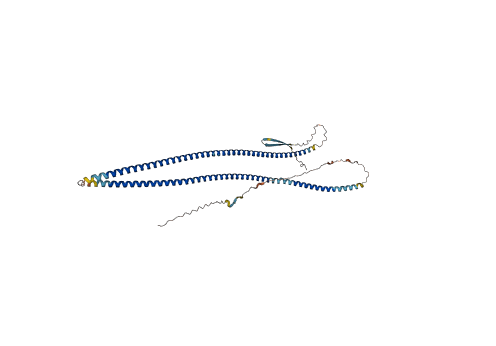
Descriptions
The autoinhibited protein was predicted that may have potential autoinhibitory elements via cis-regPred.
Autoinhibitory domains (AIDs)
Target domain |
|
Relief mechanism |
|
Assay |
cis-regPred |
Accessory elements
No accessory elements
Autoinhibited structure

Activated structure
1 structures for P15331
| Entry ID | Method | Resolution | Chain | Position | Source |
|---|---|---|---|---|---|
| AF-P15331-F1 | Predicted | AlphaFoldDB |
No variants for P15331
| Variant ID(s) | Position | Change | Description | Diseaes Association | Provenance |
|---|---|---|---|---|---|
| No variants for P15331 | |||||
No associated diseases with P15331
13 GO annotations of cellular component
| Name | Definition |
|---|---|
| axon | The long process of a neuron that conducts nerve impulses, usually away from the cell body to the terminals and varicosities, which are sites of storage and release of neurotransmitter. |
| C-fiber | The axon of a dorsal root ganglion cell that are responsive to pain and temperature. C-fibers are small in diameter (0.2-1.5 um) and unmyelinated. |
| cytoplasm | The contents of a cell excluding the plasma membrane and nucleus, but including other subcellular structures. |
| intermediate filament | A cytoskeletal structure that forms a distinct elongated structure, characteristically 10 nm in diameter, that occurs in the cytoplasm of eukaryotic cells. Intermediate filaments form a fibrous system, composed of chemically heterogeneous subunits and involved in mechanically integrating the various components of the cytoplasmic space. Intermediate filaments may be divided into five chemically distinct classes: Type I, acidic keratins; Type II, basic keratins; Type III, including desmin, vimentin and others; Type IV, neurofilaments and related filaments; and Type V, lamins. |
| neurofilament | A type of intermediate filament found in the core of neuronal axons. Neurofilaments are heteropolymers composed of three type IV polypeptides: NF-L, NF-M, and NF-H (for low, middle, and high molecular weight). Neurofilaments are responsible for the radial growth of an axon and determine axonal diameter. |
| neuron projection | A prolongation or process extending from a nerve cell, e.g. an axon or dendrite. |
| neuronal cell body | The portion of a neuron that includes the nucleus, but excludes cell projections such as axons and dendrites. |
| perikaryon | The portion of the cell soma (neuronal cell body) that excludes the nucleus. |
| photoreceptor outer segment | The outer segment of a vertebrate photoreceptor that contains a stack of membrane discs embedded with photoreceptor proteins. |
| photoreceptor outer segment membrane | The membrane surrounding the outer segment of a vertebrate photoreceptor. |
| plasma membrane | The membrane surrounding a cell that separates the cell from its external environment. It consists of a phospholipid bilayer and associated proteins. |
| terminal bouton | Terminal inflated portion of the axon, containing the specialized apparatus necessary to release neurotransmitters. The axon terminus is considered to be the whole region of thickening and the terminal bouton is a specialized region of it. |
| type III intermediate filament | A type of intermediate filament, typically made up of one or more of the proteins vimentin, desmin, glial fibrillary acidic protein (GFAP), and peripherin. Unlike the keratins, the type III proteins can form both homo- and heteropolymeric IF filaments. |
2 GO annotations of molecular function
| Name | Definition |
|---|---|
| protein-containing complex binding | Binding to a macromolecular complex. |
| structural constituent of cytoskeleton | The action of a molecule that contributes to the structural integrity of a cytoskeletal structure. |
2 GO annotations of biological process
| Name | Definition |
|---|---|
| intermediate filament cytoskeleton organization | A process that is carried out at the cellular level which results in the assembly, arrangement of constituent parts, or disassembly of cytoskeletal structures comprising intermediate filaments and their associated proteins. |
| intermediate filament organization | Control of the spatial distribution of intermediate filaments; includes organizing filaments into meshworks, bundles, or other structures, as by cross-linking. |
5 homologous proteins in AiPD
| UniProt AC | Gene Name | Protein Name | Species | Evidence Code |
|---|---|---|---|---|
| P41219 | PRPH | Peripherin | Homo sapiens (Human) | PR |
| P03995 | Gfap | Glial fibrillary acidic protein | Mus musculus (Mouse) | PR |
| P31001 | Des | Desmin | Mus musculus (Mouse) | PR |
| P20152 | Vim | Vimentin | Mus musculus (Mouse) | PR |
| P21807 | Prph | Peripherin | Rattus norvegicus (Rat) | PR |
| 10 | 20 | 30 | 40 | 50 | 60 |
| MPSSASMSHH | HSSGLRSSIS | STSYRRTFGP | PPSLSPGAFS | YSSSSRFSSS | RLLGSGSPSS |
| 70 | 80 | 90 | 100 | 110 | 120 |
| SARLGSFRAP | RAGALRLPSE | RLDFSMAEAL | NQEFLATRSN | EKQELQELND | RFANFIEKVR |
| 130 | 140 | 150 | 160 | 170 | 180 |
| FLEQQNAALR | GELSQARGQE | PARADQLCQQ | ELRELRRELE | LLGRERDRVQ | VERDGLAEDL |
| 190 | 200 | 210 | 220 | 230 | 240 |
| AALKQRLEEE | TRKREDAEHN | LVLFRKDVDD | ATLSRLELER | KIESLMDEIE | FLKKLHEEEL |
| 250 | 260 | 270 | 280 | 290 | 300 |
| RDLQVSVESQ | QVQQVEVEAT | VKPELTAALR | DIRAQYENIA | AKNLQEAEEW | YKSKYADLSD |
| 310 | 320 | 330 | 340 | 350 | 360 |
| AANRNHEALR | QAKQEMNESR | RQIQSLTCEV | DGLRGTNEAL | LRQLRELEEQ | FALEAGGYQA |
| 370 | 380 | 390 | 400 | 410 | 420 |
| GAARLEEELR | QLKEEMARHL | REYQELLNVK | MALDIEIATY | RKLLEGEESR | ISVPVHSFAS |
| 430 | 440 | 450 | 460 | 470 | |
| LSLKTTVPEM | EPLQDSHSKK | MVLIRTIETR | DGEKVVTESQ | KEQHSDLDKS | SIHSY |