Descriptions
The autoinhibited protein was predicted that may have potential autoinhibitory elements via cis-regPred.
Autoinhibitory domains (AIDs)
Target domain |
|
Relief mechanism |
|
Assay |
cis-regPred |
Accessory elements
No accessory elements
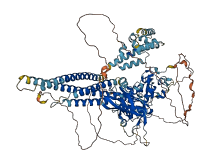
Autoinhibited structure

Activated structure
1 structures for Q9WVL2
| Entry ID | Method | Resolution | Chain | Position | Source |
|---|---|---|---|---|---|
| AF-Q9WVL2-F1 | Predicted | AlphaFoldDB |
No variants for Q9WVL2
| Variant ID(s) | Position | Change | Description | Diseaes Association | Provenance |
|---|---|---|---|---|---|
| No variants for Q9WVL2 | |||||
No associated diseases with Q9WVL2
No regional properties for Q9WVL2
| Type | Name | Position | InterPro Accession |
|---|---|---|---|
| No domain, repeats, and functional sites for Q9WVL2 | |||
5 GO annotations of cellular component
| Name | Definition |
|---|---|
| cytoplasm | The contents of a cell excluding the plasma membrane and nucleus, but including other subcellular structures. |
| cytosol | The part of the cytoplasm that does not contain organelles but which does contain other particulate matter, such as protein complexes. |
| ISGF3 complex | A transcription factor complex that consists of a Stat1-Stat2 heterodimer and the IRF9 protein. |
| nucleus | A membrane-bounded organelle of eukaryotic cells in which chromosomes are housed and replicated. In most cells, the nucleus contains all of the cell's chromosomes except the organellar chromosomes, and is the site of RNA synthesis and processing. In some species, or in specialized cell types, RNA metabolism or DNA replication may be absent. |
| plasma membrane | The membrane surrounding a cell that separates the cell from its external environment. It consists of a phospholipid bilayer and associated proteins. |
4 GO annotations of molecular function
| Name | Definition |
|---|---|
| DNA-binding transcription factor activity, RNA polymerase II-specific | A DNA-binding transcription factor activity that modulates the transcription of specific gene sets transcribed by RNA polymerase II. |
| identical protein binding | Binding to an identical protein or proteins. |
| RNA polymerase II cis-regulatory region sequence-specific DNA binding | Binding to a specific upstream regulatory DNA sequence (transcription factor recognition sequence or binding site) located in cis relative to the transcription start site (i.e., on the same strand of DNA) of a gene transcribed by RNA polymerase II. |
| ubiquitin-like protein ligase binding | Binding to a ubiquitin-like protein ligase, such as ubiquitin-ligase. |
12 GO annotations of biological process
| Name | Definition |
|---|---|
| cytokine-mediated signaling pathway | The series of molecular signals initiated by the binding of a cytokine to a receptor on the surface of a cell, and ending with the regulation of a downstream cellular process, e.g. transcription. |
| defense response | Reactions, triggered in response to the presence of a foreign body or the occurrence of an injury, which result in restriction of damage to the organism attacked or prevention/recovery from the infection caused by the attack. |
| defense response to virus | Reactions triggered in response to the presence of a virus that act to protect the cell or organism. |
| negative regulation of type I interferon-mediated signaling pathway | Any process that decreases the rate, frequency or extent of a type I interferon-mediated signaling pathway. |
| positive regulation of transcription by RNA polymerase II | Any process that activates or increases the frequency, rate or extent of transcription from an RNA polymerase II promoter. |
| receptor signaling pathway via JAK-STAT | Any process in which STAT proteins (Signal Transducers and Activators of Transcription) and JAK (Janus Activated Kinase) proteins convey a signal to trigger a change in the activity or state of a cell. The receptor signaling pathway via JAK-STAT begins with activation of a receptor and proceeeds through STAT protein activation by members of the JAK family of tyrosine kinases. STAT proteins dimerize and subsequently translocate to the nucleus. The pathway ends with regulation of target gene expression by STAT proteins. |
| regulation of cell population proliferation | Any process that modulates the frequency, rate or extent of cell proliferation. |
| regulation of mitochondrial fission | Any process that modulates the rate, frequency or extent of mitochondrial fission. Mitochondrial fission is the division of a mitochondrion within a cell to form two or more separate mitochondrial compartments. |
| regulation of protein phosphorylation | Any process that modulates the frequency, rate or extent of addition of phosphate groups into an amino acid in a protein. |
| regulation of transcription by RNA polymerase II | Any process that modulates the frequency, rate or extent of transcription mediated by RNA polymerase II. |
| response to peptide hormone | Any process that results in a change in state or activity of a cell or an organism (in terms of movement, secretion, enzyme production, gene expression, etc.) as a result of a peptide hormone stimulus. A peptide hormone is any of a class of peptides that are secreted into the blood stream and have endocrine functions in living animals. |
| type I interferon signaling pathway | The series of molecular signals initiated by type I interferon binding to its receptor on the surface of a target cell, and ending with the regulation of a downstream cellular process, e.g. transcription. Type I interferons include the interferon-alpha, beta, delta, episilon, zeta, kappa, tau, and omega gene families. |
15 homologous proteins in AiPD
| UniProt AC | Gene Name | Protein Name | Species | Evidence Code |
|---|---|---|---|---|
| P61635 | STAT3 | Signal transducer and activator of transcription 3 | Bos taurus (Bovine) | PR |
| Q6DV79 | STAT3 | Signal transducer and activator of transcription 3 | Gallus gallus (Chicken) | PR |
| P40763 | STAT3 | Signal transducer and activator of transcription 3 | Homo sapiens (Human) | PR |
| P51692 | STAT5B | Signal transducer and activator of transcription 5B | Homo sapiens (Human) | PR |
| P42229 | STAT5A | Signal transducer and activator of transcription 5A | Homo sapiens (Human) | PR |
| P42224 | STAT1 | Signal transducer and activator of transcription 1-alpha/beta | Homo sapiens (Human) | PR |
| Q14765 | STAT4 | Signal transducer and activator of transcription 4 | Homo sapiens (Human) | PR |
| P52630 | STAT2 | Signal transducer and activator of transcription 2 | Homo sapiens (Human) | PR |
| P42225 | Stat1 | Signal transducer and activator of transcription 1 | Mus musculus (Mouse) | PR |
| P42227 | Stat3 | Signal transducer and activator of transcription 3 | Mus musculus (Mouse) | PR |
| P42228 | Stat4 | Signal transducer and activator of transcription 4 | Mus musculus (Mouse) | PR |
| P42230 | Stat5a | Signal transducer and activator of transcription 5A | Mus musculus (Mouse) | PR |
| Q19S50 | STAT3 | Signal transducer and activator of transcription 3 | Sus scrofa (Pig) | PR |
| P52631 | Stat3 | Signal transducer and activator of transcription 3 | Rattus norvegicus (Rat) | PR |
| Q9NAD6 | sta-1 | Signal transducer and activator of transcription 1 | Caenorhabditis elegans | PR |
| 10 | 20 | 30 | 40 | 50 | 60 |
| MAQWEMLQNL | DSPFLDQLHQ | VYSQSFLPMD | FRQHLASWIE | DQNWREAALE | SDDAKANMLY |
| 70 | 80 | 90 | 100 | 110 | 120 |
| FSILDQLNQW | DHYSSDPKSL | LLQHNLRKFS | RDIQPFPNGP | SQLAEMIFNL | LLEEQRILIQ |
| 130 | 140 | 150 | 160 | 170 | 180 |
| AQRAQEVQPP | PAPEAVVESQ | QLEIENRIQG | LHVDIEFLVR | SIRQLKDEQD | VFSFRYTVFS |
| 190 | 200 | 210 | 220 | 230 | 240 |
| LKKTSSSDPH | QSQQAHVVQA | TANKVDRMRK | EVLDISKGLV | GRLTTLVDLL | LPKLDEWKVQ |
| 250 | 260 | 270 | 280 | 290 | 300 |
| QQKSCIGAPP | PVKSAAEQLE | QWLTAGAKFL | FHLRQLLKQL | KEMSCLRYQG | DMFAKGVDLR |
| 310 | 320 | 330 | 340 | 350 | 360 |
| NAQVMELLQR | LLQRSFVVET | QPCMPQTLHR | PLILKTGNKF | TVRTRLLVRL | QEGSESLKAE |
| 370 | 380 | 390 | 400 | 410 | 420 |
| VSVDRNSDLP | GFRKFNILTS | NQKTLTPEKG | QRQGLIWDFG | FLTLVEQRAV | GAGKGNNKGP |
| 430 | 440 | 450 | 460 | 470 | 480 |
| LAVTEELHVI | SFVVEYTYQG | LKMKLQTDTL | PVVIISNMNQ | LSFAWASILW | FNMLSPNPKN |
| 490 | 500 | 510 | 520 | 530 | 540 |
| QQFFCQAPKA | PWSLLGPVLS | WQFSSYVARG | LDSEQLGMLR | TKLFGKSCKM | EDALLSWVDF |
| 550 | 560 | 570 | 580 | 590 | 600 |
| CKRESPPGKI | PFWTWLDKIL | ELVHDHLKDL | WKDGRIMGFV | SRNQERRLLK | KMLSGTFLLR |
| 610 | 620 | 630 | 640 | 650 | 660 |
| FSETSEGGIT | CSWVEHQDDH | KVEIYSVQPY | TKEVLQSLPL | TEIIRHYQVL | AEENIPENPL |
| 670 | 680 | 690 | 700 | 710 | 720 |
| RFLYPRIPRD | EAFGCYYQEK | VNLEEQEEYL | KHKLIVISNR | QVDELQQPLE | LKQDSESLEV |
| 730 | 740 | 750 | 760 | 770 | 780 |
| NAELLLAHDQ | ELPLMMQTGL | VLGTELKVDP | ILSTAPQVLL | EPAPQVLLEP | APQVLLEPAP |
| 790 | 800 | 810 | 820 | 830 | 840 |
| QVLLEPAPQV | LLEPAPQVLL | EPAPQVLLEP | APQVQLEPAP | QVLLELAPQV | LLEPAPQVLL |
| 850 | 860 | 870 | 880 | 890 | 900 |
| ELAPQVQLEP | AHLLQQPSES | DLPEDLQQIS | VEDLKKLSNP | STEYITTNEN | PMLAGESSGD |
| 910 | 920 | ||||
| ETSIPYHSHF | DADGLLGWTL | DTF |