Q99PE8
Gene name |
Abcg5 |
Protein name |
ATP-binding cassette sub-family G member 5 |
Names |
Sterolin-1 |
Species |
Mus musculus (Mouse) |
KEGG Pathway |
mmu:27409 |
EC number |
|
Protein Class |
|
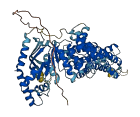
Descriptions
The autoinhibited protein was predicted that may have potential autoinhibitory elements via cis-regPred.
Autoinhibitory domains (AIDs)
Target domain |
|
Relief mechanism |
|
Assay |
cis-regPred |
Accessory elements
No accessory elements
Autoinhibited structure

Activated structure
1 structures for Q99PE8
| Entry ID | Method | Resolution | Chain | Position | Source |
|---|---|---|---|---|---|
| AF-Q99PE8-F1 | Predicted | AlphaFoldDB |
46 variants for Q99PE8
| Variant ID(s) | Position | Change | Description | Diseaes Association | Provenance |
|---|---|---|---|---|---|
| rs3389495069 | 18 | N>S | No | EVA | |
| rs108761236 | 31 | T>M | No | EVA | |
| rs3389451210 | 33 | T>I | No | EVA | |
| rs3389451210 | 33 | T>R | No | EVA | |
| rs3389393993 | 42 | L>M | No | EVA | |
| rs3389482151 | 95 | T>A | No | EVA | |
| rs220926367 | 106 | R>C | No | EVA | |
| rs3389483127 | 108 | G>W | No | EVA | |
| rs252075214 | 113 | E>D | No | EVA | |
| rs3389393973 | 176 | L>Q | No | EVA | |
| rs3389474882 | 180 | H>Y | No | EVA | |
| rs49981963 | 185 | M>V | No | EVA | |
| rs3389498903 | 219 | E>V | No | EVA | |
| rs3408166134 | 254 | R>C | No | EVA | |
| rs3389495074 | 262 | D>E | No | EVA | |
| rs3389476103 | 266 | I>N | No | EVA | |
| rs3389393974 | 284 | F>V | No | EVA | |
| rs48861462 | 328 | C>S | No | EVA | |
| rs3389462146 | 331 | K>E | No | EVA | |
| rs3389484434 | 332 | E>* | No | EVA | |
| rs3389486781 | 336 | Y>C | No | EVA | |
| rs3389451187 | 348 | Y>D | No | EVA | |
| rs49200427 | 354 | T>M | No | EVA | |
| rs3389478688 | 385 | Q>* | No | EVA | |
| rs3389441937 | 389 | M>V | No | EVA | |
| rs48735971 | 427 | L>F | No | EVA | |
| 462 | W>del | trac; strongly increased levels of sitosterol, brassicasterol and campesterol in blood plasma [UniProt] | No | ||
| rs3389482078 | 470 | L>I | No | EVA | |
| rs49134167 | 472 | V>A | No | EVA | |
| rs46754296 | 477 | V>I | No | EVA | |
| rs3389476128 | 483 | F>C | No | EVA | |
| rs3389476160 | 488 | Y>* | No | EVA | |
| rs3407451583 | 488 | Y>* | No | EVA | |
| rs3389451231 | 527 | N>T | No | EVA | |
| rs3389393997 | 537 | L>Q | No | EVA | |
| rs3389486800 | 554 | Q>E | No | EVA | |
| rs3389491843 | 554 | Q>H | No | EVA | |
| rs3389474918 | 572 | C>S | No | EVA | |
| rs4231712 | 590 | G>E | No | EVA | |
| rs4231713 | 591 | S>P | No | EVA | |
| rs4231714 | 594 | S>T | No | EVA | |
| rs4231716 | 608 | Q>E | No | EVA | |
| rs3389484412 | 608 | Q>H | No | EVA | |
| rs256876638 | 612 | K>E | No | EVA | |
| rs3389474878 | 628 | L>S | No | EVA | |
| rs3389482079 | 640 | I>L | No | EVA |
1 associated diseases with Q99PE8
Without disease ID
5 regional properties for Q99PE8
| Type | Name | Position | InterPro Accession |
|---|---|---|---|
| domain | ABC transporter-like, ATP-binding domain | 39 - 294 | IPR003439 |
| domain | AAA+ ATPase domain | 79 - 271 | IPR003593 |
| domain | ABC-2 type transporter, transmembrane domain | 369 - 581 | IPR013525 |
| conserved_site | ABC transporter-like, conserved site | 194 - 208 | IPR017871 |
| domain | ABC transporter family G domain | 251 - 326 | IPR043926 |
6 GO annotations of cellular component
| Name | Definition |
|---|---|
| apical part of cell | The region of a polarized cell that forms a tip or is distal to a base. For example, in a polarized epithelial cell, the apical region has an exposed surface and lies opposite to the basal lamina that separates the epithelium from other tissue. |
| apical plasma membrane | The region of the plasma membrane located at the apical end of the cell. |
| ATP-binding cassette (ABC) transporter complex | A complex for the transport of metabolites into and out of the cell, typically comprised of four domains; two membrane-associated domains and two ATP-binding domains at the intracellular face of the membrane, that form a central pore through the plasma membrane. Each of the four core domains may be encoded as a separate polypeptide or the domains can be fused in any one of a number of ways into multidomain polypeptides. In Bacteria and Archaebacteria, ABC transporters also include substrate binding proteins to bind substrate external to the cytoplasm and deliver it to the transporter. |
| integral component of plasma membrane | The component of the plasma membrane consisting of the gene products and protein complexes having at least some part of their peptide sequence embedded in the hydrophobic region of the membrane. |
| membrane | A lipid bilayer along with all the proteins and protein complexes embedded in it an attached to it. |
| receptor complex | Any protein complex that undergoes combination with a hormone, neurotransmitter, drug or intracellular messenger to initiate a change in cell function. |
7 GO annotations of molecular function
| Name | Definition |
|---|---|
| ABC-type transporter activity | Primary active transporter characterized by two nucleotide-binding domains and two transmembrane domains. Uses the energy generated from ATP hydrolysis to drive the transport of a substance across a membrane. |
| ATP binding | Binding to ATP, adenosine 5'-triphosphate, a universally important coenzyme and enzyme regulator. |
| ATP hydrolysis activity | Catalysis of the reaction: ATP + H2O = ADP + H+ phosphate. ATP hydrolysis is used in some reactions as an energy source, for example to catalyze a reaction or drive transport against a concentration gradient. |
| ATPase-coupled transmembrane transporter activity | Primary active transporter of a solute across a membrane, via the reaction: ATP + H2O = ADP + phosphate, to directly drive the transport of a substance across a membrane. The transport protein may be transiently phosphorylated (P-type transporters), or not (ABC-type transporters and other families of transporters). Primary active transport occurs up the solute's concentration gradient and is driven by a primary energy source. |
| cholesterol transfer activity | Removes cholesterol from a membrane or a monolayer lipid particle, transports it through the aqueous phase while protected in a hydrophobic pocket, and brings it to an acceptor membrane or lipid particle. |
| metal ion binding | Binding to a metal ion. |
| protein heterodimerization activity | Binding to a nonidentical protein to form a heterodimer. |
13 GO annotations of biological process
| Name | Definition |
|---|---|
| bile acid signaling pathway | The series of molecular signals initiated by bile acid binding to its receptor, and ending with the regulation of a downstream cellular process, e.g. transcription. |
| cholesterol efflux | The directed movement of cholesterol, cholest-5-en-3-beta-ol, out of a cell or organelle. |
| cholesterol homeostasis | Any process involved in the maintenance of an internal steady state of cholesterol within an organism or cell. |
| intestinal cholesterol absorption | Uptake of cholesterol into the blood by absorption from the small intestine. |
| negative regulation of intestinal cholesterol absorption | Any process that stops, prevents, or reduces the frequency, rate or extent of uptake of cholesterol into the blood by absorption from the intestine. |
| negative regulation of intestinal phytosterol absorption | Any process that stops, prevents, or reduces the frequency, rate or extent of the directed movement of phytosterols into the blood by absorption from the small intestine. |
| response to ionizing radiation | Any process that results in a change in state or activity of a cell or an organism (in terms of movement, secretion, enzyme production, gene expression, etc.) as a result of a ionizing radiation stimulus. Ionizing radiation is radiation with sufficient energy to remove electrons from atoms and may arise from spontaneous decay of unstable isotopes, resulting in alpha and beta particles and gamma rays. Ionizing radiation also includes X-rays. |
| response to muscle activity | Any process that results in a change in state or activity of a cell or an organism (in terms of movement, secretion, enzyme production, gene expression, etc.) as a result of a muscle activity stimulus. |
| response to nutrient | Any process that results in a change in state or activity of a cell or an organism (in terms of movement, secretion, enzyme production, gene expression, etc.) as a result of a nutrient stimulus. |
| response to xenobiotic stimulus | Any process that results in a change in state or activity of a cell or an organism (in terms of movement, secretion, enzyme production, gene expression, etc.) as a result of a stimulus from a xenobiotic, a compound foreign to the organim exposed to it. It may be synthesized by another organism (like ampicilin) or it can be a synthetic chemical. |
| sterol transport | The directed movement of sterols into, out of or within a cell, or between cells, by means of some agent such as a transporter or pore. Sterols are steroids with one or more hydroxyl groups and a hydrocarbon side-chain in the molecule. |
| transmembrane transport | The process in which a solute is transported across a lipid bilayer, from one side of a membrane to the other. |
| triglyceride homeostasis | Any process involved in the maintenance of an internal steady state of triglyceride within an organism or cell. |
10 homologous proteins in AiPD
| UniProt AC | Gene Name | Protein Name | Species | Evidence Code |
|---|---|---|---|---|
| P45844 | ABCG1 | ATP-binding cassette sub-family G member 1 | Homo sapiens (Human) | PR |
| Q9H172 | ABCG4 | ATP-binding cassette sub-family G member 4 | Homo sapiens (Human) | PR |
| Q64343 | Abcg1 | ATP-binding cassette sub-family G member 1 | Mus musculus (Mouse) | PR |
| Q99PE7 | Abcg5 | ATP-binding cassette sub-family G member 5 | Rattus norvegicus (Rat) | PR |
| Q11180 | wht-1 | ABC transporter ATP-binding protein/permease wht-1 | Caenorhabditis elegans | PR |
| Q09466 | wht-3 | ABC transporter ATP-binding protein/permease wht-3 | Caenorhabditis elegans | PR |
| Q9MAG3 | ABCG24 | ABC transporter G family member 24 | Arabidopsis thaliana (Mouse-ear cress) | PR |
| Q9M2V6 | ABCG17 | ABC transporter G family member 17 | Arabidopsis thaliana (Mouse-ear cress) | PR |
| Q9MAH4 | ABCG10 | ABC transporter G family member 10 | Arabidopsis thaliana (Mouse-ear cress) | PR |
| Q9SZR9 | ABCG9 | ABC transporter G family member 9 | Arabidopsis thaliana (Mouse-ear cress) | PR |
| 10 | 20 | 30 | 40 | 50 | 60 |
| MGELPFLSPE | GARGPHINRG | SLSSLEQGSV | TGTEARHSLG | VLHVSYSVSN | RVGPWWNIKS |
| 70 | 80 | 90 | 100 | 110 | 120 |
| CQQKWDRQIL | KDVSLYIESG | QIMCILGSSG | SGKTTLLDAI | SGRLRRTGTL | EGEVFVNGCE |
| 130 | 140 | 150 | 160 | 170 | 180 |
| LRRDQFQDCF | SYVLQSDVFL | SSLTVRETLR | YTAMLALCRS | SADFYNKKVE | AVMTELSLSH |
| 190 | 200 | 210 | 220 | 230 | 240 |
| VADQMIGSYN | FGGISSGERR | RVSIAAQLLQ | DPKVMMLDEP | TTGLDCMTAN | QIVLLLAELA |
| 250 | 260 | 270 | 280 | 290 | 300 |
| RRDRIVIVTI | HQPRSELFQH | FDKIAILTYG | ELVFCGTPEE | MLGFFNNCGY | PCPEHSNPFD |
| 310 | 320 | 330 | 340 | 350 | 360 |
| FYMDLTSVDT | QSREREIETY | KRVQMLECAF | KESDIYHKIL | ENIERARYLK | TLPTVPFKTK |
| 370 | 380 | 390 | 400 | 410 | 420 |
| DPPGMFGKLG | VLLRRVTRNL | MRNKQAVIMR | LVQNLIMGLF | LIFYLLRVQN | NTLKGAVQDR |
| 430 | 440 | 450 | 460 | 470 | 480 |
| VGLLYQLVGA | TPYTGMLNAV | NLFPMLRAVS | DQESQDGLYH | KWQMLLAYVL | HVLPFSVIAT |
| 490 | 500 | 510 | 520 | 530 | 540 |
| VIFSSVCYWT | LGLYPEVARF | GYFSAALLAP | HLIGEFLTLV | LLGIVQNPNI | VNSIVALLSI |
| 550 | 560 | 570 | 580 | 590 | 600 |
| SGLLIGSGFI | RNIQEMPIPL | KILGYFTFQK | YCCEILVVNE | FYGLNFTCGG | SNTSMLNHPM |
| 610 | 620 | 630 | 640 | 650 | |
| CAITQGVQFI | EKTCPGATSR | FTANFLILYG | FIPALVILGI | VIFKVRDYLI | SR |