Q64343
Gene name |
Abcg1 |
Protein name |
ATP-binding cassette sub-family G member 1 |
Names |
ATP-binding cassette transporter 8, White protein homolog |
Species |
Mus musculus (Mouse) |
KEGG Pathway |
mmu:11307 |
EC number |
|
Protein Class |
|
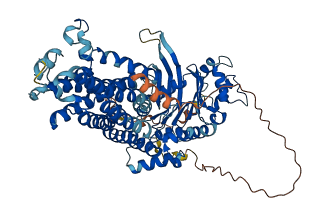
Descriptions
The autoinhibited protein was predicted that may have potential autoinhibitory elements via cis-regPred.
Autoinhibitory domains (AIDs)
Target domain |
|
Relief mechanism |
|
Assay |
cis-regPred |
Accessory elements
No accessory elements
Autoinhibited structure

Activated structure
1 structures for Q64343
| Entry ID | Method | Resolution | Chain | Position | Source |
|---|---|---|---|---|---|
| AF-Q64343-F1 | Predicted | AlphaFoldDB |
34 variants for Q64343
| Variant ID(s) | Position | Change | Description | Diseaes Association | Provenance |
|---|---|---|---|---|---|
| rs3389461365 | 68 | S>F | No | EVA | |
| rs3389456881 | 90 | P>L | No | EVA | |
| rs3389430306 | 111 | G>* | No | EVA | |
| rs3389430342 | 124 | K>E | No | EVA | |
| rs3407234068 | 131 | L>Q | No | EVA | |
| rs3389400188 | 142 | A>G | No | EVA | |
| rs3389444074 | 185 | K>E | No | EVA | |
| rs3389461361 | 223 | K>R | No | EVA | |
| rs3407739975 | 246 | G>D | No | EVA | |
| rs3389452858 | 270 | V>A | No | EVA | |
| rs3389450137 | 270 | V>L | No | EVA | |
| rs3389450105 | 285 | D>A | No | EVA | |
| rs3389452889 | 291 | S>N | No | EVA | |
| rs3389440227 | 297 | Y>F | No | EVA | |
| rs3389400159 | 297 | Y>N | No | EVA | |
| rs3389449067 | 305 | V>L | No | EVA | |
| rs108780066 | 314 | N>S | No | EVA | |
| rs3389456874 | 331 | G>W | No | EVA | |
| rs3389363682 | 358 | G>R | No | EVA | |
| rs3389444016 | 371 | P>L | No | EVA | |
| rs3389440266 | 386 | S>L | No | EVA | |
| rs3389456877 | 392 | Q>H | No | EVA | |
| rs3389456832 | 419 | I>S | No | EVA | |
| rs3389461313 | 459 | M>K | No | EVA | |
| rs51545897 | 470 | S>I | No | EVA | |
| rs3389363661 | 489 | A>T | No | EVA | |
| rs3389418027 | 497 | F>L | No | EVA | |
| rs3389430309 | 502 | P>H | No | EVA | |
| rs3389363676 | 521 | R>S | No | EVA | |
| rs3389430341 | 532 | T>I | No | EVA | |
| rs3407921043 | 538 | S>T | No | EVA | |
| rs3389440270 | 564 | V>I | No | EVA | |
| rs3389447666 | 574 | F>L | No | EVA | |
| rs3389409924 | 636 | L>P | No | EVA |
No associated diseases with Q64343
5 regional properties for Q64343
| Type | Name | Position | InterPro Accession |
|---|---|---|---|
| domain | ABC transporter-like, ATP-binding domain | 77 - 317 | IPR003439 |
| domain | AAA+ ATPase domain | 110 - 293 | IPR003593 |
| domain | ABC-2 type transporter, transmembrane domain | 391 - 599 | IPR013525 |
| conserved_site | ABC transporter-like, conserved site | 217 - 231 | IPR017871 |
| domain | ABC transporter family G domain | 274 - 336 | IPR043926 |
Functions
9 GO annotations of cellular component
| Name | Definition |
|---|---|
| endoplasmic reticulum membrane | The lipid bilayer surrounding the endoplasmic reticulum. |
| endosome | A vacuole to which materials ingested by endocytosis are delivered. |
| external side of plasma membrane | The leaflet of the plasma membrane that faces away from the cytoplasm and any proteins embedded or anchored in it or attached to its surface. |
| Golgi membrane | The lipid bilayer surrounding any of the compartments of the Golgi apparatus. |
| integral component of membrane | The component of a membrane consisting of the gene products and protein complexes having at least some part of their peptide sequence embedded in the hydrophobic region of the membrane. |
| membrane | A lipid bilayer along with all the proteins and protein complexes embedded in it an attached to it. |
| mitochondrion | A semiautonomous, self replicating organelle that occurs in varying numbers, shapes, and sizes in the cytoplasm of virtually all eukaryotic cells. It is notably the site of tissue respiration. |
| plasma membrane | The membrane surrounding a cell that separates the cell from its external environment. It consists of a phospholipid bilayer and associated proteins. |
| recycling endosome | An organelle consisting of a network of tubules that functions in targeting molecules, such as receptors transporters and lipids, to the plasma membrane. |
10 GO annotations of molecular function
| Name | Definition |
|---|---|
| ABC-type sterol transporter activity | Enables the transfer of a solute or solutes from one side of a membrane to the other according to the reaction: ATP + H2O + sterol(in) = ADP + phosphate + sterol(out). |
| ADP binding | Binding to ADP, adenosine 5'-diphosphate. |
| ATP binding | Binding to ATP, adenosine 5'-triphosphate, a universally important coenzyme and enzyme regulator. |
| ATPase-coupled transmembrane transporter activity | Primary active transporter of a solute across a membrane, via the reaction: ATP + H2O = ADP + phosphate, to directly drive the transport of a substance across a membrane. The transport protein may be transiently phosphorylated (P-type transporters), or not (ABC-type transporters and other families of transporters). Primary active transport occurs up the solute's concentration gradient and is driven by a primary energy source. |
| cholesterol transfer activity | Removes cholesterol from a membrane or a monolayer lipid particle, transports it through the aqueous phase while protected in a hydrophobic pocket, and brings it to an acceptor membrane or lipid particle. |
| floppase activity | Catalysis of the movement of a lipid from the cytosolic to the exoplasmic leaftlet of a membrane, using energy from the hydrolysis of ATP. |
| phosphatidylcholine floppase activity | Catalysis of the movement of phosphatidylcholine from the cytosolic to the exoplasmic leaftlet of a membrane, using energy from the hydrolysis of ATP. |
| protein heterodimerization activity | Binding to a nonidentical protein to form a heterodimer. |
| protein homodimerization activity | Binding to an identical protein to form a homodimer. |
| toxin transmembrane transporter activity | Enables the transfer of a toxin from one side of a membrane to the other. A toxin is a poisonous compound (typically a protein) that is produced by cells or organisms and that can cause disease when introduced into the body or tissues of an organism. |
24 GO annotations of biological process
| Name | Definition |
|---|---|
| amyloid precursor protein catabolic process | The chemical reactions and pathways resulting in the breakdown of amyloid precursor protein (APP), the precursor of amyloid-beta, a glycoprotein associated with Alzheimer's disease. |
| cellular response to high density lipoprotein particle stimulus | Any process that results in a change in state or activity of a cell (in terms of movement, secretion, enzyme production, gene expression, etc.) as a result of a high density lipoprotein particle stimulus. |
| cholesterol efflux | The directed movement of cholesterol, cholest-5-en-3-beta-ol, out of a cell or organelle. |
| cholesterol homeostasis | Any process involved in the maintenance of an internal steady state of cholesterol within an organism or cell. |
| cholesterol metabolic process | The chemical reactions and pathways involving cholesterol, cholest-5-en-3 beta-ol, the principal sterol of vertebrates and the precursor of many steroids, including bile acids and steroid hormones. It is a component of the plasma membrane lipid bilayer and of plasma lipoproteins and can be found in all animal tissues. |
| cholesterol transport | The directed movement of cholesterol, cholest-5-en-3-beta-ol, into, out of or within a cell, or between cells, by means of some agent such as a transporter or pore. |
| glycoprotein transport | The directed movement of a glycoprotein, a protein that contains covalently bound glycose (i.e. monosaccharide) residues, into, out of or within a cell, or between cells, by means of some agent such as a transporter or pore. |
| high-density lipoprotein particle remodeling | The acquisition, loss or modification of a protein or lipid within a high-density lipoprotein particle, including the hydrolysis of triglyceride by hepatic lipase, with the subsequent loss of free fatty acid, and the transfer of cholesterol esters from LDL to a triglyceride-rich lipoprotein particle by cholesteryl ester transfer protein (CETP), with the simultaneous transfer of triglyceride to LDL. |
| intracellular cholesterol transport | The directed movement of cholesterol, cholest-5-en-3-beta-ol, within cells. |
| low-density lipoprotein particle remodeling | The acquisition, loss or modification of a protein or lipid within a low-density lipoprotein particle, including the hydrolysis of triglyceride by hepatic lipase, with the subsequent loss of free fatty acid, and the transfer of cholesterol esters from LDL to a triglyceride-rich lipoprotein particle by cholesteryl ester transfer protein (CETP), with the simultaneous transfer of triglyceride to LDL. |
| negative regulation of lipid storage | Any process that decreases the rate, frequency or extent of lipid storage. Lipid storage is the accumulation and maintenance in cells or tissues of lipids, compounds soluble in organic solvents but insoluble or sparingly soluble in aqueous solvents. Lipid reserves can be accumulated during early developmental stages for mobilization and utilization at later stages of development. |
| negative regulation of macrophage derived foam cell differentiation | Any process that decreases the rate, frequency or extent of macrophage derived foam cell differentiation. Macrophage derived foam cell differentiation is the process in which a macrophage acquires the specialized features of a foam cell. A foam cell is a type of cell containing lipids in small vacuoles and typically seen in atherosclerotic lesions, as well as other conditions. |
| phospholipid efflux | The directed movement of a phospholipid out of a cell or organelle. |
| phospholipid homeostasis | Any process involved in the maintenance of an internal steady state of phospholipid within an organism or cell. |
| positive regulation of amyloid-beta formation | Any process that activates or increases the frequency, rate or extent of amyloid-beta formation. |
| positive regulation of cholesterol biosynthetic process | Any process that activates or increases the frequency, rate or extent of the chemical reactions and pathways resulting in the formation of cholesterol. |
| positive regulation of cholesterol efflux | Any process that increases the frequency, rate or extent of cholesterol efflux. Cholesterol efflux is the directed movement of cholesterol, cholest-5-en-3-beta-ol, out of a cell or organelle. |
| positive regulation of insulin secretion involved in cellular response to glucose stimulus | Any process that increases the frequency, rate or extent of the regulated release of insulin that contributes to the response of a cell to glucose. |
| positive regulation of protein secretion | Any process that activates or increases the frequency, rate or extent of the controlled release of a protein from a cell. |
| positive regulation of secretory granule organization | Any process that activates or increases the frequency, rate or extent of secretory granule organization. |
| regulation of cholesterol metabolic process | Any process that modulates the rate, frequency, or extent of cholesterol metabolism, the chemical reactions and pathways involving cholesterol, cholest-5-en-3 beta-ol, the principal sterol of vertebrates and the precursor of many steroids, including bile acids and steroid hormones. |
| response to lipid | Any process that results in a change in state or activity of a cell or an organism (in terms of movement, secretion, enzyme production, gene expression, etc.) as a result of a lipid stimulus. |
| reverse cholesterol transport | The directed movement of peripheral cell cholesterol, cholest-5-en-3-beta-ol, towards the liver for catabolism. |
| transmembrane transport | The process in which a solute is transported across a lipid bilayer, from one side of a membrane to the other. |
10 homologous proteins in AiPD
| UniProt AC | Gene Name | Protein Name | Species | Evidence Code |
|---|---|---|---|---|
| Q9H172 | ABCG4 | ATP-binding cassette sub-family G member 4 | Homo sapiens (Human) | PR |
| P45844 | ABCG1 | ATP-binding cassette sub-family G member 1 | Homo sapiens (Human) | PR |
| Q99PE8 | Abcg5 | ATP-binding cassette sub-family G member 5 | Mus musculus (Mouse) | PR |
| Q99PE7 | Abcg5 | ATP-binding cassette sub-family G member 5 | Rattus norvegicus (Rat) | PR |
| Q09466 | wht-3 | ABC transporter ATP-binding protein/permease wht-3 | Caenorhabditis elegans | PR |
| Q11180 | wht-1 | ABC transporter ATP-binding protein/permease wht-1 | Caenorhabditis elegans | PR |
| Q9MAG3 | ABCG24 | ABC transporter G family member 24 | Arabidopsis thaliana (Mouse-ear cress) | PR |
| Q9M2V6 | ABCG17 | ABC transporter G family member 17 | Arabidopsis thaliana (Mouse-ear cress) | PR |
| Q9MAH4 | ABCG10 | ABC transporter G family member 10 | Arabidopsis thaliana (Mouse-ear cress) | PR |
| Q9SZR9 | ABCG9 | ABC transporter G family member 9 | Arabidopsis thaliana (Mouse-ear cress) | PR |
| 10 | 20 | 30 | 40 | 50 | 60 |
| MACLMAAFSV | GTAMNASSYS | AAMTEPKSVC | VSVDEVVSSN | VDEVETDLLN | GHLKKVDNNF |
| 70 | 80 | 90 | 100 | 110 | 120 |
| TEAQRFSSLP | RRAAVNIEFK | DLSYSVPEGP | WWKKKGYKTL | LKGISGKFNS | GELVAIMGPS |
| 130 | 140 | 150 | 160 | 170 | 180 |
| GAGKSTLMNI | LAGYRETGMK | GAVLINGMPR | DLRCFRKVSC | YIMQDDMLLP | HLTVQEAMMV |
| 190 | 200 | 210 | 220 | 230 | 240 |
| SAHLKLQEKD | EGRREMVKEI | LTALGLLPCA | NTRTGSLSGG | QRKRLAIALE | LVNNPPVMFF |
| 250 | 260 | 270 | 280 | 290 | 300 |
| DEPTSGLDSA | SCFQVVSLMK | GLAQGGRSIV | CTIHQPSAKL | FELFDQLYVL | SQGQCVYRGK |
| 310 | 320 | 330 | 340 | 350 | 360 |
| VSNLVPYLRD | LGLNCPTYHN | PADFVMEVAS | GEYGDQNSRL | VRAVREGMCD | ADYKRDLGGD |
| 370 | 380 | 390 | 400 | 410 | 420 |
| TDVNPFLWHR | PAEEDSASME | GCHSFSASCL | TQFCILFKRT | FLSIMRDSVL | THLRITSHIG |
| 430 | 440 | 450 | 460 | 470 | 480 |
| IGLLIGLLYL | GIGNEAKKVL | SNSGFLFFSM | LFLMFAALMP | TVLTFPLEMS | VFLREHLNYW |
| 490 | 500 | 510 | 520 | 530 | 540 |
| YSLKAYYLAK | TMADVPFQIM | FPVAYCSIVY | WMTSQPSDAV | RFVLFAALGT | MTSLVAQSLG |
| 550 | 560 | 570 | 580 | 590 | 600 |
| LLIGAASTSL | QVATFVGPVT | AIPVLLFSGF | FVSFDTIPAY | LQWMSYISYV | RYGFEGVILS |
| 610 | 620 | 630 | 640 | 650 | 660 |
| IYGLDREDLH | CDIAETCHFQ | KSEAILRELD | VENAKLYLDF | IVLGIFFISL | RLIAYFVLRY |
| KIRAER |