P45376
Gene name |
Akr1b1 |
Protein name |
Aldo-keto reductase family 1 member B1 |
Names |
Aldehyde reductase, Aldo-keto reductase family 1 member B3, Aldose reductase, AR |
Species |
Mus musculus (Mouse) |
KEGG Pathway |
mmu:11677 |
EC number |
1.1.1.21: With NAD(+) or NADP(+) as acceptor |
Protein Class |
|
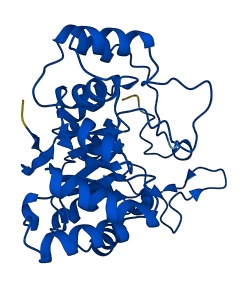
Descriptions
The autoinhibited protein was predicted that may have potential autoinhibitory elements via cis-regPred.
Autoinhibitory domains (AIDs)
Target domain |
|
Relief mechanism |
|
Assay |
cis-regPred |
Accessory elements
No accessory elements
Autoinhibited structure

Activated structure
1 structures for P45376
| Entry ID | Method | Resolution | Chain | Position | Source |
|---|---|---|---|---|---|
| AF-P45376-F1 | Predicted | AlphaFoldDB |
13 variants for P45376
| Variant ID(s) | Position | Change | Description | Diseaes Association | Provenance |
|---|---|---|---|---|---|
| rs3396551050 | 37 | D>N | No | EVA | |
| rs3388789829 | 58 | A>T | No | EVA | |
| rs3388821538 | 60 | Q>P | No | EVA | |
| rs3388805730 | 67 | V>M | No | EVA | |
| rs3388820393 | 100 | L>M | No | EVA | |
| rs585635984 | 155 | K>* | No | EVA | |
| rs3388822632 | 173 | K>Q | No | EVA | |
| rs3388822715 | 177 | K>E | No | EVA | |
| rs3388814988 | 183 | N>K | No | EVA | |
| rs3388823994 | 184 | Q>* | No | EVA | |
| rs3388821508 | 203 | K>T | No | EVA | |
| rs578520318 | 274 | L>F | No | EVA | |
| rs8239444 | 281 | V>L | No | EVA |
No associated diseases with P45376
4 regional properties for P45376
| Type | Name | Position | InterPro Accession |
|---|---|---|---|
| conserved_site | Aldo/keto reductase, conserved site | 39 - 56 | IPR018170-1 |
| conserved_site | Aldo/keto reductase, conserved site | 145 - 162 | IPR018170-2 |
| conserved_site | Aldo/keto reductase, conserved site | 261 - 276 | IPR018170-3 |
| domain | NADP-dependent oxidoreductase domain | 16 - 289 | IPR023210 |
Functions
| Description | ||
|---|---|---|
| EC Number | 1.1.1.21 | With NAD(+) or NADP(+) as acceptor |
| Subcellular Localization |
|
|
| PANTHER Family | ||
| PANTHER Subfamily | ||
| PANTHER Protein Class | ||
| PANTHER Pathway Category | No pathway information available | |
9 GO annotations of cellular component
| Name | Definition |
|---|---|
| cytosol | The part of the cytoplasm that does not contain organelles but which does contain other particulate matter, such as protein complexes. |
| extracellular space | That part of a multicellular organism outside the cells proper, usually taken to be outside the plasma membranes, and occupied by fluid. |
| mast cell granule | Coarse, bluish-black staining cytoplasmic granules, bounded by a plasma membrane and found in mast cells and basophils. Contents include histamine, heparin, chondroitin sulfates, chymase and tryptase. |
| nucleoplasm | That part of the nuclear content other than the chromosomes or the nucleolus. |
| paranodal junction | A highly specialized cell-cell junction found in vertebrates, which forms between a neuron and a glial cell, and has structural similarity to Drosophila septate junctions. It flanks the node of Ranvier in myelinated nerve and electrically isolates the myelinated from unmyelinated nerve segments and physically separates the voltage-gated sodium channels at the node from the cluster of potassium channels underneath the myelin sheath. |
| perinuclear region of cytoplasm | Cytoplasm situated near, or occurring around, the nucleus. |
| plasma membrane bounded cell projection cytoplasm | All of the contents of a plasma membrane bounded cell projection, excluding the plasma membrane surrounding the projection. |
| Schmidt-Lanterman incisure | Regions within compact myelin in which the cytoplasmic faces of the enveloping myelin sheath are not tightly juxtaposed, and include cytoplasm from the cell responsible for making the myelin. Schmidt-Lanterman incisures occur in the compact myelin internode, while lateral loops are analogous structures found in the paranodal region adjacent to the nodes of Ranvier. |
| Schwann cell microvillus | Small finger-like extension of a Schwann cell that contacts the nodal membrane. |
8 GO annotations of molecular function
| Name | Definition |
|---|---|
| alditol:NADP+ 1-oxidoreductase activity | Catalysis of the reaction: an alditol + NADP+ = an aldose + NADPH + H+. |
| allyl-alcohol dehydrogenase activity | Catalysis of the reaction: allyl alcohol + NADP(+) = acrolein + H(+) + NADPH. |
| cis-1,2-dihydro-1,2-dihydroxynaphthalene dehydrogenase activity | Catalysis of the reaction: cis-1,2-dihydronaphthalene-1,2-diol + NAD+ = naphthalene-1,2-diol + NADH + H+. |
| glyceraldehyde oxidoreductase activity | Catalysis of the reaction: A + D-glyceraldehyde + H2O = (R)-glycerate + AH2 + H(+). |
| glycerol dehydrogenase [NADP+] activity | Catalysis of the reaction: glycerol + NADP+ = D-glyceraldehyde + NADPH. |
| NADP-retinol dehydrogenase activity | Catalysis of the reaction: all-trans-retinol + NADP+ = all-trans-retinal + NADPH + H+. |
| prostaglandin H2 endoperoxidase reductase activity | Catalysis of the reaction: prostaglandin H2 + NADPH + H+ -> prostaglandin F2alpha + NADP+. This reaction is the reduction of prostaglandin H2 ((5Z,13E)-(15S)-9alpha,11alpha-Epidioxy-15-hydroxyprosta-5,13-dienoate) to prostaglandin F2alpha ((5Z,13E)-(15S)-9alpha,11alpha,15-Trihydroxyprosta-5,13-dienoate). |
| retinal dehydrogenase activity | Catalysis of the reaction: retinal + NAD+ + H2O = retinoate + NADH. Acts on both 11-trans and 13-cis forms of retinal. |
23 GO annotations of biological process
| Name | Definition |
|---|---|
| cellular hyperosmotic salinity response | Any process that results in a change in state or activity of a cell (in terms of movement, secretion, enzyme production, gene expression, etc.) as a result of detection of, or exposure to, an increase in the concentration of salt (particularly but not exclusively sodium and chloride ions) in the environment. |
| cellular response to hydrogen peroxide | Any process that results in a change in state or activity of a cell (in terms of movement, secretion, enzyme production, gene expression, etc.) as a result of a hydrogen peroxide (H2O2) stimulus. |
| cellular response to methylglyoxal | Any process that results in a change in state or activity of a cell (in terms of movement, secretion, enzyme production, gene expression, etc.) as a result of a methylglyoxal stimulus. Methylglyoxal is a 2-oxoaldehyde derived from propanal. |
| daunorubicin metabolic process | The chemical reactions and pathways involving daunorubicin, a chemotherapeutic of the anthracycline family that is given as a treatment for some types of cancer. |
| doxorubicin metabolic process | The chemical reactions and pathways involving doxorubicin, an anthracycline antibiotic, used in cancer chemotherapy. |
| epithelial cell maturation | The developmental process, independent of morphogenetic (shape) change, that is required for an epithelial cell to attain its fully functional state. An epithelial cell is a cell usually found in a two-dimensional sheet with a free surface. |
| fructose biosynthetic process | The chemical reactions and pathways resulting in the formation of fructose, the ketohexose arabino-2-hexulose. |
| inner medullary collecting duct development | The process whose specific outcome is the progression of the inner medullary collecting duct over time, from its formation to the mature structure. The inner medullary collecting duct is the portion of the collecting duct that lies in the renal inner medulla. |
| metanephric collecting duct development | The process whose specific outcome is the progression of a collecting duct in the metanephros over time, from its formation to the mature structure. The collecting duct responds to vasopressin and aldosterone to regulate water, electrolyte and acid-base balance. The collecting duct is the final common path through which urine flows before entering the ureter and then emptying into the bladder. |
| monosaccharide metabolic process | The chemical reactions and pathways involving monosaccharides, the simplest carbohydrates. They are polyhydric alcohols containing either an aldehyde or a keto group and between three to ten or more carbon atoms. They form the constitutional repeating units of oligo- and polysaccharides. |
| negative regulation of apoptotic process | Any process that stops, prevents, or reduces the frequency, rate or extent of cell death by apoptotic process. |
| norepinephrine metabolic process | The chemical reactions and pathways involving norepinephrine, a hormone secreted by the adrenal medulla, and a neurotransmitter in the sympathetic peripheral nervous system and in some tracts in the central nervous system. It is also the demethylated biosynthetic precursor of epinephrine. |
| organic cyclic compound metabolic process | The chemical reactions and pathways involving organic cyclic compound. |
| positive regulation of receptor signaling pathway via JAK-STAT | Any process that activates or increases the frequency, rate or extent of the JAK-STAT signaling pathway activity. |
| positive regulation of smooth muscle cell proliferation | Any process that activates or increases the rate or extent of smooth muscle cell proliferation. |
| regulation of urine volume | Any process that modulates the amount of urine excreted from the body over a unit of time. |
| renal water homeostasis | Renal process involved in the maintenance of an internal steady state of water in the body. |
| response to organic substance | Any process that results in a change in state or activity of a cell or an organism (in terms of movement, secretion, enzyme production, gene expression, etc.) as a result of an organic substance stimulus. |
| response to water deprivation | Any process that results in a change in state or activity of a cell or an organism (in terms of movement, secretion, enzyme production, gene expression, etc.) as a result of a water deprivation stimulus, prolonged deprivation of water. |
| retinoid metabolic process | The chemical reactions and pathways involving retinoids, any member of a class of isoprenoids that contain or are derived from four prenyl groups linked head-to-tail. Retinoids include retinol and retinal and structurally similar natural derivatives or synthetic compounds, but need not have vitamin A activity. |
| sorbitol biosynthetic process | The chemical reactions and pathways resulting in the formation of sorbitol (D-glucitol), one of the ten stereoisomeric hexitols. It can be derived from glucose by reduction of the aldehyde group. |
| stress-activated protein kinase signaling cascade | The series of molecular signals in which a stress-activated protein kinase (SAPK) cascade relays a signal. |
| tissue homeostasis | A homeostatic process involved in the maintenance of an internal steady state within a defined tissue of an organism, including control of cellular proliferation and death and control of metabolic function. |
10 homologous proteins in AiPD
| UniProt AC | Gene Name | Protein Name | Species | Evidence Code |
|---|---|---|---|---|
| P16116 | AKR1B1 | Aldo-keto reductase family 1 member B1 | Bos taurus (Bovine) | PR |
| O60218 | AKR1B10 | Aldo-keto reductase family 1 member B10 | Homo sapiens (Human) | PR |
| P15121 | AKR1B1 | Aldo-keto reductase family 1 member B1 | Homo sapiens (Human) | PR |
| P45377 | Akr1b8 | Aldose reductase-related protein 2 | Mus musculus (Mouse) | PR |
| P80276 | AKR1B1 | Aldo-keto reductase family 1 member B1 | Sus scrofa (Pig) | PR |
| P07943 | Akr1b1 | Aldo-keto reductase family 1 member B1 | Rattus norvegicus (Rat) | PR |
| Q84TF0 | AKR4C10 | Aldo-keto reductase family 4 member C10 | Arabidopsis thaliana (Mouse-ear cress) | PR |
| Q9M338 | AKR4C11 | Aldo-keto reductase family 4 member C11 | Arabidopsis thaliana (Mouse-ear cress) | PR |
| Q0PGJ6 | AKR4C9 | NADPH-dependent aldo-keto reductase, chloroplastic | Arabidopsis thaliana (Mouse-ear cress) | PR |
| O80944 | AKR4C8 | Aldo-keto reductase family 4 member C8 | Arabidopsis thaliana (Mouse-ear cress) | PR |
| 10 | 20 | 30 | 40 | 50 | 60 |
| MASHLELNNG | TKMPTLGLGT | WKSPPGQVTE | AVKVAIDLGY | RHIDCAQVYQ | NEKEVGVALQ |
| 70 | 80 | 90 | 100 | 110 | 120 |
| EKLKEQVVKR | QDLFIVSKLW | CTFHDKSMVK | GAFQKTLSDL | QLDYLDLYLI | HWPTGFKPGP |
| 130 | 140 | 150 | 160 | 170 | 180 |
| DYFPLDASGN | VIPSDTDFVD | TWTAMEQLVD | EGLVKTIGVS | NFNPLQIERI | LNKPGLKYKP |
| 190 | 200 | 210 | 220 | 230 | 240 |
| AVNQIECHPY | LTQEKLIEYC | HSKGIVVTAY | SPLGSPDRPW | AKPEDPSLLE | DPRIKAIAAK |
| 250 | 260 | 270 | 280 | 290 | 300 |
| YNKTTAQVLI | RFPIQRNLVV | IPKSVTPVRI | AENLKVFDFE | VSSEDMATLL | SYNRNWRVCA |
| 310 | |||||
| LMSCAKHKDY | PFHAEV |