P42558
Gene name |
RAN |
Protein name |
GTP-binding nuclear protein Ran |
Names |
GTPase Ran, Ras-like protein TC4, Ras-related nuclear protein |
Species |
Gallus gallus (Chicken) |
KEGG Pathway |
gga:396193 |
EC number |
|
Protein Class |
|
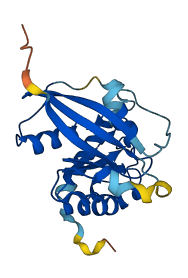
Descriptions
The autoinhibited protein was predicted that may have potential autoinhibitory elements via cis-regPred.
Autoinhibitory domains (AIDs)
Target domain |
|
Relief mechanism |
|
Assay |
cis-regPred |
Accessory elements
No accessory elements
Autoinhibited structure

Activated structure
1 structures for P42558
| Entry ID | Method | Resolution | Chain | Position | Source |
|---|---|---|---|---|---|
| AF-P42558-F1 | Predicted | AlphaFoldDB |
3 variants for P42558
| Variant ID(s) | Position | Change | Description | Diseaes Association | Provenance |
|---|---|---|---|---|---|
| rs10730631 | 3 | A>S | No | Ensembl | |
| rs736657426 | 70 | E>G | No | Ensembl | |
| rs10724557 | 84 | Q>* | No | Ensembl |
No associated diseases with P42558
1 regional properties for P42558
| Type | Name | Position | InterPro Accession |
|---|---|---|---|
| domain | NAD(P)-binding domain | 6 - 331 | IPR016040 |
Functions
11 GO annotations of cellular component
| Name | Definition |
|---|---|
| centriole | A cellular organelle, found close to the nucleus in many eukaryotic cells, consisting of a small cylinder with microtubular walls, 300-500 nm long and 150-250 nm in diameter. It contains nine short, parallel, peripheral microtubular fibrils, each fibril consisting of one complete microtubule fused to two incomplete microtubules. Cells usually have two centrioles, lying at right angles to each other. At division, each pair of centrioles generates another pair and the twin pairs form the pole of the mitotic spindle. |
| chromatin | The ordered and organized complex of DNA, protein, and sometimes RNA, that forms the chromosome. |
| cytoplasm | The contents of a cell excluding the plasma membrane and nucleus, but including other subcellular structures. |
| cytosol | The part of the cytoplasm that does not contain organelles but which does contain other particulate matter, such as protein complexes. |
| midbody | A thin cytoplasmic bridge formed between daughter cells at the end of cytokinesis. The midbody forms where the contractile ring constricts, and may persist for some time before finally breaking to complete cytokinesis. |
| nuclear envelope | The double lipid bilayer enclosing the nucleus and separating its contents from the rest of the cytoplasm; includes the intermembrane space, a gap of width 20-40 nm (also called the perinuclear space). |
| nucleolus | A small, dense body one or more of which are present in the nucleus of eukaryotic cells. It is rich in RNA and protein, is not bounded by a limiting membrane, and is not seen during mitosis. Its prime function is the transcription of the nucleolar DNA into 45S ribosomal-precursor RNA, the processing of this RNA into 5.8S, 18S, and 28S components of ribosomal RNA, and the association of these components with 5S RNA and proteins synthesized outside the nucleolus. This association results in the formation of ribonucleoprotein precursors; these pass into the cytoplasm and mature into the 40S and 60S subunits of the ribosome. |
| nucleoplasm | That part of the nuclear content other than the chromosomes or the nucleolus. |
| nucleus | A membrane-bounded organelle of eukaryotic cells in which chromosomes are housed and replicated. In most cells, the nucleus contains all of the cell's chromosomes except the organellar chromosomes, and is the site of RNA synthesis and processing. In some species, or in specialized cell types, RNA metabolism or DNA replication may be absent. |
| recycling endosome | An organelle consisting of a network of tubules that functions in targeting molecules, such as receptors transporters and lipids, to the plasma membrane. |
| RNA nuclear export complex | A complex which usually consists of three components, e.g. in Xenopus and yeast, the export receptor CRM1 (also known as exportin 1), the Ran protein and any RNA with a nuclear export sequence (NES). The complex acts to export RNA molecules with a NES from the nucleus through a nuclear pore. |
6 GO annotations of molecular function
| Name | Definition |
|---|---|
| GDP binding | Binding to GDP, guanosine 5'-diphosphate. |
| GTP binding | Binding to GTP, guanosine triphosphate. |
| GTPase activity | Catalysis of the reaction: GTP + H2O = GDP + H+ + phosphate. |
| magnesium ion binding | Binding to a magnesium (Mg) ion. |
| pre-miRNA binding | Binding to a precursor microRNA (pre-miRNA) transcript, a stem-loop-containing precursor of microRNA. |
| protein heterodimerization activity | Binding to a nonidentical protein to form a heterodimer. |
11 GO annotations of biological process
| Name | Definition |
|---|---|
| GTP metabolic process | The chemical reactions and pathways involving GTP, guanosine triphosphate. |
| mitotic sister chromatid segregation | The cell cycle process in which replicated homologous chromosomes are organized and then physically separated and apportioned to two sets during the mitotic cell cycle. Each replicated chromosome, composed of two sister chromatids, aligns at the cell equator, paired with its homologous partner. One homolog of each morphologic type goes into each of the resulting chromosome sets. |
| positive regulation of protein binding | Any process that activates or increases the frequency, rate or extent of protein binding. |
| positive regulation of protein import into nucleus | Any process that activates or increases the frequency, rate or extent of movement of proteins from the cytoplasm into the nucleus. |
| protein export from nucleus | The directed movement of a protein from the nucleus into the cytoplasm. |
| protein import into nucleus | The directed movement of a protein from the cytoplasm to the nucleus. |
| protein localization to nucleolus | A process in which a protein is transported to, or maintained in, a location within a nucleolus. |
| ribosomal large subunit export from nucleus | The directed movement of a ribosomal large subunit from the nucleus into the cytoplasm. |
| ribosomal small subunit export from nucleus | The directed movement of a ribosomal small subunit from the nucleus into the cytoplasm. |
| ribosomal subunit export from nucleus | The directed movement of a ribosomal subunit from the nucleus into the cytoplasm. |
| snRNA import into nucleus | The directed movement of snRNA, small nuclear ribonucleic acid into the nucleus. |
12 homologous proteins in AiPD
| UniProt AC | Gene Name | Protein Name | Species | Evidence Code |
|---|---|---|---|---|
| P32836 | GSP2 | GTP-binding nuclear protein GSP2/CNR2 | Saccharomyces cerevisiae (strain ATCC 204508 / S288c) (Baker's yeast) | PR |
| P32835 | GSP1 | GTP-binding nuclear protein GSP1/CNR1 | Saccharomyces cerevisiae (strain ATCC 204508 / S288c) (Baker's yeast) | PR |
| Q9VZ23 | Ran | GTP-binding nuclear protein Ran | Drosophila melanogaster (Fruit fly) | PR |
| Q7F7I7 | RAN1 | GTP-binding nuclear protein Ran-1 | Oryza sativa subsp japonica (Rice) | PR |
| Q7GD79 | RAN2 | GTP-binding nuclear protein Ran-2 | Oryza sativa subsp japonica (Rice) | PR |
| O17915 | ran-1 | GTP-binding nuclear protein ran-1 | Caenorhabditis elegans | PR |
| P41916 | RAN1 | GTP-binding nuclear protein Ran-1 | Arabidopsis thaliana (Mouse-ear cress) | PR |
| P41917 | RAN2 | GTP-binding nuclear protein Ran-2 | Arabidopsis thaliana (Mouse-ear cress) | PR |
| Q8H156 | RAN3 | GTP-binding nuclear protein Ran-3 | Arabidopsis thaliana (Mouse-ear cress) | PR |
| P38546 | RAN1 | GTP-binding nuclear protein Ran1 | Solanum lycopersicum (Tomato) (Lycopersicon esculentum) | PR |
| P38547 | RAN2 | GTP-binding nuclear protein Ran2 | Solanum lycopersicum (Tomato) (Lycopersicon esculentum) | PR |
| Q6GL85 | ran | GTP-binding nuclear protein Ran | Xenopus tropicalis (Western clawed frog) (Silurana tropicalis) | PR |
| 10 | 20 | 30 | 40 | 50 | 60 |
| MAAQGEPQVQ | FKLVLVGDGG | TGKTTFVKRH | LTGEFEKKYV | ATLGVEVHPL | VFHTNRGPIK |
| 70 | 80 | 90 | 100 | 110 | 120 |
| FNVWDTAGQE | KFGGLRDGYY | IQAQCAIIMF | DVTSRVTYKN | VPNWHRDLVR | VCENIPIVLC |
| 130 | 140 | 150 | 160 | 170 | 180 |
| GNKVDIKDRK | VKAKSIVFHR | KKNLQYYDIS | AKSNYNFEKP | FLWLARKLIG | DPNLEFVAMP |
| 190 | 200 | 210 | |||
| ALAPPEVVMD | PALAAQYEQD | LQIAQTTALP | DEDDDL |