P41251
Gene name |
Slc11a1 (Bcg, Ity, Lsh, Nramp1) |
Protein name |
Natural resistance-associated macrophage protein 1 |
Names |
NRAMP 1, Solute carrier family 11 member 1 |
Species |
Mus musculus (Mouse) |
KEGG Pathway |
mmu:18173 |
EC number |
|
Protein Class |
|
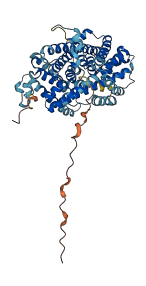
Descriptions
The autoinhibited protein was predicted that may have potential autoinhibitory elements via cis-regPred.
Autoinhibitory domains (AIDs)
Target domain |
|
Relief mechanism |
|
Assay |
cis-regPred |
Accessory elements
No accessory elements
Autoinhibited structure

Activated structure
1 structures for P41251
| Entry ID | Method | Resolution | Chain | Position | Source |
|---|---|---|---|---|---|
| AF-P41251-F1 | Predicted | AlphaFoldDB |
23 variants for P41251
| Variant ID(s) | Position | Change | Description | Diseaes Association | Provenance |
|---|---|---|---|---|---|
| rs264004332 | 29 | A>V | No | EVA | |
| rs217642798 | 48 | G>D | No | EVA | |
| rs3390183481 | 109 | R>Q | No | EVA | |
| rs3390135499 | 110 | L>P | No | EVA | |
| rs3388477279 | 116 | K>M | No | EVA | |
| rs3388476821 | 147 | M>K | No | EVA | |
| rs3388479962 | 157 | F>L | No | EVA | |
| rs47476426 | 169 | D>G | No | EVA | |
| rs255785786 | 218 | Q>P | No | EVA | |
| rs3388477818 | 265 | E>A | No | EVA | |
| rs3388479148 | 279 | M>L | No | EVA | |
| rs3388476786 | 297 | L>P | No | EVA | |
| rs3388476484 | 331 | F>S | No | EVA | |
| rs3388476873 | 342 | I>M | No | EVA | |
| rs231711272 | 391 | R>Q | No | EVA | |
| rs3388477195 | 426 | D>V | No | EVA | |
| rs3388477100 | 428 | L>V | No | EVA | |
| rs3388477015 | 434 | L>Q | No | EVA | |
| rs3388478312 | 455 | E>K | No | EVA | |
| rs3388477734 | 461 | M>K | No | EVA | |
| rs254750960 | 461 | M>L | No | EVA | |
| rs3388479184 | 511 | L>M | No | EVA | |
| rs3388476898 | 545 | Q>K | No | EVA |
No associated diseases with P41251
No regional properties for P41251
| Type | Name | Position | InterPro Accession |
|---|---|---|---|
| No domain, repeats, and functional sites for P41251 | |||
Functions
7 GO annotations of cellular component
| Name | Definition |
|---|---|
| endosome membrane | The lipid bilayer surrounding an endosome. |
| integral component of membrane | The component of a membrane consisting of the gene products and protein complexes having at least some part of their peptide sequence embedded in the hydrophobic region of the membrane. |
| late endosome | A prelysosomal endocytic organelle differentiated from early endosomes by lower lumenal pH and different protein composition. Late endosomes are more spherical than early endosomes and are mostly juxtanuclear, being concentrated near the microtubule organizing center. |
| lysosome | A small lytic vacuole that has cell cycle-independent morphology found in most animal cells and that contains a variety of hydrolases, most of which have their maximal activities in the pH range 5-6. The contained enzymes display latency if properly isolated. About 40 different lysosomal hydrolases are known and lysosomes have a great variety of morphologies and functions. |
| phagocytic vesicle membrane | The lipid bilayer surrounding a phagocytic vesicle. |
| plasma membrane | The membrane surrounding a cell that separates the cell from its external environment. It consists of a phospholipid bilayer and associated proteins. |
| tertiary granule membrane | The lipid bilayer surrounding a tertiary granule. |
6 GO annotations of molecular function
| Name | Definition |
|---|---|
| cadmium ion transmembrane transporter activity | Enables the transfer of cadmium (Cd) ions from one side of a membrane to the other. |
| iron ion transmembrane transporter activity | Enables the transfer of iron (Fe) ions from one side of a membrane to the other. |
| manganese ion transmembrane transporter activity | Enables the transfer of manganese (Mn) ions from one side of a membrane to the other. |
| metal cation:proton antiporter activity | Enables the transfer of a solute or solutes from one side of a membrane to the other according to the reaction: metal ion(in) + H+(out) = metal ion(out) + H+(in). |
| protein homodimerization activity | Binding to an identical protein to form a homodimer. |
| transition metal ion transmembrane transporter activity | Enables the transfer of transition metal ions from one side of a membrane to the other. A transition metal is an element whose atom has an incomplete d-subshell of extranuclear electrons, or which gives rise to a cation or cations with an incomplete d-subshell. Transition metals often have more than one valency state. Biologically relevant transition metals include vanadium, manganese, iron, copper, cobalt, nickel, molybdenum and silver. |
37 GO annotations of biological process
| Name | Definition |
|---|---|
| activation of protein kinase activity | Any process that initiates the activity of an inactive protein kinase. |
| antigen processing and presentation of peptide antigen | The process in which an antigen-presenting cell expresses peptide antigen in association with an MHC protein complex on its cell surface, including proteolysis and transport steps for the peptide antigen both prior to and following assembly with the MHC protein complex. The peptide antigen is typically, but not always, processed from an endogenous or exogenous protein. |
| cadmium ion transmembrane transport | A process in which a cadmium ion is transported from one side of a membrane to the other by means of some agent such as a transporter or pore. |
| cellular cadmium ion homeostasis | Any process involved in the maintenance of an internal steady state of cadmium ions at the level of a cell. |
| cellular iron ion homeostasis | Any process involved in the maintenance of an internal steady state of iron ions at the level of a cell. |
| defense response to bacterium | Reactions triggered in response to the presence of a bacterium that act to protect the cell or organism. |
| defense response to Gram-negative bacterium | Reactions triggered in response to the presence of a Gram-negative bacterium that act to protect the cell or organism. |
| defense response to protozoan | Reactions triggered in response to the presence of a protozoan that act to protect the cell or organism. |
| establishment of localization in cell | Any process, occuring in a cell, that localizes a substance or cellular component. This may occur via movement, tethering or selective degradation. |
| inflammatory response | The immediate defensive reaction (by vertebrate tissue) to infection or injury caused by chemical or physical agents. The process is characterized by local vasodilation, extravasation of plasma into intercellular spaces and accumulation of white blood cells and macrophages. |
| iron ion homeostasis | Any process involved in the maintenance of an internal steady state of iron ions within an organism or cell. |
| iron ion transport | The directed movement of iron (Fe) ions into, out of or within a cell, or between cells, by means of some agent such as a transporter or pore. |
| L-arginine transmembrane transport | The directed movement of L-arginine across a membrane. |
| macrophage activation | A change in morphology and behavior of a macrophage resulting from exposure to a cytokine, chemokine, cellular ligand, or soluble factor. |
| manganese ion transport | The directed movement of manganese (Mn) ions into, out of or within a cell, or between cells, by means of some agent such as a transporter or pore. |
| MAPK cascade | An intracellular protein kinase cascade containing at least a MAPK, a MAPKK and a MAP3K. The cascade can also contain an additional tiers: the upstream MAP4K. The kinases in each tier phosphorylate and activate the kinase in the downstream tier to transmit a signal within a cell. |
| metal ion transport | The directed movement of metal ions, any metal ion with an electric charge, into, out of or within a cell, or between cells, by means of some agent such as a transporter or pore. |
| MHC class II biosynthetic process | The chemical reactions and pathways resulting in the formation of major histocompatibility protein class II. |
| mRNA stabilization | Prevention of degradation of mRNA molecules. In the absence of compensating changes in other processes, the slowing of mRNA degradation can result in an overall increase in the population of active mRNA molecules. |
| multicellular organismal iron ion homeostasis | Any process involved in the maintenance of the distribution of iron stores within tissues and organs of a multicellular organism. |
| negative regulation of cytokine production | Any process that stops, prevents, or reduces the rate of production of a cytokine. |
| nitrite transport | The directed movement of nitrite into, out of or within a cell, or between cells, by means of some agent such as a transporter or pore. |
| phagocytosis | A vesicle-mediated transport process that results in the engulfment of external particulate material by phagocytes and their delivery to the lysosome. The particles are initially contained within phagocytic vacuoles (phagosomes), which then fuse with primary lysosomes to effect digestion of the particles. |
| positive regulation of cytokine production | Any process that activates or increases the frequency, rate or extent of production of a cytokine. |
| positive regulation of dendritic cell antigen processing and presentation | Any process that activates or increases the frequency, rate, or extent of dendritic cell antigen processing and presentation. |
| positive regulation of gene expression | Any process that increases the frequency, rate or extent of gene expression. Gene expression is the process in which a gene's coding sequence is converted into a mature gene product (protein or RNA). |
| positive regulation of interferon-gamma production | Any process that activates or increases the frequency, rate, or extent of interferon-gamma production. Interferon-gamma is also known as type II interferon. |
| positive regulation of phagocytosis | Any process that activates or increases the frequency, rate or extent of phagocytosis. |
| positive regulation of T-helper 1 type immune response | Any process that activates or increases the frequency, rate, or extent of a T-helper 1 type immune response. |
| positive regulation of transcription by RNA polymerase II | Any process that activates or increases the frequency, rate or extent of transcription from an RNA polymerase II promoter. |
| respiratory burst | A phase of elevated metabolic activity, during which oxygen consumption increases; this leads to the production, by an NADH dependent system, of hydrogen peroxide (H2O2), superoxide anions and hydroxyl radicals. |
| response to bacterium | Any process that results in a change in state or activity of a cell or an organism (in terms of movement, secretion, enzyme production, gene expression, etc.) as a result of a stimulus from a bacterium. |
| response to interferon-gamma | Any process that results in a change in state or activity of a cell or an organism (in terms of movement, secretion, enzyme production, gene expression, etc.) as a result of an interferon-gamma stimulus. Interferon-gamma is also known as type II interferon. |
| response to lipopolysaccharide | Any process that results in a change in state or activity of an organism (in terms of movement, secretion, enzyme production, gene expression, etc.) as a result of a lipopolysaccharide stimulus; lipopolysaccharide is a major component of the cell wall of gram-negative bacteria. |
| T cell proliferation involved in immune response | The expansion of a T cell population by cell division as part of an immune response. |
| vacuolar acidification | Any process that reduces the pH of the vacuole, measured by the concentration of the hydrogen ion. |
| wound healing | The series of events that restore integrity to a damaged tissue, following an injury. |
12 homologous proteins in AiPD
| UniProt AC | Gene Name | Protein Name | Species | Evidence Code |
|---|---|---|---|---|
| Q27981 | SLC11A1 | Natural resistance-associated macrophage protein 1 | Bos taurus (Bovine) | PR |
| P49281 | SLC11A2 | Natural resistance-associated macrophage protein 2 | Homo sapiens (Human) | PR |
| P49279 | SLC11A1 | Natural resistance-associated macrophage protein 1 | Homo sapiens (Human) | PR |
| P49282 | Slc11a2 | Natural resistance-associated macrophage protein 2 | Mus musculus (Mouse) | PR |
| O77741 | SLC11A1 | Natural resistance-associated macrophage protein 1 | Sus scrofa (Pig) | PR |
| O54902 | Slc11a2 | Natural resistance-associated macrophage protein 2 | Rattus norvegicus (Rat) | PR |
| P70553 | Slc11a1 | Natural resistance-associated macrophage protein 1 | Rattus norvegicus (Rat) | PR |
| Q2QN30 | NRAMP6 | Metal transporter Nramp6 | Oryza sativa subsp japonica (Rice) | PR |
| Q6ZG85 | NRAT1 | Metal transporter NRAT1 | Oryza sativa subsp japonica (Rice) | PR |
| Q9C6B2 | NRAMP2 | Metal transporter Nramp2 | Arabidopsis thaliana (Mouse-ear cress) | PR |
| Q9SN36 | NRAMP5 | Metal transporter Nramp5 | Arabidopsis thaliana (Mouse-ear cress) | PR |
| Q9SNV9 | NRAMP3 | Metal transporter Nramp3 | Arabidopsis thaliana (Mouse-ear cress) | PR |
| 10 | 20 | 30 | 40 | 50 | 60 |
| MISDKSPPRL | SRPSYGSISS | LPGPAPQPAP | CRETYLSEKI | PIPSADQGTF | SLRKLWAFTG |
| 70 | 80 | 90 | 100 | 110 | 120 |
| PGFLMSIAFL | DPGNIESDLQ | AGAVAGFKLL | WVLLWATVLG | LLCQRLAARL | GVVTGKDLGE |
| 130 | 140 | 150 | 160 | 170 | 180 |
| VCHLYYPKVP | RILLWLTIEL | AIVGSDMQEV | IGTAISFNLL | SAGRIPLWDG | VLITIVDTFF |
| 190 | 200 | 210 | 220 | 230 | 240 |
| FLFLDNYGLR | KLEAFFGLLI | TIMALTFGYE | YVVAHPSQGA | LLKGLVLPTC | PGCGQPELLQ |
| 250 | 260 | 270 | 280 | 290 | 300 |
| AVGIVGAIIM | PHNIYLHSAL | VKSREVDRTR | RVDVREANMY | FLIEATIALS | VSFIINLFVM |
| 310 | 320 | 330 | 340 | 350 | 360 |
| AVFGQAFYQQ | TNEEAFNICA | NSSLQNYAKI | FPRDNNTVSV | DIYQGGVILG | CLFGPAALYI |
| 370 | 380 | 390 | 400 | 410 | 420 |
| WAVGLLAAGQ | SSTMTGTYAG | QFVMEGFLKL | RWSRFARVLL | TRSCAILPTV | LVAVFRDLKD |
| 430 | 440 | 450 | 460 | 470 | 480 |
| LSGLNDLLNV | LQSLLLPFAV | LPILTFTSMP | AVMQEFANGR | MSKAITSCIM | ALVCAINLYF |
| 490 | 500 | 510 | 520 | 530 | 540 |
| VISYLPSLPH | PAYFGLVALF | AIGYLGLTAY | LAWTCCIAHG | ATFLTHSSHK | HFLYGLPNEE |
| QGGVQGSG |