O54902
Gene name |
Slc11a2 (Dct1, Dmt1, Nramp2) |
Protein name |
Natural resistance-associated macrophage protein 2 |
Names |
MRC OX-2 antigen, NRAMP 2, Divalent cation transporter 1, Divalent metal transporter 1, DMT-1, Solute carrier family 11 member 2 |
Species |
Rattus norvegicus (Rat) |
KEGG Pathway |
rno:25715 |
EC number |
|
Protein Class |
|
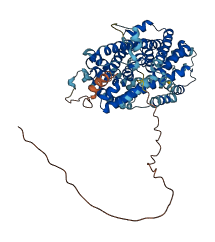
Descriptions
The autoinhibited protein was predicted that may have potential autoinhibitory elements via cis-regPred.
Autoinhibitory domains (AIDs)
Target domain |
|
Relief mechanism |
|
Assay |
cis-regPred |
Accessory elements
No accessory elements
Autoinhibited structure

Activated structure
1 structures for O54902
| Entry ID | Method | Resolution | Chain | Position | Source |
|---|---|---|---|---|---|
| AF-O54902-F1 | Predicted | AlphaFoldDB |
1 variants for O54902
| Variant ID(s) | Position | Change | Description | Diseaes Association | Provenance |
|---|---|---|---|---|---|
| 185 | G>R | microcytic anemia; impairs metal ion transport [UniProt] | No |
1 associated diseases with O54902
Without disease ID
No regional properties for O54902
| Type | Name | Position | InterPro Accession |
|---|---|---|---|
| No domain, repeats, and functional sites for O54902 | |||
Functions
23 GO annotations of cellular component
| Name | Definition |
|---|---|
| apical part of cell | The region of a polarized cell that forms a tip or is distal to a base. For example, in a polarized epithelial cell, the apical region has an exposed surface and lies opposite to the basal lamina that separates the epithelium from other tissue. |
| apical plasma membrane | The region of the plasma membrane located at the apical end of the cell. |
| basal part of cell | The region of a cell situated near the base. For example, in a polarized epithelial cell, the basal surface rests on the basal lamina that separates the epithelium from other tissue. |
| brush border membrane | The portion of the plasma membrane surrounding the brush border. |
| cell surface | The external part of the cell wall and/or plasma membrane. |
| cytoplasm | The contents of a cell excluding the plasma membrane and nucleus, but including other subcellular structures. |
| cytoplasmic vesicle | A vesicle found in the cytoplasm of a cell. |
| early endosome | A membrane-bounded organelle that receives incoming material from primary endocytic vesicles that have been generated by clathrin-dependent and clathrin-independent endocytosis; vesicles fuse with the early endosome to deliver cargo for sorting into recycling or degradation pathways. |
| endosome | A vacuole to which materials ingested by endocytosis are delivered. |
| extracellular vesicle | Any vesicle that is part of the extracellular region. |
| integral component of membrane | The component of a membrane consisting of the gene products and protein complexes having at least some part of their peptide sequence embedded in the hydrophobic region of the membrane. |
| integral component of plasma membrane | The component of the plasma membrane consisting of the gene products and protein complexes having at least some part of their peptide sequence embedded in the hydrophobic region of the membrane. |
| late endosome | A prelysosomal endocytic organelle differentiated from early endosomes by lower lumenal pH and different protein composition. Late endosomes are more spherical than early endosomes and are mostly juxtanuclear, being concentrated near the microtubule organizing center. |
| late endosome membrane | The lipid bilayer surrounding a late endosome. |
| lysosomal membrane | The lipid bilayer surrounding the lysosome and separating its contents from the cell cytoplasm. |
| mitochondrial outer membrane | The outer, i.e. cytoplasm-facing, lipid bilayer of the mitochondrial envelope. |
| nucleus | A membrane-bounded organelle of eukaryotic cells in which chromosomes are housed and replicated. In most cells, the nucleus contains all of the cell's chromosomes except the organellar chromosomes, and is the site of RNA synthesis and processing. In some species, or in specialized cell types, RNA metabolism or DNA replication may be absent. |
| paraferritin complex | A cytoplasmic protein complex that contains integrin, mobilferrin and a flavin monooxygenase, is capable of reducing Fe(III) to Fe(II) utilizing NADPH, and is involved in iron transport. Fe(II) is required in the cell as the substrate for ferrochelatase in the synthesis of heme. |
| perinuclear region of cytoplasm | Cytoplasm situated near, or occurring around, the nucleus. |
| plasma membrane | The membrane surrounding a cell that separates the cell from its external environment. It consists of a phospholipid bilayer and associated proteins. |
| recycling endosome | An organelle consisting of a network of tubules that functions in targeting molecules, such as receptors transporters and lipids, to the plasma membrane. |
| trans-Golgi network | The network of interconnected tubular and cisternal structures located within the Golgi apparatus on the side distal to the endoplasmic reticulum, from which secretory vesicles emerge. The trans-Golgi network is important in the later stages of protein secretion where it is thought to play a key role in the sorting and targeting of secreted proteins to the correct destination. |
| vacuole | A closed structure, found only in eukaryotic cells, that is completely surrounded by unit membrane and contains liquid material. Cells contain one or several vacuoles, that may have different functions from each other. Vacuoles have a diverse array of functions. They can act as a storage organelle for nutrients or waste products, as a degradative compartment, as a cost-effective way of increasing cell size, and as a homeostatic regulator controlling both turgor pressure and pH of the cytosol. |
19 GO annotations of molecular function
| Name | Definition |
|---|---|
| cadmium ion binding | Binding to a cadmium ion (Cd). |
| cadmium ion transmembrane transporter activity | Enables the transfer of cadmium (Cd) ions from one side of a membrane to the other. |
| cobalt ion binding | Binding to a cobalt ion (Co). |
| cobalt ion transmembrane transporter activity | Enables the transfer of cobalt (Co) ions from one side of a membrane to the other. |
| copper ion binding | Binding to a copper (Cu) ion. |
| copper ion transmembrane transporter activity | Enables the transfer of copper (Cu) ions from one side of a membrane to the other. |
| ferrous iron transmembrane transporter activity | Enables the transfer of ferrous iron (Fe(II) or Fe2+) ions from one side of a membrane to the other. |
| inorganic cation transmembrane transporter activity | Enables the transfer of inorganic cations from one side of a membrane to the other. Inorganic cations are atoms or small molecules with a positive charge that do not contain carbon in covalent linkage. |
| iron ion binding | Binding to an iron (Fe) ion. |
| iron ion transmembrane transporter activity | Enables the transfer of iron (Fe) ions from one side of a membrane to the other. |
| lead ion transmembrane transporter activity | Enables the transfer of lead (Pb) ions from one side of a membrane to the other. |
| manganese ion binding | Binding to a manganese ion (Mn). |
| manganese ion transmembrane transporter activity | Enables the transfer of manganese (Mn) ions from one side of a membrane to the other. |
| nickel cation binding | Binding to a nickel (Ni) cation. |
| nickel cation transmembrane transporter activity | Enables the transfer of nickel (Ni) cations from one side of a membrane to the other. |
| solute:proton symporter activity | Enables the transfer of a solute or solutes from one side of a membrane to the other according to the reaction: solute(out) + H+(out) = solute(in) + H+(in). |
| transition metal ion transmembrane transporter activity | Enables the transfer of transition metal ions from one side of a membrane to the other. A transition metal is an element whose atom has an incomplete d-subshell of extranuclear electrons, or which gives rise to a cation or cations with an incomplete d-subshell. Transition metals often have more than one valency state. Biologically relevant transition metals include vanadium, manganese, iron, copper, cobalt, nickel, molybdenum and silver. |
| vanadium ion transmembrane transporter activity | Enables the transfer of vanadium (V) ions from one side of a membrane to the other. |
| zinc ion binding | Binding to a zinc ion (Zn). |
27 GO annotations of biological process
| Name | Definition |
|---|---|
| cadmium ion transmembrane transport | A process in which a cadmium ion is transported from one side of a membrane to the other by means of some agent such as a transporter or pore. |
| cellular response to hypoxia | Any process that results in a change in state or activity of a cell (in terms of movement, secretion, enzyme production, gene expression, etc.) as a result of a stimulus indicating lowered oxygen tension. Hypoxia, defined as a decline in O2 levels below normoxic levels of 20.8 - 20.95%, results in metabolic adaptation at both the cellular and organismal level. |
| cellular response to iron ion | Any process that results in a change in state or activity of a cell (in terms of movement, secretion, enzyme production, gene expression, etc.) as a result of an iron ion stimulus. |
| cellular response to tumor necrosis factor | Any process that results in a change in state or activity of a cell (in terms of movement, secretion, enzyme production, gene expression, etc.) as a result of a tumor necrosis factor stimulus. |
| cobalt ion transport | The directed movement of cobalt (Co) ions into, out of or within a cell, or between cells, by means of some agent such as a transporter or pore. |
| copper ion import across plasma membrane | The directed movement of copper ions from outside of a cell, across the plasma membrane and into the cytosol. |
| copper ion transport | The directed movement of copper (Cu) ions into, out of or within a cell, or between cells, by means of some agent such as a transporter or pore. |
| dendrite morphogenesis | The process in which the anatomical structures of a dendrite are generated and organized. |
| erythrocyte development | The process whose specific outcome is the progression of an erythrocyte over time, from its formation to the mature structure. |
| establishment of localization in cell | Any process, occuring in a cell, that localizes a substance or cellular component. This may occur via movement, tethering or selective degradation. |
| heme biosynthetic process | The chemical reactions and pathways resulting in the formation of heme, any compound of iron complexed in a porphyrin (tetrapyrrole) ring, from less complex precursors. |
| iron import into cell | The directed movement of iron ions from outside of a cell into the cytoplasmic compartment. This may occur via transport across the plasma membrane or via endocytosis. |
| iron ion transmembrane transport | A process in which an iron ion is transported from one side of a membrane to the other by means of some agent such as a transporter or pore. |
| iron ion transport | The directed movement of iron (Fe) ions into, out of or within a cell, or between cells, by means of some agent such as a transporter or pore. |
| lead ion transport | The directed movement of lead (Pb) ions into, out of or within a cell, or between cells, by means of some agent such as a transporter or pore. |
| learning or memory | The acquisition and processing of information and/or the storage and retrieval of this information over time. |
| manganese ion transport | The directed movement of manganese (Mn) ions into, out of or within a cell, or between cells, by means of some agent such as a transporter or pore. |
| multicellular organismal iron ion homeostasis | Any process involved in the maintenance of the distribution of iron stores within tissues and organs of a multicellular organism. |
| nickel cation transport | The directed movement of nickel (Ni) cations into, out of or within a cell, or between cells, by means of some agent such as a transporter or pore. |
| porphyrin-containing compound biosynthetic process | The chemical reactions and pathways resulting in the formation of any member of a large group of derivatives or analogs of porphyrin. Porphyrin consists of a ring of four pyrrole nuclei linked each to the next at their alpha positions through a methine group. |
| porphyrin-containing compound metabolic process | The chemical reactions and pathways involving any member of a large group of derivatives or analogs of porphyrin. Porphyrins consists of a ring of four pyrrole nuclei linked each to the next at their alpha positions through a methine group. |
| response to cadmium ion | Any process that results in a change in state or activity of a cell or an organism (in terms of movement, secretion, enzyme production, gene expression, etc.) as a result of a cadmium (Cd) ion stimulus. |
| response to hypoxia | Any process that results in a change in state or activity of a cell or an organism (in terms of movement, secretion, enzyme production, gene expression, etc.) as a result of a stimulus indicating lowered oxygen tension. Hypoxia, defined as a decline in O2 levels below normoxic levels of 20.8 - 20.95%, results in metabolic adaptation at both the cellular and organismal level. |
| response to iron ion | Any process that results in a change in state or activity of a cell or an organism (in terms of movement, secretion, enzyme production, gene expression, etc.) as a result of an iron ion stimulus. |
| response to lead ion | Any process that results in a change in state or activity of a cell or an organism (in terms of movement, secretion, enzyme production, gene expression, etc.) as a result of a lead ion stimulus. |
| response to manganese ion | Any process that results in a change in state or activity of a cell or an organism (in terms of movement, secretion, enzyme production, gene expression, etc.) as a result of a manganese ion stimulus. |
| transition metal ion transport | The directed movement of transition metal ions into, out of or within a cell, or between cells, by means of some agent such as a transporter or pore. A transition metal is an element whose atom has an incomplete d-subshell of extranuclear electrons, or which gives rise to a cation or cations with an incomplete d-subshell. Transition metals often have more than one valency state. Biologically relevant transition metals include vanadium, manganese, iron, copper, cobalt, nickel, molybdenum and silver. |
12 homologous proteins in AiPD
| UniProt AC | Gene Name | Protein Name | Species | Evidence Code |
|---|---|---|---|---|
| Q27981 | SLC11A1 | Natural resistance-associated macrophage protein 1 | Bos taurus (Bovine) | PR |
| P49279 | SLC11A1 | Natural resistance-associated macrophage protein 1 | Homo sapiens (Human) | PR |
| P49281 | SLC11A2 | Natural resistance-associated macrophage protein 2 | Homo sapiens (Human) | PR |
| P41251 | Slc11a1 | Natural resistance-associated macrophage protein 1 | Mus musculus (Mouse) | PR |
| P49282 | Slc11a2 | Natural resistance-associated macrophage protein 2 | Mus musculus (Mouse) | PR |
| O77741 | SLC11A1 | Natural resistance-associated macrophage protein 1 | Sus scrofa (Pig) | PR |
| P70553 | Slc11a1 | Natural resistance-associated macrophage protein 1 | Rattus norvegicus (Rat) | PR |
| Q6ZG85 | NRAT1 | Metal transporter NRAT1 | Oryza sativa subsp japonica (Rice) | PR |
| Q2QN30 | NRAMP6 | Metal transporter Nramp6 | Oryza sativa subsp japonica (Rice) | PR |
| Q9SNV9 | NRAMP3 | Metal transporter Nramp3 | Arabidopsis thaliana (Mouse-ear cress) | PR |
| Q9SN36 | NRAMP5 | Metal transporter Nramp5 | Arabidopsis thaliana (Mouse-ear cress) | PR |
| Q9C6B2 | NRAMP2 | Metal transporter Nramp2 | Arabidopsis thaliana (Mouse-ear cress) | PR |
| 10 | 20 | 30 | 40 | 50 | 60 |
| MVLDPEEKIP | DDGASGDHGD | SASLGAINPA | YSNSSLPHST | GDSEEPFTTY | FDEKIPIPEE |
| 70 | 80 | 90 | 100 | 110 | 120 |
| EYSCFSFRKL | WAFTGPGFLM | SIAYLDPGNI | ESDLQSGAVA | GFKLLWVLLL | ATIVGLLLQR |
| 130 | 140 | 150 | 160 | 170 | 180 |
| LAARLGVVTG | LHLAEVCHRQ | YPKVPRIILW | LMVELAIIGS | DMQEVIGSAI | AINLLSAGRV |
| 190 | 200 | 210 | 220 | 230 | 240 |
| PLYGGVLITI | ADTFVFLFLD | KYGLRKLEAF | FGFLITIMAL | TFGYEYVTVK | PSQSQVLRGM |
| 250 | 260 | 270 | 280 | 290 | 300 |
| FVPSCSGCHT | PQVEQAVGIV | GAVIMPHNMY | LHSALVKSRQ | VNRANKQEVR | EANKYFFIES |
| 310 | 320 | 330 | 340 | 350 | 360 |
| CIALFVSFII | NVFVVSVFAE | AFFEKTNEQV | VEVCRNSSSP | HADLFPNDNS | TLAVDIYKGG |
| 370 | 380 | 390 | 400 | 410 | 420 |
| VVLGCYFGPA | ALYIWAVGIL | AAGQSSTMTG | TYSGQFVMEG | FLNLKWSRFA | RVILTRSIAI |
| 430 | 440 | 450 | 460 | 470 | 480 |
| IPTLLVAVFQ | DVEHLTGMND | FLNVLQSLQL | PFALIPILTF | TSLRPVMSEF | SNGIGWRIAG |
| 490 | 500 | 510 | 520 | 530 | 540 |
| GILVLLVCSI | NMYFVVVYVQ | ELGHVALYVV | AAVVSVAYLG | FVFYLGWQCL | IALGLSFLDC |
| 550 | 560 | ||||
| GRSYHLGLTA | RPEIYLLNTV | DAVSLVSR |