P27798
Gene name |
crt-1 (Y38A10A.5) |
Protein name |
Calreticulin |
Names |
|
Species |
Caenorhabditis elegans |
KEGG Pathway |
cel:CELE_Y38A10A.5 |
EC number |
|
Protein Class |
|
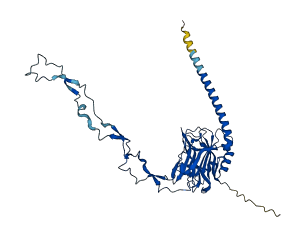
Descriptions
The autoinhibited protein was predicted that may have potential autoinhibitory elements via cis-regPred.
Autoinhibitory domains (AIDs)
Target domain |
|
Relief mechanism |
|
Assay |
cis-regPred |
Accessory elements
No accessory elements
Autoinhibited structure

Activated structure
1 structures for P27798
| Entry ID | Method | Resolution | Chain | Position | Source |
|---|---|---|---|---|---|
| AF-P27798-F1 | Predicted | AlphaFoldDB |
No variants for P27798
| Variant ID(s) | Position | Change | Description | Diseaes Association | Provenance |
|---|---|---|---|---|---|
| No variants for P27798 | |||||
No associated diseases with P27798
1 regional properties for P27798
| Type | Name | Position | InterPro Accession |
|---|---|---|---|
| domain | Staphylococcal nuclease (SNase-like), OB-fold | 177 - 344 | IPR016071 |
3 GO annotations of cellular component
| Name | Definition |
|---|---|
| cytoplasm | The contents of a cell excluding the plasma membrane and nucleus, but including other subcellular structures. |
| endoplasmic reticulum lumen | The volume enclosed by the membranes of the endoplasmic reticulum. |
| endoplasmic reticulum membrane | The lipid bilayer surrounding the endoplasmic reticulum. |
3 GO annotations of molecular function
| Name | Definition |
|---|---|
| calcium ion binding | Binding to a calcium ion (Ca2+). |
| carbohydrate binding | Binding to a carbohydrate, which includes monosaccharides, oligosaccharides and polysaccharides as well as substances derived from monosaccharides by reduction of the carbonyl group (alditols), by oxidation of one or more hydroxy groups to afford the corresponding aldehydes, ketones, or carboxylic acids, or by replacement of one or more hydroxy group(s) by a hydrogen atom. Cyclitols are generally not regarded as carbohydrates. |
| unfolded protein binding | Binding to an unfolded protein. |
11 GO annotations of biological process
| Name | Definition |
|---|---|
| defecation | The expulsion of feces from the rectum. |
| endoplasmic reticulum unfolded protein response | The series of molecular signals generated as a consequence of the presence of unfolded proteins in the endoplasmic reticulum (ER) or other ER-related stress; results in changes in the regulation of transcription and translation. |
| hemidesmosome assembly | Assembly of hemidesmosomes, integrin-containing protein complexes that bind to laminin in the basal lamina. Hemidesmosomes form the contact between the basal surface of epithelial cells and the underlying basal lamina. |
| multicellular organismal reproductive process | The process, occurring above the cellular level, that is pertinent to the reproductive function of a multicellular organism. This includes the integrated processes at the level of tissues and organs. |
| negative regulation of oxidative stress-induced neuron death | Any process that stops, prevents or reduces the frequency, rate or extent of oxidative stress-induced neuron death. |
| programmed cell death | A process which begins when a cell receives an internal or external signal and activates a series of biochemical events (signaling pathway). The process ends with the death of the cell. |
| protein folding | The process of assisting in the covalent and noncovalent assembly of single chain polypeptides or multisubunit complexes into the correct tertiary structure. |
| regulation of gene expression | Any process that modulates the frequency, rate or extent of gene expression. Gene expression is the process in which a gene's coding sequence is converted into a mature gene product (protein or RNA). |
| response to ethanol | Any process that results in a change in state or activity of a cell or an organism (in terms of movement, secretion, enzyme production, gene expression, etc.) as a result of an ethanol stimulus. |
| response to heat | Any process that results in a change in state or activity of a cell or an organism (in terms of movement, secretion, enzyme production, gene expression, etc.) as a result of a heat stimulus, a temperature stimulus above the optimal temperature for that organism. |
| ubiquitin-dependent ERAD pathway | The series of steps necessary to target endoplasmic reticulum (ER)-resident proteins for degradation by the cytoplasmic proteasome. Begins with recognition of the ER-resident protein, includes retrotranslocation (dislocation) of the protein from the ER to the cytosol, protein ubiquitination necessary for correct substrate transfer, transport of the protein to the proteasome, and ends with degradation of the protein by the cytoplasmic proteasome. |
14 homologous proteins in AiPD
| UniProt AC | Gene Name | Protein Name | Species | Evidence Code |
|---|---|---|---|---|
| Q2TBR8 | CALR3 | Calreticulin-3 | Bos taurus (Bovine) | PR |
| P52193 | CALR | Calreticulin | Bos taurus (Bovine) | PR |
| P29413 | Calr | Calreticulin | Drosophila melanogaster (Fruit fly) | PR |
| P27797 | CALR | Calreticulin | Homo sapiens (Human) | PR |
| Q96L12 | CALR3 | Calreticulin-3 | Homo sapiens (Human) | PR |
| P14211 | Calr | Calreticulin | Mus musculus (Mouse) | PR |
| Q9D9Q6 | Calr3 | Calreticulin-3 | Mus musculus (Mouse) | PR |
| P28491 | CALR | Calreticulin | Sus scrofa (Pig) | PR |
| P18418 | Calr | Calreticulin | Rattus norvegicus (Rat) | PR |
| Q9SLY8 | CRO1 | Calreticulin | Oryza sativa subsp japonica (Rice) | PR |
| Q7Z1E6 | crt | Calreticulin | Bombyx mori (Silk moth) | PR |
| Q38858 | CRT2 | Calreticulin-2 | Arabidopsis thaliana (Mouse-ear cress) | PR |
| O04151 | CRT1 | Calreticulin-1 | Arabidopsis thaliana (Mouse-ear cress) | PR |
| O04153 | CRT3 | Calreticulin-3 | Arabidopsis thaliana (Mouse-ear cress) | PR |
| 10 | 20 | 30 | 40 | 50 | 60 |
| MKSLCLLAIV | AVVSAEVYFK | EEFNDASWEK | RWVQSKHKDD | FGAFKLSAGK | FFDVESRDQG |
| 70 | 80 | 90 | 100 | 110 | 120 |
| IQTSQDAKFY | SRAAKFDKDF | SNKGKTLVIQ | YTVKHEQGID | CGGGYVKVMR | ADADLGDFHG |
| 130 | 140 | 150 | 160 | 170 | 180 |
| ETPYNVMFGP | DICGPTRRVH | VILNYKGENK | LIKKEITCKS | DELTHLYTLI | LNSDNTYEVK |
| 190 | 200 | 210 | 220 | 230 | 240 |
| IDGESAQTGS | LEEDWDLLPA | KKIKDPDAKK | PEDWDEREYI | DDAEDAKPED | WEKPEHIPDP |
| 250 | 260 | 270 | 280 | 290 | 300 |
| DAKKPEDWDD | EMDGEWEPPM | IDNPEYKGEW | KPKQIKNPAY | KGKWIHPEIE | NPEYTPDDEL |
| 310 | 320 | 330 | 340 | 350 | 360 |
| YSYESWGAIG | FDLWQVKSGT | IFDNIIITDS | VEEAEAHAAE | TFDKLKTVEK | EKKEKADEET |
| 370 | 380 | 390 | |||
| RKAEEEARKK | AEEEKEAKKD | DDEEEKEEEE | GHDEL |