O04153
Gene name |
CRT3 (At1g08450, T27G7.13) |
Protein name |
Calreticulin-3 |
Names |
Protein PRIORITY IN SWEET LIFE 1 |
Species |
Arabidopsis thaliana (Mouse-ear cress) |
KEGG Pathway |
ath:AT1G08450 |
EC number |
|
Protein Class |
|
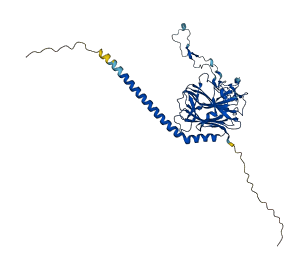
Descriptions
The autoinhibited protein was predicted that may have potential autoinhibitory elements via cis-regPred.
Autoinhibitory domains (AIDs)
Target domain |
|
Relief mechanism |
|
Assay |
cis-regPred |
Accessory elements
No accessory elements
Autoinhibited structure

Activated structure
1 structures for O04153
| Entry ID | Method | Resolution | Chain | Position | Source |
|---|---|---|---|---|---|
| AF-O04153-F1 | Predicted | AlphaFoldDB |
18 variants for O04153
| Variant ID(s) | Position | Change | Description | Diseaes Association | Provenance |
|---|---|---|---|---|---|
| tmp_1_2671737_G_C | 22 | L>V | No | 1000Genomes | |
| tmp_1_2671353_G_T | 52 | N>K | No | 1000Genomes | |
| tmp_1_2671300_G_T | 70 | P>H | No | 1000Genomes | |
| ENSVATH04539387 | 156 | I>L | No | 1000Genomes | |
| tmp_1_2670358_G_A | 158 | S>L | No | 1000Genomes | |
| tmp_1_2670176_C_T | 219 | V>I | No | 1000Genomes | |
| tmp_1_2669841_G_A | 237 | P>L | No | 1000Genomes | |
| tmp_1_2669827_G_A | 242 | P>S | No | 1000Genomes | |
| tmp_1_2669254_T_G | 298 | K>N | No | 1000Genomes | |
| tmp_1_2669228_G_A | 307 | P>L | No | 1000Genomes | |
| ENSVATH10787970 | 310 | E>V | No | 1000Genomes | |
| ENSVATH13865169 | 322 | K>N | No | 1000Genomes | |
| tmp_1_2668727_A_G | 352 | I>T | No | 1000Genomes | |
| tmp_1_2668495_C_A | 372 | E>D | No | 1000Genomes | |
| ENSVATH01024802 | 400 | R>Q | No | 1000Genomes | |
| ENSVATH00011788 | 408 | Y>D | No | 1000Genomes | |
| ENSVATH00011787 | 408 | Y>S | No | 1000Genomes | |
| ENSVATH04539373 | 412 | N>Y | No | 1000Genomes |
No associated diseases with O04153
2 regional properties for O04153
| Type | Name | Position | InterPro Accession |
|---|---|---|---|
| conserved_site | Calreticulin/calnexin, conserved site | 107 - 122 | IPR018124-1 |
| conserved_site | Calreticulin/calnexin, conserved site | 139 - 147 | IPR018124-2 |
4 GO annotations of cellular component
| Name | Definition |
|---|---|
| endoplasmic reticulum | The irregular network of unit membranes, visible only by electron microscopy, that occurs in the cytoplasm of many eukaryotic cells. The membranes form a complex meshwork of tubular channels, which are often expanded into slitlike cavities called cisternae. The ER takes two forms, rough (or granular), with ribosomes adhering to the outer surface, and smooth (with no ribosomes attached). |
| endoplasmic reticulum lumen | The volume enclosed by the membranes of the endoplasmic reticulum. |
| endoplasmic reticulum membrane | The lipid bilayer surrounding the endoplasmic reticulum. |
| extracellular region | The space external to the outermost structure of a cell. For cells without external protective or external encapsulating structures this refers to space outside of the plasma membrane. This term covers the host cell environment outside an intracellular parasite. |
3 GO annotations of molecular function
| Name | Definition |
|---|---|
| calcium ion binding | Binding to a calcium ion (Ca2+). |
| carbohydrate binding | Binding to a carbohydrate, which includes monosaccharides, oligosaccharides and polysaccharides as well as substances derived from monosaccharides by reduction of the carbonyl group (alditols), by oxidation of one or more hydroxy groups to afford the corresponding aldehydes, ketones, or carboxylic acids, or by replacement of one or more hydroxy group(s) by a hydrogen atom. Cyclitols are generally not regarded as carbohydrates. |
| unfolded protein binding | Binding to an unfolded protein. |
5 GO annotations of biological process
| Name | Definition |
|---|---|
| anthocyanin-containing compound metabolic process | The chemical reactions and pathways involving anthocyanins, any member of a group of intensely colored soluble glycosides of anthocyanidins that occur in plants. They are responsible from most of the scarlet, purple, mauve and blue coloring in higher plants, especially of flowers. |
| defense response to bacterium | Reactions triggered in response to the presence of a bacterium that act to protect the cell or organism. |
| plant-type hypersensitive response | The rapid, localized death of plant cells in response to invasion by a pathogen. |
| protein folding | The process of assisting in the covalent and noncovalent assembly of single chain polypeptides or multisubunit complexes into the correct tertiary structure. |
| ubiquitin-dependent ERAD pathway | The series of steps necessary to target endoplasmic reticulum (ER)-resident proteins for degradation by the cytoplasmic proteasome. Begins with recognition of the ER-resident protein, includes retrotranslocation (dislocation) of the protein from the ER to the cytosol, protein ubiquitination necessary for correct substrate transfer, transport of the protein to the proteasome, and ends with degradation of the protein by the cytoplasmic proteasome. |
14 homologous proteins in AiPD
| UniProt AC | Gene Name | Protein Name | Species | Evidence Code |
|---|---|---|---|---|
| Q2TBR8 | CALR3 | Calreticulin-3 | Bos taurus (Bovine) | PR |
| P52193 | CALR | Calreticulin | Bos taurus (Bovine) | PR |
| P29413 | Calr | Calreticulin | Drosophila melanogaster (Fruit fly) | PR |
| P27797 | CALR | Calreticulin | Homo sapiens (Human) | PR |
| Q96L12 | CALR3 | Calreticulin-3 | Homo sapiens (Human) | PR |
| P14211 | Calr | Calreticulin | Mus musculus (Mouse) | PR |
| Q9D9Q6 | Calr3 | Calreticulin-3 | Mus musculus (Mouse) | PR |
| P28491 | CALR | Calreticulin | Sus scrofa (Pig) | PR |
| P18418 | Calr | Calreticulin | Rattus norvegicus (Rat) | PR |
| Q9SLY8 | CRO1 | Calreticulin | Oryza sativa subsp japonica (Rice) | PR |
| P27798 | crt-1 | Calreticulin | Caenorhabditis elegans | PR |
| Q7Z1E6 | crt | Calreticulin | Bombyx mori (Silk moth) | PR |
| O04151 | CRT1 | Calreticulin-1 | Arabidopsis thaliana (Mouse-ear cress) | PR |
| Q38858 | CRT2 | Calreticulin-2 | Arabidopsis thaliana (Mouse-ear cress) | PR |
| 10 | 20 | 30 | 40 | 50 | 60 |
| MGLPQNKLSF | FCFFFLVSVL | TLAPLAFSEI | FLEEHFEGGW | KSRWVLSDWK | RNEGKAGTFK |
| 70 | 80 | 90 | 100 | 110 | 120 |
| HTAGKWPGDP | DNKGIQTYND | AKHYAISAKI | PEFSNKNRTL | VVQYSVKIEQ | DIECGGAYIK |
| 130 | 140 | 150 | 160 | 170 | 180 |
| LLSGYVNQKQ | FGGDTPYSLM | FGPDICGTQT | KKLHVIVSYQ | GQNYPIKKDL | QCETDKLNHF |
| 190 | 200 | 210 | 220 | 230 | 240 |
| YTFILRPDAS | YSVLVDNKER | EFGSMYTDWD | ILPPRKIKVK | NAKKPEDWDD | REYIDDPNDV |
| 250 | 260 | 270 | 280 | 290 | 300 |
| KPEGFDSIPR | EIPDRKAKEP | EDWDEEENGL | WEPPKIPNSA | YKGPWKAKRI | KNPNYKGKWK |
| 310 | 320 | 330 | 340 | 350 | 360 |
| NPWIDNPEFE | DDPDLYVLKS | IKYAGIEVWQ | VKAGSIFDNI | LICDDPAYAR | SIVDDYFAQH |
| 370 | 380 | 390 | 400 | 410 | 420 |
| RESEKELFAE | AEKERKARED | EEARIAREEG | ERRRKERDHR | YGDRRRRYKR | PNPRDYMDDY |
| HDEL |