P06730
Gene name |
EIF4E |
Protein name |
Eukaryotic translation initiation factor 4E |
Names |
Erythrocyte receptor, LFA-2, LFA-3 receptor, Rosette receptor, T-cell surface antigen T11/Leu-5, eIF-4E, eIF4E, eIF-4F 25 kDa subunit, mRNA cap-binding protein |
Species |
Homo sapiens (Human) |
KEGG Pathway |
hsa:1977 |
EC number |
|
Protein Class |
|
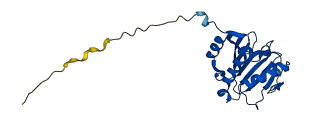
Descriptions
The autoinhibited protein was predicted that may have potential autoinhibitory elements via cis-regPred.
Autoinhibitory domains (AIDs)
Target domain |
|
Relief mechanism |
|
Assay |
cis-regPred |
Accessory elements
No accessory elements
Autoinhibited structure

Activated structure
39 structures for P06730
| Entry ID | Method | Resolution | Chain | Position | Source |
|---|---|---|---|---|---|
| 1IPB | X-ray | 200 A | A | 1-217 | PDB |
| 1IPC | X-ray | 200 A | A | 1-217 | PDB |
| 1WKW | X-ray | 210 A | A | 27-217 | PDB |
| 2GPQ | NMR | - | A | 1-217 | PDB |
| 2V8W | X-ray | 230 A | A/E | 1-217 | PDB |
| 2V8X | X-ray | 230 A | A/E | 1-217 | PDB |
| 2V8Y | X-ray | 210 A | A/E | 1-217 | PDB |
| 2W97 | X-ray | 229 A | A/B | 1-217 | PDB |
| 3AM7 | X-ray | 220 A | A | 27-217 | PDB |
| 3TF2 | X-ray | 210 A | A/B/C/D | 1-217 | PDB |
| 3U7X | X-ray | 210 A | A/B | 1-217 | PDB |
| 4AZA | X-ray | 216 A | A/C | 1-217 | PDB |
| 4BEA | X-ray | 257 A | A | 1-217 | PDB |
| 4DT6 | X-ray | 260 A | A | 1-217 | PDB |
| 4DUM | X-ray | 295 A | A | 1-217 | PDB |
| 4TPW | X-ray | 150 A | A/B | 28-217 | PDB |
| 4TQB | X-ray | 159 A | A/B | 28-217 | PDB |
| 4TQC | X-ray | 180 A | A/B | 28-217 | PDB |
| 4UED | X-ray | 175 A | A | 36-217 | PDB |
| 5EHC | X-ray | 240 A | A | 1-217 | PDB |
| 5EI3 | X-ray | 171 A | A | 1-217 | PDB |
| 5EIR | X-ray | 269 A | A | 1-217 | PDB |
| 5EKV | X-ray | 361 A | A/C | 1-217 | PDB |
| 5GW6 | X-ray | 197 A | A | 23-217 | PDB |
| 5T46 | X-ray | 153 A | A/C | 1-217 | PDB |
| 5ZJY | X-ray | 159 A | A | 28-217 | PDB |
| 5ZJZ | X-ray | 167 A | A | 28-217 | PDB |
| 5ZK5 | X-ray | 225 A | A | 28-217 | PDB |
| 5ZK7 | X-ray | 212 A | A/B | 28-217 | PDB |
| 5ZK9 | X-ray | 176 A | A | 28-217 | PDB |
| 5ZML | X-ray | 180 A | A | 27-217 | PDB |
| 7D6Y | X-ray | 167 A | A | 1-217 | PDB |
| 7D8B | X-ray | 246 A | A/C | 1-217 | PDB |
| 7EZW | X-ray | 235 A | A | 1-217 | PDB |
| 7F07 | X-ray | 225 A | A | 1-217 | PDB |
| 7MEU | X-ray | 191 A | A/B | 26-217 | PDB |
| 7XTP | X-ray | 183 A | A/B | 1-217 | PDB |
| 8SX4 | X-ray | 199 A | A/B | 28-217 | PDB |
| AF-P06730-F1 | Predicted | AlphaFoldDB |
74 variants for P06730
| Variant ID(s) | Position | Change | Description | Diseaes Association | Provenance |
|---|---|---|---|---|---|
|
rs1402853326 CA357532838 |
3 | T>S | No |
ClinGen gnomAD |
|
|
CA3017924 rs750575002 |
4 | V>F | No |
ClinGen ExAC gnomAD |
|
|
CA357532836 rs750575002 |
4 | V>I | No |
ClinGen ExAC gnomAD |
|
|
CA3017921 rs374110967 |
6 | P>L | No |
ClinGen ESP ExAC gnomAD |
|
|
CA357532821 rs374110967 |
6 | P>Q | No |
ClinGen ESP ExAC gnomAD |
|
|
CA357532820 rs374110967 |
6 | P>R | No |
ClinGen ESP ExAC gnomAD |
|
|
CA101896160 rs961375613 |
6 | P>S | No |
ClinGen Ensembl |
|
|
rs780217614 CA3017856 |
8 | T>I | No |
ClinGen ExAC gnomAD |
|
|
CA3017855 rs756349708 |
9 | T>A | No |
ClinGen ExAC gnomAD |
|
|
rs1560643670 CA357535491 |
10 | P>S | No |
ClinGen Ensembl |
|
|
CA3017854 rs750797120 |
11 | T>I | No |
ClinGen ExAC TOPMed gnomAD |
|
|
CA101892320 rs1046296407 |
13 | N>H | No |
ClinGen TOPMed |
|
|
CA3017852 rs757655058 |
15 | P>L | No |
ClinGen ExAC TOPMed gnomAD |
|
|
rs767708353 CA3017853 |
15 | P>S | No |
ClinGen ExAC gnomAD |
|
|
rs1328355640 CA357535450 |
17 | T>I | No |
ClinGen gnomAD |
|
|
rs1440053682 CA357535443 |
18 | E>G | No |
ClinGen gnomAD |
|
|
CA3017847 rs766039535 |
19 | E>A | No |
ClinGen ExAC gnomAD |
|
|
CA3017845 rs772918368 |
22 | T>M | Variant assessed as Somatic; 0.0 impact. [NCI-TCGA] | No |
ClinGen ExAC NCI-TCGA gnomAD |
|
CA3017842 rs774230839 |
25 | N>T | No |
ClinGen ExAC gnomAD |
|
|
rs1407830526 CA357535382 |
27 | E>K | No |
ClinGen gnomAD |
|
|
rs768619573 CA3017841 |
29 | A>T | No |
ClinGen ExAC TOPMed gnomAD |
|
|
CA101892306 rs749157215 |
30 | N>D | No |
ClinGen Ensembl |
|
|
CA357535357 rs1330422107 |
30 | N>K | No |
ClinGen gnomAD |
|
|
CA3017839 rs780066971 |
33 | H>Q | No |
ClinGen ExAC TOPMed gnomAD |
|
|
rs749358476 CA3017840 |
33 | H>R | No |
ClinGen ExAC TOPMed gnomAD |
|
| TCGA novel | 33 | H>Y | Variant assessed as Somatic; impact. [NCI-TCGA] | No | NCI-TCGA |
|
CA357535332 rs1162995059 |
34 | Y>C | No |
ClinGen gnomAD |
|
|
rs965276525 CA101892302 |
38 | P>A | No |
ClinGen Ensembl |
|
|
CA3017821 rs775511040 |
42 | R>S | No |
ClinGen ExAC gnomAD |
|
|
CA101889641 rs2120378 |
53 | S>T | No |
ClinGen Ensembl |
|
|
CA357534551 rs1251551425 |
65 | K>R | No |
ClinGen gnomAD |
|
| TCGA novel | 68 | T>I | Variant assessed as Somatic; impact. [NCI-TCGA] | No | NCI-TCGA |
| TCGA novel | 68 | T>N | Variant assessed as Somatic; impact. [NCI-TCGA] | No | NCI-TCGA |
|
rs1303107400 CA357534504 |
71 | D>E | No |
ClinGen gnomAD |
|
|
CA3017818 rs745994691 |
71 | D>G | No |
ClinGen ExAC gnomAD |
|
|
CA101888897 rs868460893 |
76 | Y>H | No |
ClinGen Ensembl |
|
|
rs769814766 CA3017801 |
79 | I>T | No |
ClinGen ExAC gnomAD |
|
|
rs1191807310 CA357534419 |
81 | L>F | No |
ClinGen gnomAD |
|
| TCGA novel | 82 | S>C | Variant assessed as Somatic; impact. [NCI-TCGA] | No | NCI-TCGA |
| TCGA novel | 94 | F>C | Variant assessed as Somatic; impact. [NCI-TCGA] | No | NCI-TCGA |
|
CA357534296 rs1179083091 |
97 | G>S | No |
ClinGen gnomAD |
|
|
CA3017785 rs758100407 |
109 | R>L | No |
ClinGen ExAC TOPMed gnomAD |
|
|
rs758100407 CA3017784 |
109 | R>Q | No |
ClinGen ExAC TOPMed gnomAD |
|
| TCGA novel | 112 | R>Q | Variant assessed as Somatic; impact. [NCI-TCGA] | No | NCI-TCGA |
| TCGA novel | 118 | N>S | Variant assessed as Somatic; impact. [NCI-TCGA] | No | NCI-TCGA |
| TCGA novel | 119 | K>R | Variant assessed as Somatic; impact. [NCI-TCGA] | No | NCI-TCGA |
|
COSM3428794 rs17850950 CA101888754 |
127 | D>N | large_intestine Variant assessed as Somatic; impact. [Cosmic, NCI-TCGA] | No |
ClinGen cosmic curated Ensembl NCI-TCGA |
|
COSM1059187 CA3017780 rs776434815 |
128 | R>H | Variant assessed as Somatic; 0.0 impact. endometrium [NCI-TCGA, Cosmic] | No |
ClinGen cosmic curated ExAC NCI-TCGA gnomAD |
|
CA357533704 rs1423832254 |
137 | L>V | No |
ClinGen TOPMed |
|
|
rs1400825529 CA357533644 |
145 | Y>C | No |
ClinGen TOPMed |
|
|
rs774451037 CA3017754 |
147 | D>E | No |
ClinGen ExAC gnomAD |
|
|
CA357533632 rs1193712071 |
147 | D>N | No |
ClinGen gnomAD |
|
|
rs968700652 CA101888323 |
149 | V>L | No |
ClinGen TOPMed |
|
| TCGA novel | 155 | N>S | Variant assessed as Somatic; impact. [NCI-TCGA] | No | NCI-TCGA |
|
rs749648246 CA3017752 |
158 | A>T | No |
ClinGen ExAC TOPMed gnomAD |
|
|
CA3017751 rs773512920 |
175 | A>G | No |
ClinGen ExAC TOPMed gnomAD |
|
|
rs770337295 CA3017750 |
177 | T>A | No |
ClinGen ExAC gnomAD |
|
|
CA357533407 rs1284726660 |
179 | I>T | No |
ClinGen TOPMed gnomAD |
|
|
rs777133297 CA3017722 |
181 | R>M | No |
ClinGen ExAC TOPMed gnomAD |
|
|
rs1384924849 CA357533108 |
181 | R>S | No |
ClinGen gnomAD |
|
|
rs1579143765 CA357533103 |
182 | V>G | No |
ClinGen Ensembl |
|
|
CA3017721 rs138645913 |
182 | V>I | No |
ClinGen ESP ExAC TOPMed gnomAD |
|
|
rs138645913 CA357533106 |
182 | V>L | No |
ClinGen ESP ExAC TOPMed gnomAD |
|
|
CA3017720 rs747639784 |
184 | K>T | No |
ClinGen ExAC gnomAD |
|
|
CA357533082 rs768240575 |
185 | E>D | No |
ClinGen ExAC gnomAD |
|
|
CA3017719 rs778594185 |
185 | E>K | No |
ClinGen ExAC TOPMed gnomAD |
|
|
rs780061762 CA3017716 |
188 | G>E | No |
ClinGen ExAC gnomAD |
|
| TCGA novel | 192 | K>N | Variant assessed as Somatic; impact. [NCI-TCGA] | No | NCI-TCGA |
|
CA3017715 rs755977303 |
193 | I>V | No |
ClinGen ExAC gnomAD |
|
|
rs967400435 CA101887415 |
195 | I>V | No |
ClinGen TOPMed gnomAD |
|
|
CA357532990 rs1388747352 |
199 | S>C | No |
ClinGen TOPMed |
|
|
rs200243582 CA3017712 |
201 | A>T | No |
ClinGen ExAC TOPMed gnomAD |
|
|
rs751640787 CA3017711 |
205 | T>A | No |
ClinGen ExAC TOPMed gnomAD |
|
|
CA3017710 rs764367114 |
208 | G>S | No |
ClinGen ExAC gnomAD |
2 associated diseases with P06730
[MIM: 615091]: Autism 19 (AUTS19)
A complex multifactorial, pervasive developmental disorder characterized by impairments in reciprocal social interaction and communication, restricted and stereotyped patterns of interests and activities, and the presence of developmental abnormalities by 3 years of age. Most individuals with autism also manifest moderate intellectual disability. {ECO:0000269|PubMed:19556253}. Note=Disease susceptibility is associated with variants affecting the gene represented in this entry. A heterozygous single-nucleotide insertion has been found in families affected by autism. The variant results in increased promoter activity and is involved in disease pathogenesis through EIF4E deregulation (PubMed:19556253). {ECO:0000269|PubMed:19556253}.
Without disease ID
- A complex multifactorial, pervasive developmental disorder characterized by impairments in reciprocal social interaction and communication, restricted and stereotyped patterns of interests and activities, and the presence of developmental abnormalities by 3 years of age. Most individuals with autism also manifest moderate intellectual disability. {ECO:0000269|PubMed:19556253}. Note=Disease susceptibility is associated with variants affecting the gene represented in this entry. A heterozygous single-nucleotide insertion has been found in families affected by autism. The variant results in increased promoter activity and is involved in disease pathogenesis through EIF4E deregulation (PubMed:19556253). {ECO:0000269|PubMed:19556253}.
Functions
14 GO annotations of cellular component
| Name | Definition |
|---|---|
| chromatoid body | A ribonucleoprotein complex found in the cytoplasm of male germ cells, composed of exceedingly thin filaments that are consolidated into a compact mass or into dense strands of varying thickness that branch to form an irregular network. Contains mRNAs, miRNAs, and protein components involved in miRNA processing (such as Argonaute proteins and the endonuclease Dicer) and in RNA decay (such as the decapping enzyme DCP1a and GW182). |
| cytoplasm | The contents of a cell excluding the plasma membrane and nucleus, but including other subcellular structures. |
| cytoplasmic ribonucleoprotein granule | A ribonucleoprotein granule located in the cytoplasm. |
| cytoplasmic stress granule | A dense aggregation in the cytosol composed of proteins and RNAs that appear when the cell is under stress. |
| cytosol | The part of the cytoplasm that does not contain organelles but which does contain other particulate matter, such as protein complexes. |
| eukaryotic translation initiation factor 4F complex | The eukaryotic translation initiation factor 4F complex is composed of eIF4E, eIF4A and eIF4G; it is involved in the recognition of the mRNA cap, ATP-dependent unwinding of the 5'-terminal secondary structure and recruitment of the mRNA to the ribosome. |
| extracellular exosome | A vesicle that is released into the extracellular region by fusion of the limiting endosomal membrane of a multivesicular body with the plasma membrane. Extracellular exosomes, also simply called exosomes, have a diameter of about 40-100 nm. |
| glutamatergic synapse | A synapse that uses glutamate as a neurotransmitter. |
| mRNA cap binding complex | Any protein complex that binds to an mRNA cap at any time in the lifetime of the mRNA. |
| nucleus | A membrane-bounded organelle of eukaryotic cells in which chromosomes are housed and replicated. In most cells, the nucleus contains all of the cell's chromosomes except the organellar chromosomes, and is the site of RNA synthesis and processing. In some species, or in specialized cell types, RNA metabolism or DNA replication may be absent. |
| P-body | A focus in the cytoplasm where mRNAs may become inactivated by decapping or some other mechanism. Protein and RNA localized to these foci are involved in mRNA degradation, nonsense-mediated mRNA decay (NMD), translational repression, and RNA-mediated gene silencing. |
| perinuclear region of cytoplasm | Cytoplasm situated near, or occurring around, the nucleus. |
| postsynaptic cytosol | The region of the cytosol consisting of all cytosol that is part of the postsynapse. |
| RISC complex | A ribonucleoprotein complex that contains members of the Argonaute family of proteins, small interfering RNAs (siRNAs) or microRNAs (miRNAs), and miRNA or siRNA-complementary mRNAs, in addition to a number of accessory factors. The RISC complex is involved in posttranscriptional repression of gene expression through downregulation of translation or induction of mRNA degradation. |
7 GO annotations of molecular function
| Name | Definition |
|---|---|
| DNA-binding transcription factor binding | Binding to a DNA-binding transcription factor, a protein that interacts with a specific DNA sequence (sometimes referred to as a motif) within the regulatory region of a gene to modulate transcription. |
| enzyme binding | Binding to an enzyme, a protein with catalytic activity. |
| eukaryotic initiation factor 4G binding | Binding to eukaryotic initiation factor 4G, a polypeptide factor involved in the initiation of ribosome-mediated translation. |
| RNA 7-methylguanosine cap binding | Binding to a 7-methylguanosine group added cotranscriptionally to the 5' end of RNA molecules transcribed by polymerase II. |
| RNA binding | Binding to an RNA molecule or a portion thereof. |
| RNA cap binding | Binding to a 7-methylguanosine (m7G) group or derivative located at the 5' end of an RNA molecule. |
| translation initiation factor activity | Functions in the initiation of ribosome-mediated translation of mRNA into a polypeptide. |
12 GO annotations of biological process
| Name | Definition |
|---|---|
| behavioral fear response | An acute behavioral change resulting from a perceived external threat. |
| cellular response to dexamethasone stimulus | Any process that results in a change in state or activity of a cell (in terms of movement, secretion, enzyme production, gene expression, etc.) as a result of a dexamethasone stimulus. |
| G1/S transition of mitotic cell cycle | The mitotic cell cycle transition by which a cell in G1 commits to S phase. The process begins with the build up of G1 cyclin-dependent kinase (G1 CDK), resulting in the activation of transcription of G1 cyclins. The process ends with the positive feedback of the G1 cyclins on the G1 CDK which commits the cell to S phase, in which DNA replication is initiated. |
| lung development | The process whose specific outcome is the progression of the lung over time, from its formation to the mature structure. In all air-breathing vertebrates the lungs are developed from the ventral wall of the oesophagus as a pouch which divides into two sacs. In amphibians and many reptiles the lungs retain very nearly this primitive sac-like character, but in the higher forms the connection with the esophagus becomes elongated into the windpipe and the inner walls of the sacs become more and more divided, until, in the mammals, the air spaces become minutely divided into tubes ending in small air cells, in the walls of which the blood circulates in a fine network of capillaries. In mammals the lungs are more or less divided into lobes, and each lung occupies a separate cavity in the thorax. |
| negative regulation of neuron differentiation | Any process that stops, prevents, or reduces the frequency, rate or extent of neuron differentiation. |
| negative regulation of translation | Any process that stops, prevents, or reduces the frequency, rate or extent of the chemical reactions and pathways resulting in the formation of proteins by the translation of mRNA or circRNA. |
| neuron differentiation | The process in which a relatively unspecialized cell acquires specialized features of a neuron. |
| positive regulation of mitotic cell cycle | Any process that activates or increases the rate or extent of progression through the mitotic cell cycle. |
| regulation of translation | Any process that modulates the frequency, rate or extent of the chemical reactions and pathways resulting in the formation of proteins by the translation of mRNA or circRNA. |
| regulation of translation at postsynapse, modulating synaptic transmission | Any process that modulates synaptic transmission by regulating translation occurring at the postsynapse. |
| stem cell population maintenance | The process by which an organism or tissue maintains a population of stem cells of a single type. This can be achieved by a number of mechanisms: stem cell asymmetric division maintains stem cell numbers; stem cell symmetric division increases them; maintenance of a stem cell niche maintains the conditions for commitment to the stem cell fate for some types of stem cell; stem cells may arise de novo from other cell types. |
| translational initiation | The process preceding formation of the peptide bond between the first two amino acids of a protein. This includes the formation of a complex of the ribosome, mRNA or circRNA, and an initiation complex that contains the first aminoacyl-tRNA. |
9 homologous proteins in AiPD
| UniProt AC | Gene Name | Protein Name | Species | Evidence Code |
|---|---|---|---|---|
| Q03389 | Eukaryotic translation initiation factor isoform 4E-2 | Triticum aestivum (Wheat) | PR | |
| P07260 | CDC33 | Eukaryotic translation initiation factor 4E | Saccharomyces cerevisiae (strain ATCC 204508 / S288c) (Baker's yeast) | PR |
| Q8N5X7 | EIF4E3 | Eukaryotic translation initiation factor 4E type 3 | Homo sapiens (Human) | PR |
| O60573 | EIF4E2 | Eukaryotic translation initiation factor 4E type 2 | Homo sapiens (Human) | PR |
| A6NMX2 | EIF4E1B | Eukaryotic translation initiation factor 4E type 1B | Homo sapiens (Human) | PR |
| O81482 | Eukaryotic translation initiation factor isoform 4E-2 | Zea mays (Maize) | PR | |
| P63073 | Eif4e | Eukaryotic translation initiation factor 4E | Mus musculus (Mouse) | PR |
| O61955 | ife-3 | Eukaryotic translation initiation factor 4E-3 | Caenorhabditis elegans | PR |
| Q9C7P6 | EIF4E3 | Eukaryotic translation initiation factor 4E-3 | Arabidopsis thaliana (Mouse-ear cress) | PR |
| 10 | 20 | 30 | 40 | 50 | 60 |
| MATVEPETTP | TPNPPTTEEE | KTESNQEVAN | PEHYIKHPLQ | NRWALWFFKN | DKSKTWQANL |
| 70 | 80 | 90 | 100 | 110 | 120 |
| RLISKFDTVE | DFWALYNHIQ | LSSNLMPGCD | YSLFKDGIEP | MWEDEKNKRG | GRWLITLNKQ |
| 130 | 140 | 150 | 160 | 170 | 180 |
| QRRSDLDRFW | LETLLCLIGE | SFDDYSDDVC | GAVVNVRAKG | DKIAIWTTEC | ENREAVTHIG |
| 190 | 200 | 210 | |||
| RVYKERLGLP | PKIVIGYQSH | ADTATKSGST | TKNRFVV |