P63073
Gene name |
Eif4e |
Protein name |
Eukaryotic translation initiation factor 4E |
Names |
eIF-4E, eIF4E, mRNA cap-binding protein, eIF-4F 25 kDa subunit |
Species |
Mus musculus (Mouse) |
KEGG Pathway |
mmu:13684 |
EC number |
|
Protein Class |
|
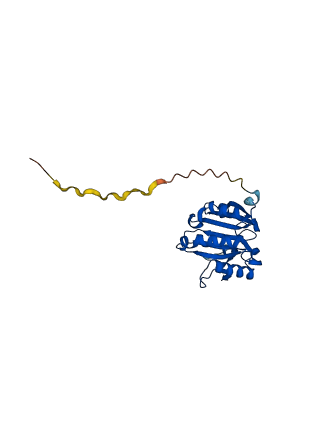
Descriptions
The autoinhibited protein was predicted that may have potential autoinhibitory elements via cis-regPred.
Autoinhibitory domains (AIDs)
Target domain |
|
Relief mechanism |
|
Assay |
cis-regPred |
Accessory elements
No accessory elements
Autoinhibited structure

Activated structure
25 structures for P63073
| Entry ID | Method | Resolution | Chain | Position | Source |
|---|---|---|---|---|---|
| 1EJ1 | X-ray | 220 A | A/B | 28-217 | PDB |
| 1EJ4 | X-ray | 225 A | A | 28-217 | PDB |
| 1EJH | X-ray | 220 A | A/B/C/D | 28-217 | PDB |
| 1L8B | X-ray | 180 A | A/B | 28-217 | PDB |
| 5BXV | X-ray | 210 A | A/C | 27-217 | PDB |
| 5J5O | X-ray | 187 A | A/B/C/D | 28-217 | PDB |
| 5J5Y | X-ray | 175 A | A/B/C/D | 28-217 | PDB |
| 5M7V | X-ray | 174 A | A/B/C/D | 28-217 | PDB |
| 5M7W | X-ray | 197 A | A/B/C/D | 28-217 | PDB |
| 5M7X | X-ray | 168 A | A/B/C/D | 28-217 | PDB |
| 5M7Z | X-ray | 169 A | A/B/C/D | 28-217 | PDB |
| 5M80 | X-ray | 212 A | A/B/C/D | 28-217 | PDB |
| 5M81 | X-ray | 190 A | A/B/C/D | 28-217 | PDB |
| 5M83 | X-ray | 186 A | A/B | 28-217 | PDB |
| 5M84 | X-ray | 185 A | A/B | 28-217 | PDB |
| 5OSX | X-ray | 192 A | A/B/C/D | 28-217 | PDB |
| 6GKJ | X-ray | 207 A | A/B/C/D | 28-217 | PDB |
| 6GKK | X-ray | 186 A | A/B/C/D | 28-217 | PDB |
| 6GKL | X-ray | 220 A | A/B/C/D | 28-217 | PDB |
| 6U06 | X-ray | 196 A | A/B/C/D | 28-217 | PDB |
| 6U09 | X-ray | 179 A | A/B/C/D | 28-217 | PDB |
| 6YLR | X-ray | 220 A | A/B | 28-217 | PDB |
| 6YLT | X-ray | 267 A | A/B/C/D | 28-217 | PDB |
| 6YLV | X-ray | 266 A | A/B/C/D | 28-217 | PDB |
| AF-P63073-F1 | Predicted | AlphaFoldDB |
2 variants for P63073
| Variant ID(s) | Position | Change | Description | Diseaes Association | Provenance |
|---|---|---|---|---|---|
| rs3388667159 | 164 | A>V | No | EVA | |
| rs3388671332 | 170 | C>S | No | EVA |
No associated diseases with P63073
No regional properties for P63073
| Type | Name | Position | InterPro Accession |
|---|---|---|---|
| No domain, repeats, and functional sites for P63073 | |||
Functions
15 GO annotations of cellular component
| Name | Definition |
|---|---|
| chromatoid body | A ribonucleoprotein complex found in the cytoplasm of male germ cells, composed of exceedingly thin filaments that are consolidated into a compact mass or into dense strands of varying thickness that branch to form an irregular network. Contains mRNAs, miRNAs, and protein components involved in miRNA processing (such as Argonaute proteins and the endonuclease Dicer) and in RNA decay (such as the decapping enzyme DCP1a and GW182). |
| cytoplasm | The contents of a cell excluding the plasma membrane and nucleus, but including other subcellular structures. |
| cytoplasmic ribonucleoprotein granule | A ribonucleoprotein granule located in the cytoplasm. |
| cytoplasmic stress granule | A dense aggregation in the cytosol composed of proteins and RNAs that appear when the cell is under stress. |
| cytosol | The part of the cytoplasm that does not contain organelles but which does contain other particulate matter, such as protein complexes. |
| eukaryotic translation initiation factor 4F complex | The eukaryotic translation initiation factor 4F complex is composed of eIF4E, eIF4A and eIF4G; it is involved in the recognition of the mRNA cap, ATP-dependent unwinding of the 5'-terminal secondary structure and recruitment of the mRNA to the ribosome. |
| glutamatergic synapse | A synapse that uses glutamate as a neurotransmitter. |
| mRNA cap binding complex | Any protein complex that binds to an mRNA cap at any time in the lifetime of the mRNA. |
| nucleus | A membrane-bounded organelle of eukaryotic cells in which chromosomes are housed and replicated. In most cells, the nucleus contains all of the cell's chromosomes except the organellar chromosomes, and is the site of RNA synthesis and processing. In some species, or in specialized cell types, RNA metabolism or DNA replication may be absent. |
| P-body | A focus in the cytoplasm where mRNAs may become inactivated by decapping or some other mechanism. Protein and RNA localized to these foci are involved in mRNA degradation, nonsense-mediated mRNA decay (NMD), translational repression, and RNA-mediated gene silencing. |
| perinuclear region of cytoplasm | Cytoplasm situated near, or occurring around, the nucleus. |
| postsynapse | The part of a synapse that is part of the post-synaptic cell. |
| postsynaptic cytosol | The region of the cytosol consisting of all cytosol that is part of the postsynapse. |
| protein-containing complex | A stable assembly of two or more macromolecules, i.e. proteins, nucleic acids, carbohydrates or lipids, in which at least one component is a protein and the constituent parts function together. |
| RISC complex | A ribonucleoprotein complex that contains members of the Argonaute family of proteins, small interfering RNAs (siRNAs) or microRNAs (miRNAs), and miRNA or siRNA-complementary mRNAs, in addition to a number of accessory factors. The RISC complex is involved in posttranscriptional repression of gene expression through downregulation of translation or induction of mRNA degradation. |
6 GO annotations of molecular function
| Name | Definition |
|---|---|
| DNA-binding transcription factor binding | Binding to a DNA-binding transcription factor, a protein that interacts with a specific DNA sequence (sometimes referred to as a motif) within the regulatory region of a gene to modulate transcription. |
| enzyme binding | Binding to an enzyme, a protein with catalytic activity. |
| eukaryotic initiation factor 4G binding | Binding to eukaryotic initiation factor 4G, a polypeptide factor involved in the initiation of ribosome-mediated translation. |
| RNA 7-methylguanosine cap binding | Binding to a 7-methylguanosine group added cotranscriptionally to the 5' end of RNA molecules transcribed by polymerase II. |
| translation initiation factor activity | Functions in the initiation of ribosome-mediated translation of mRNA into a polypeptide. |
| translation regulator activity | Any molecular function involved in the initiation, activation, perpetuation, repression or termination of polypeptide synthesis at the ribosome. |
12 GO annotations of biological process
| Name | Definition |
|---|---|
| behavioral fear response | An acute behavioral change resulting from a perceived external threat. |
| cellular response to dexamethasone stimulus | Any process that results in a change in state or activity of a cell (in terms of movement, secretion, enzyme production, gene expression, etc.) as a result of a dexamethasone stimulus. |
| G1/S transition of mitotic cell cycle | The mitotic cell cycle transition by which a cell in G1 commits to S phase. The process begins with the build up of G1 cyclin-dependent kinase (G1 CDK), resulting in the activation of transcription of G1 cyclins. The process ends with the positive feedback of the G1 cyclins on the G1 CDK which commits the cell to S phase, in which DNA replication is initiated. |
| negative regulation of neuron differentiation | Any process that stops, prevents, or reduces the frequency, rate or extent of neuron differentiation. |
| negative regulation of translation | Any process that stops, prevents, or reduces the frequency, rate or extent of the chemical reactions and pathways resulting in the formation of proteins by the translation of mRNA or circRNA. |
| neuron differentiation | The process in which a relatively unspecialized cell acquires specialized features of a neuron. |
| positive regulation of mitotic cell cycle | Any process that activates or increases the rate or extent of progression through the mitotic cell cycle. |
| regulation of translation | Any process that modulates the frequency, rate or extent of the chemical reactions and pathways resulting in the formation of proteins by the translation of mRNA or circRNA. |
| regulation of translation at postsynapse, modulating synaptic transmission | Any process that modulates synaptic transmission by regulating translation occurring at the postsynapse. |
| stem cell population maintenance | The process by which an organism or tissue maintains a population of stem cells of a single type. This can be achieved by a number of mechanisms: stem cell asymmetric division maintains stem cell numbers; stem cell symmetric division increases them; maintenance of a stem cell niche maintains the conditions for commitment to the stem cell fate for some types of stem cell; stem cells may arise de novo from other cell types. |
| translation | The cellular metabolic process in which a protein is formed, using the sequence of a mature mRNA or circRNA molecule to specify the sequence of amino acids in a polypeptide chain. Translation is mediated by the ribosome, and begins with the formation of a ternary complex between aminoacylated initiator methionine tRNA, GTP, and initiation factor 2, which subsequently associates with the small subunit of the ribosome and an mRNA or circRNA. Translation ends with the release of a polypeptide chain from the ribosome. |
| translational initiation | The process preceding formation of the peptide bond between the first two amino acids of a protein. This includes the formation of a complex of the ribosome, mRNA or circRNA, and an initiation complex that contains the first aminoacyl-tRNA. |
8 homologous proteins in AiPD
| UniProt AC | Gene Name | Protein Name | Species | Evidence Code |
|---|---|---|---|---|
| Q03389 | Eukaryotic translation initiation factor isoform 4E-2 | Triticum aestivum (Wheat) | PR | |
| P07260 | CDC33 | Eukaryotic translation initiation factor 4E | Saccharomyces cerevisiae (strain ATCC 204508 / S288c) (Baker's yeast) | PR |
| A6NMX2 | EIF4E1B | Eukaryotic translation initiation factor 4E type 1B | Homo sapiens (Human) | PR |
| P06730 | EIF4E | Eukaryotic translation initiation factor 4E | Homo sapiens (Human) | PR |
| O81482 | Eukaryotic translation initiation factor isoform 4E-2 | Zea mays (Maize) | PR | |
| Q8BMB3 | Eif4e2 | Eukaryotic translation initiation factor 4E type 2 | Mus musculus (Mouse) | PR |
| O61955 | ife-3 | Eukaryotic translation initiation factor 4E-3 | Caenorhabditis elegans | PR |
| Q9C7P6 | EIF4E3 | Eukaryotic translation initiation factor 4E-3 | Arabidopsis thaliana (Mouse-ear cress) | PR |
| 10 | 20 | 30 | 40 | 50 | 60 |
| MATVEPETTP | TTNPPPAEEE | KTESNQEVAN | PEHYIKHPLQ | NRWALWFFKN | DKSKTWQANL |
| 70 | 80 | 90 | 100 | 110 | 120 |
| RLISKFDTVE | DFWALYNHIQ | LSSNLMPGCD | YSLFKDGIEP | MWEDEKNKRG | GRWLITLNKQ |
| 130 | 140 | 150 | 160 | 170 | 180 |
| QRRSDLDRFW | LETLLCLIGE | SFDDYSDDVC | GAVVNVRAKG | DKIAIWTTEC | ENRDAVTHIG |
| 190 | 200 | 210 | |||
| RVYKERLGLP | PKIVIGYQSH | ADTATKSGST | TKNRFVV |