Q8BMB3
Gene name |
Eif4e2 |
Protein name |
Eukaryotic translation initiation factor 4E type 2 |
Names |
eIF-4E type 2, eIF4E type 2, eIF4E-2, mRNA cap-binding protein type 2, Eukaryotic translation initiation factor 4E-like 3, eIF4E-like protein 4E-LP |
Species |
Mus musculus (Mouse) |
KEGG Pathway |
mmu:26987 |
EC number |
|
Protein Class |
|
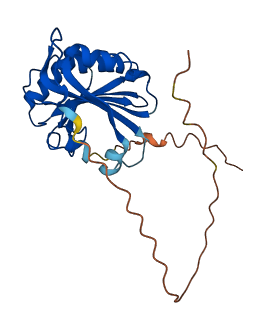
Descriptions
The autoinhibited protein was predicted that may have potential autoinhibitory elements via cis-regPred.
Autoinhibitory domains (AIDs)
Target domain |
|
Relief mechanism |
|
Assay |
cis-regPred |
Accessory elements
No accessory elements
Autoinhibited structure

Activated structure
1 structures for Q8BMB3
| Entry ID | Method | Resolution | Chain | Position | Source |
|---|---|---|---|---|---|
| AF-Q8BMB3-F1 | Predicted | AlphaFoldDB |
12 variants for Q8BMB3
| Variant ID(s) | Position | Change | Description | Diseaes Association | Provenance |
|---|---|---|---|---|---|
| rs3388483388 | 24 | T>S | No | EVA | |
| rs13464593 | 31 | E>G | No | EVA | |
| rs3388483699 | 71 | R>P | No | EVA | |
| rs3388484474 | 77 | S>I | No | EVA | |
| rs3388484532 | 77 | S>R | No | EVA | |
| rs3390274201 | 78 | Y>* | No | EVA | |
| rs3388483363 | 109 | G>D | No | EVA | |
| rs3388484993 | 129 | N>K | No | EVA | |
| rs3388483984 | 134 | K>N | No | EVA | |
| rs3388485762 | 138 | R>G | No | EVA | |
| rs3388483909 | 145 | S>F | No | EVA | |
| rs3388487119 | 211 | I>F | No | EVA |
No associated diseases with Q8BMB3
No regional properties for Q8BMB3
| Type | Name | Position | InterPro Accession |
|---|---|---|---|
| No domain, repeats, and functional sites for Q8BMB3 | |||
4 GO annotations of cellular component
| Name | Definition |
|---|---|
| cytoplasm | The contents of a cell excluding the plasma membrane and nucleus, but including other subcellular structures. |
| eukaryotic translation initiation factor 4F complex | The eukaryotic translation initiation factor 4F complex is composed of eIF4E, eIF4A and eIF4G; it is involved in the recognition of the mRNA cap, ATP-dependent unwinding of the 5'-terminal secondary structure and recruitment of the mRNA to the ribosome. |
| mRNA cap binding complex | Any protein complex that binds to an mRNA cap at any time in the lifetime of the mRNA. |
| P-body | A focus in the cytoplasm where mRNAs may become inactivated by decapping or some other mechanism. Protein and RNA localized to these foci are involved in mRNA degradation, nonsense-mediated mRNA decay (NMD), translational repression, and RNA-mediated gene silencing. |
3 GO annotations of molecular function
| Name | Definition |
|---|---|
| RNA 7-methylguanosine cap binding | Binding to a 7-methylguanosine group added cotranscriptionally to the 5' end of RNA molecules transcribed by polymerase II. |
| translation initiation factor activity | Functions in the initiation of ribosome-mediated translation of mRNA into a polypeptide. |
| ubiquitin protein ligase binding | Binding to a ubiquitin protein ligase enzyme, any of the E3 proteins. |
3 GO annotations of biological process
| Name | Definition |
|---|---|
| in utero embryonic development | The process whose specific outcome is the progression of the embryo in the uterus over time, from formation of the zygote in the oviduct, to birth. An example of this process is found in Mus musculus. |
| miRNA-mediated gene silencing by inhibition of translation | An RNA interference pathway in which microRNAs (miRNAs) block the translation of target mRNAs into proteins. Once incorporated into a RNA-induced silencing complex (RISC), a miRNA will typically mediate repression of translation if the miRNA imperfectly base-pairs with the 3' untranslated regions of target mRNAs. |
| negative regulation of translation | Any process that stops, prevents, or reduces the frequency, rate or extent of the chemical reactions and pathways resulting in the formation of proteins by the translation of mRNA or circRNA. |
5 homologous proteins in AiPD
| UniProt AC | Gene Name | Protein Name | Species | Evidence Code |
|---|---|---|---|---|
| A3RCV9 | NCBP | Eukaryotic translation initiation factor NCBP | Triticum aestivum (Wheat) | PR |
| O60573 | EIF4E2 | Eukaryotic translation initiation factor 4E type 2 | Homo sapiens (Human) | PR |
| P63073 | Eif4e | Eukaryotic translation initiation factor 4E | Mus musculus (Mouse) | PR |
| Q10NQ9 | NCBP | Eukaryotic translation initiation factor NCBP | Oryza sativa subsp japonica (Rice) | PR |
| Q22888 | ife-4 | Eukaryotic translation initiation factor 4E-4 | Caenorhabditis elegans | PR |
| 10 | 20 | 30 | 40 | 50 | 60 |
| MNNKFDALKD | DDSGDHDQNE | ENSTQKDGEK | EKTDRDKSQS | SGKRKAVVPG | PAEHPLQYNY |
| 70 | 80 | 90 | 100 | 110 | 120 |
| TFWYSRRTPG | RPTSSQSYEQ | NIKQIGTFAS | VEQFWKFYSH | MVRPGDLTGH | SDFHLFKEGI |
| 130 | 140 | 150 | 160 | 170 | 180 |
| KPMWEDDANK | NGGKWIIRLR | KGLASRCWEN | LILAMLGEQF | MVGEEICGAV | VSVRFQEDII |
| 190 | 200 | 210 | 220 | 230 | 240 |
| SIWNKTASDQ | ATTARIRDTL | RRVLNLPPNT | IMEYKTHTDS | IKMPGRLGPQ | RLLFQNLWKP |
| RLNVP |