Q10NQ9
Gene name |
NCBP (Os03g0262400, LOC_Os03g15590, OsJ_10222) |
Protein name |
Eukaryotic translation initiation factor NCBP |
Names |
Novel cap-binding protein, nCBP, mRNA cap-binding protein |
Species |
Oryza sativa subsp japonica (Rice) |
KEGG Pathway |
osa:4332327 |
EC number |
|
Protein Class |
|
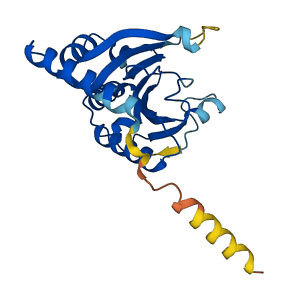
Descriptions
The autoinhibited protein was predicted that may have potential autoinhibitory elements via cis-regPred.
Autoinhibitory domains (AIDs)
Target domain |
|
Relief mechanism |
|
Assay |
cis-regPred |
Accessory elements
No accessory elements
Autoinhibited structure

Activated structure
1 structures for Q10NQ9
| Entry ID | Method | Resolution | Chain | Position | Source |
|---|---|---|---|---|---|
| AF-Q10NQ9-F1 | Predicted | AlphaFoldDB |
No variants for Q10NQ9
| Variant ID(s) | Position | Change | Description | Diseaes Association | Provenance |
|---|---|---|---|---|---|
| No variants for Q10NQ9 | |||||
No associated diseases with Q10NQ9
1 regional properties for Q10NQ9
| Type | Name | Position | InterPro Accession |
|---|---|---|---|
| conserved_site | Eukaryotic translation initiation factor 4E (eIF-4E), conserved site | 105 - 128 | IPR019770 |
1 GO annotations of cellular component
| Name | Definition |
|---|---|
| eukaryotic translation initiation factor 4F complex | The eukaryotic translation initiation factor 4F complex is composed of eIF4E, eIF4A and eIF4G; it is involved in the recognition of the mRNA cap, ATP-dependent unwinding of the 5'-terminal secondary structure and recruitment of the mRNA to the ribosome. |
2 GO annotations of molecular function
| Name | Definition |
|---|---|
| RNA 7-methylguanosine cap binding | Binding to a 7-methylguanosine group added cotranscriptionally to the 5' end of RNA molecules transcribed by polymerase II. |
| translation initiation factor activity | Functions in the initiation of ribosome-mediated translation of mRNA into a polypeptide. |
1 GO annotations of biological process
| Name | Definition |
|---|---|
| response to stimulus | Any process that results in a change in state or activity of a cell or an organism (in terms of movement, secretion, enzyme production, gene expression, etc.) as a result of a stimulus. The process begins with detection of the stimulus and ends with a change in state or activity or the cell or organism. |
7 homologous proteins in AiPD
| UniProt AC | Gene Name | Protein Name | Species | Evidence Code |
|---|---|---|---|---|
| A3RCV9 | NCBP | Eukaryotic translation initiation factor NCBP | Triticum aestivum (Wheat) | PR |
| Q8N5X7 | EIF4E3 | Eukaryotic translation initiation factor 4E type 3 | Homo sapiens (Human) | PR |
| O60573 | EIF4E2 | Eukaryotic translation initiation factor 4E type 2 | Homo sapiens (Human) | PR |
| Q8BMB3 | Eif4e2 | Eukaryotic translation initiation factor 4E type 2 | Mus musculus (Mouse) | PR |
| Q22888 | ife-4 | Eukaryotic translation initiation factor 4E-4 | Caenorhabditis elegans | PR |
| Q28ET8 | eif4e3 | Eukaryotic translation initiation factor 4E type 3 | Xenopus tropicalis (Western clawed frog) (Silurana tropicalis) | PR |
| Q66HY7 | eif4e3 | Eukaryotic translation initiation factor 4E type 3 | Danio rerio (Zebrafish) (Brachydanio rerio) | PR |
| 10 | 20 | 30 | 40 | 50 | 60 |
| MEPAAEKREA | EQEELQQQHD | EPAVPSADDD | EAEAEENERR | NRELKAGFHP | LRRRFVLWYT |
| 70 | 80 | 90 | 100 | 110 | 120 |
| RRTPGARSQS | YEDNIKKIVD | FSTVESFWVC | YCHLTRPVSL | PSPTDLHLFK | EGIRPLWEDP |
| 130 | 140 | 150 | 160 | 170 | 180 |
| ANRSGGKWII | RFKKTVSGRF | WEDLVLVLVG | DQLDYSDDVC | GVVLSVRFNE | DILSVWNRNA |
| 190 | 200 | 210 | 220 | ||
| SDHQAVMTLR | DSIKRHLKLP | HSYLMEYKPH | DASLRDNSSY | RNTWLRG |