Q9VLU5
Gene name |
Wwox (CG7221) |
Protein name |
WW domain-containing oxidoreductase |
Names |
|
Species |
Drosophila melanogaster (Fruit fly) |
KEGG Pathway |
dme:Dmel_CG7221 |
EC number |
|
Protein Class |
|
Descriptions
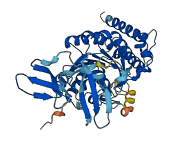
The autoinhibited protein was predicted that may have potential autoinhibitory elements via cis-regPred.
Autoinhibitory domains (AIDs)
Target domain |
|
Relief mechanism |
|
Assay |
cis-regPred |
Accessory elements
No accessory elements
Autoinhibited structure

Activated structure
1 structures for Q9VLU5
| Entry ID | Method | Resolution | Chain | Position | Source |
|---|---|---|---|---|---|
| AF-Q9VLU5-F1 | Predicted | AlphaFoldDB |
No variants for Q9VLU5
| Variant ID(s) | Position | Change | Description | Diseaes Association | Provenance |
|---|---|---|---|---|---|
| No variants for Q9VLU5 | |||||
No associated diseases with Q9VLU5
3 regional properties for Q9VLU5
| Type | Name | Position | InterPro Accession |
|---|---|---|---|
| domain | WW domain | 11 - 44 | IPR001202-1 |
| domain | WW domain | 52 - 86 | IPR001202-2 |
| domain | WWOX, classical (c)-like SDR domain | 121 - 402 | IPR042732 |
1 GO annotations of cellular component
| Name | Definition |
|---|---|
| cytoplasm | The contents of a cell excluding the plasma membrane and nucleus, but including other subcellular structures. |
1 GO annotations of molecular function
| Name | Definition |
|---|---|
| oxidoreductase activity | Catalysis of an oxidation-reduction (redox) reaction, a reversible chemical reaction in which the oxidation state of an atom or atoms within a molecule is altered. One substrate acts as a hydrogen or electron donor and becomes oxidized, while the other acts as hydrogen or electron acceptor and becomes reduced. |
5 GO annotations of biological process
| Name | Definition |
|---|---|
| apoptotic process | A programmed cell death process which begins when a cell receives an internal (e.g. DNA damage) or external signal (e.g. an extracellular death ligand), and proceeds through a series of biochemical events (signaling pathway phase) which trigger an execution phase. The execution phase is the last step of an apoptotic process, and is typically characterized by rounding-up of the cell, retraction of pseudopodes, reduction of cellular volume (pyknosis), chromatin condensation, nuclear fragmentation (karyorrhexis), plasma membrane blebbing and fragmentation of the cell into apoptotic bodies. When the execution phase is completed, the cell has died. |
| defense response to Gram-negative bacterium | Reactions triggered in response to the presence of a Gram-negative bacterium that act to protect the cell or organism. |
| regulation of reactive oxygen species metabolic process | Any process that modulates the frequency, rate or extent of reactive oxygen species metabolic process. |
| response to ionizing radiation | Any process that results in a change in state or activity of a cell or an organism (in terms of movement, secretion, enzyme production, gene expression, etc.) as a result of a ionizing radiation stimulus. Ionizing radiation is radiation with sufficient energy to remove electrons from atoms and may arise from spontaneous decay of unstable isotopes, resulting in alpha and beta particles and gamma rays. Ionizing radiation also includes X-rays. |
| Wnt signaling pathway | The series of molecular signals initiated by binding of a Wnt protein to a frizzled family receptor on the surface of the target cell and ending with a change in cell state. |
13 homologous proteins in AiPD
| UniProt AC | Gene Name | Protein Name | Species | Evidence Code |
|---|---|---|---|---|
| P53878 | YNL181W | Uncharacterized oxidoreductase YNL181W | Saccharomyces cerevisiae (strain ATCC 204508 / S288c) (Baker's yeast) | PR |
| P16152 | CBR1 | Carbonyl reductase [NADPH] 1 | Homo sapiens (Human) | PR |
| O75828 | CBR3 | Carbonyl reductase [NADPH] 3 | Homo sapiens (Human) | PR |
| A6NN90 | C2orf81 | Uncharacterized protein C2orf81 | Homo sapiens (Human) | PR |
| Q9HBH5 | RDH14 | Retinol dehydrogenase 14 | Homo sapiens (Human) | PR |
| Q9NZC7 | WWOX | WW domain-containing oxidoreductase | Homo sapiens (Human) | PR |
| Q8CEE7 | Rdh13 | Retinol dehydrogenase 13 | Mus musculus (Mouse) | PR |
| Q9ERI6 | Rdh14 | Retinol dehydrogenase 14 | Mus musculus (Mouse) | PR |
| Q9DAQ4 | Uncharacterized protein C2orf81 homolog | Mus musculus (Mouse) | PR | |
| Q91WL8 | Wwox | WW domain-containing oxidoreductase | Mus musculus (Mouse) | PR |
| Q6AXP4 | Uncharacterized protein C2orf81 homolog | Rattus norvegicus (Rat) | PR | |
| A2RVM0 | TIC32 | Short-chain dehydrogenase TIC 32, chloroplastic | Arabidopsis thaliana (Mouse-ear cress) | PR |
| Q803A8 | wwox | WW domain-containing oxidoreductase | Danio rerio (Zebrafish) (Brachydanio rerio) | PR |
| 10 | 20 | 30 | 40 | 50 | 60 |
| MIALPDTDSE | DELPPGWEER | ATDDGTVCYV | NQQGKTSQWT | HPRTGRSKRI | TGELPLGWEK |
| 70 | 80 | 90 | 100 | 110 | 120 |
| YYDEQGKRFM | FLNKETQQRT | NVDPRLAFAV | EEPTQNVAQV | RQRFDSCSTA | LQVLHGKDLH |
| 130 | 140 | 150 | 160 | 170 | 180 |
| GRTALITGAN | CGIGYETARS | LAHHGCEIIF | ACRNRSSAEA | AIERIAQERP | AARSRCRFAA |
| 190 | 200 | 210 | 220 | 230 | 240 |
| LDLSSLRSVQ | RFVEEIKQSV | SHIDYLILNA | GVFALPYTRT | VDGLETTFQV | SHLSHFYLTL |
| 250 | 260 | 270 | 280 | 290 | 300 |
| QLETLFDYKT | RIIVLSSESH | RFANLPVENL | AVHHLSPPPE | KYWSMMAYNN | AKLCNVLFAQ |
| 310 | 320 | 330 | 340 | 350 | 360 |
| ELAQRWKQRG | ISVFSLHPGN | MVSSDLSRNY | WFYRLLFAIV | RPFTKSLQQA | AATSIYCATA |
| 370 | 380 | 390 | 400 | ||
| NELTGLSGLY | FNNCFFCEPS | KLSKSAALQQ | QLWKLSENLI | AELVEQEQH |