Q91WL8
Gene name |
Wwox (Wox1) |
Protein name |
WW domain-containing oxidoreductase |
Names |
|
Species |
Mus musculus (Mouse) |
KEGG Pathway |
mmu:80707 |
EC number |
|
Protein Class |
|
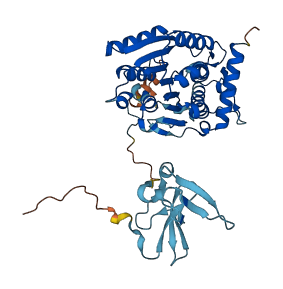
Descriptions
The autoinhibited protein was predicted that may have potential autoinhibitory elements via cis-regPred.
Autoinhibitory domains (AIDs)
Target domain |
|
Relief mechanism |
|
Assay |
cis-regPred |
Accessory elements
No accessory elements
Autoinhibited structure

Activated structure
1 structures for Q91WL8
| Entry ID | Method | Resolution | Chain | Position | Source |
|---|---|---|---|---|---|
| AF-Q91WL8-F1 | Predicted | AlphaFoldDB |
17 variants for Q91WL8
| Variant ID(s) | Position | Change | Description | Diseaes Association | Provenance |
|---|---|---|---|---|---|
| rs3389015162 | 25 | R>I | No | EVA | |
| rs3389014521 | 82 | R>G | No | EVA | |
| rs3399611772 | 115 | E>V | No | EVA | |
| rs3399157234 | 116 | I>L | No | EVA | |
| rs3389011843 | 128 | L>M | No | EVA | |
| rs238382309 | 186 | V>M | No | EVA | |
| rs3389019024 | 195 | E>D | No | EVA | |
| rs3389001541 | 226 | E>A | No | EVA | |
| rs31398163 | 279 | R>H | No | EVA | |
| rs31398163 | 279 | R>P | No | EVA | |
| rs3389007870 | 280 | L>P | No | EVA | |
| rs3389001577 | 290 | M>I | No | EVA | |
| rs3389007829 | 353 | Q>* | No | EVA | |
| rs3388989790 | 359 | T>I | No | EVA | |
| rs3389018962 | 369 | E>G | No | EVA | |
| rs3388989796 | 389 | Q>H | No | EVA | |
| rs31506803 | 410 | G>S | No | EVA |
No associated diseases with Q91WL8
3 regional properties for Q91WL8
| Type | Name | Position | InterPro Accession |
|---|---|---|---|
| domain | WW domain | 16 - 49 | IPR001202-1 |
| domain | WW domain | 57 - 90 | IPR001202-2 |
| domain | WWOX, classical (c)-like SDR domain | 124 - 407 | IPR042732 |
Functions
9 GO annotations of cellular component
| Name | Definition |
|---|---|
| cytoplasm | The contents of a cell excluding the plasma membrane and nucleus, but including other subcellular structures. |
| cytosol | The part of the cytoplasm that does not contain organelles but which does contain other particulate matter, such as protein complexes. |
| Golgi apparatus | A membrane-bound cytoplasmic organelle of the endomembrane system that further processes the core oligosaccharides (e.g. N-glycans) added to proteins in the endoplasmic reticulum and packages them into membrane-bound vesicles. The Golgi apparatus operates at the intersection of the secretory, lysosomal, and endocytic pathways. |
| microvillus | Thin cylindrical membrane-covered projections on the surface of an animal cell containing a core bundle of actin filaments. Present in especially large numbers on the absorptive surface of intestinal cells. |
| mitochondrion | A semiautonomous, self replicating organelle that occurs in varying numbers, shapes, and sizes in the cytoplasm of virtually all eukaryotic cells. It is notably the site of tissue respiration. |
| nucleoplasm | That part of the nuclear content other than the chromosomes or the nucleolus. |
| nucleus | A membrane-bounded organelle of eukaryotic cells in which chromosomes are housed and replicated. In most cells, the nucleus contains all of the cell's chromosomes except the organellar chromosomes, and is the site of RNA synthesis and processing. In some species, or in specialized cell types, RNA metabolism or DNA replication may be absent. |
| plasma membrane | The membrane surrounding a cell that separates the cell from its external environment. It consists of a phospholipid bilayer and associated proteins. |
| RNA polymerase II transcription regulator complex | A transcription factor complex that acts at a regulatory region of a gene transcribed by RNA polymerase II. |
3 GO annotations of molecular function
| Name | Definition |
|---|---|
| enzyme binding | Binding to an enzyme, a protein with catalytic activity. |
| identical protein binding | Binding to an identical protein or proteins. |
| oxidoreductase activity | Catalysis of an oxidation-reduction (redox) reaction, a reversible chemical reaction in which the oxidation state of an atom or atoms within a molecule is altered. One substrate acts as a hydrogen or electron donor and becomes oxidized, while the other acts as hydrogen or electron acceptor and becomes reduced. |
10 GO annotations of biological process
| Name | Definition |
|---|---|
| cellular response to transforming growth factor beta stimulus | Any process that results in a change in state or activity of a cell (in terms of movement, secretion, enzyme production, gene expression, etc.) as a result of a transforming growth factor beta stimulus. |
| extrinsic apoptotic signaling pathway | The series of molecular signals in which a signal is conveyed from the cell surface to trigger the apoptotic death of a cell. The pathway starts with either a ligand binding to a cell surface receptor, or a ligand being withdrawn from a cell surface receptor (e.g. in the case of signaling by dependence receptors), and ends when the execution phase of apoptosis is triggered. |
| intrinsic apoptotic signaling pathway by p53 class mediator | The series of molecular signals in which an intracellular signal is conveyed to trigger the apoptotic death of a cell. The pathway is induced by the cell cycle regulator phosphoprotein p53, or an equivalent protein, and ends when the execution phase of apoptosis is triggered. |
| negative regulation of Wnt signaling pathway | Any process that stops, prevents, or reduces the frequency, rate or extent of the Wnt signaling pathway. |
| osteoblast differentiation | The process whereby a relatively unspecialized cell acquires the specialized features of an osteoblast, a mesodermal or neural crest cell that gives rise to bone. |
| positive regulation of extrinsic apoptotic signaling pathway | Any process that activates or increases the frequency, rate or extent of extrinsic apoptotic signaling pathway. |
| positive regulation of extrinsic apoptotic signaling pathway in absence of ligand | Any process that activates or increases the frequency, rate or extent of extrinsic apoptotic signaling pathway in absence of ligand. |
| positive regulation of transcription by RNA polymerase II | Any process that activates or increases the frequency, rate or extent of transcription from an RNA polymerase II promoter. |
| skeletal system morphogenesis | The process in which the anatomical structures of the skeleton are generated and organized. |
| Wnt signaling pathway | The series of molecular signals initiated by binding of a Wnt protein to a frizzled family receptor on the surface of the target cell and ending with a change in cell state. |
13 homologous proteins in AiPD
| UniProt AC | Gene Name | Protein Name | Species | Evidence Code |
|---|---|---|---|---|
| P53878 | YNL181W | Uncharacterized oxidoreductase YNL181W | Saccharomyces cerevisiae (strain ATCC 204508 / S288c) (Baker's yeast) | PR |
| Q9VLU5 | Wwox | WW domain-containing oxidoreductase | Drosophila melanogaster (Fruit fly) | PR |
| P16152 | CBR1 | Carbonyl reductase [NADPH] 1 | Homo sapiens (Human) | PR |
| O75828 | CBR3 | Carbonyl reductase [NADPH] 3 | Homo sapiens (Human) | PR |
| A6NN90 | C2orf81 | Uncharacterized protein C2orf81 | Homo sapiens (Human) | PR |
| Q9HBH5 | RDH14 | Retinol dehydrogenase 14 | Homo sapiens (Human) | PR |
| Q9NZC7 | WWOX | WW domain-containing oxidoreductase | Homo sapiens (Human) | PR |
| Q8CEE7 | Rdh13 | Retinol dehydrogenase 13 | Mus musculus (Mouse) | PR |
| Q9DAQ4 | Uncharacterized protein C2orf81 homolog | Mus musculus (Mouse) | PR | |
| Q9ERI6 | Rdh14 | Retinol dehydrogenase 14 | Mus musculus (Mouse) | PR |
| Q6AXP4 | Uncharacterized protein C2orf81 homolog | Rattus norvegicus (Rat) | PR | |
| A2RVM0 | TIC32 | Short-chain dehydrogenase TIC 32, chloroplastic | Arabidopsis thaliana (Mouse-ear cress) | PR |
| Q803A8 | wwox | WW domain-containing oxidoreductase | Danio rerio (Zebrafish) (Brachydanio rerio) | PR |
| 10 | 20 | 30 | 40 | 50 | 60 |
| MAALRYAGLD | DTDSEDELPP | GWEERTTKDG | WVYYANHTEE | KTQWEHPKTG | KRKRVAGDLP |
| 70 | 80 | 90 | 100 | 110 | 120 |
| YGWEQETDEN | GQVFFVDHIN | KRTTYLDPRL | AFTVDDNPTK | PTTRQRYDGS | TTAMEILQGR |
| 130 | 140 | 150 | 160 | 170 | 180 |
| DFTGKVVLVT | GANSGIGFET | AKSFALHGAH | VILACRNLSR | ASEAVSRILE | EWHKAKVEAM |
| 190 | 200 | 210 | 220 | 230 | 240 |
| TLDLAVLRSV | QHFAEAFKAK | NVSLHVLVCN | AGTFALPWGL | TKDGLETTFQ | VNHLGHFYLV |
| 250 | 260 | 270 | 280 | 290 | 300 |
| QLLQDVLCRS | SPARVIVVSS | ESHRFTDIND | SSGKLDLSRL | SPPRSDYWAM | LAYNRSKLCN |
| 310 | 320 | 330 | 340 | 350 | 360 |
| ILFSNELHRR | LSPRGVTSNA | VHPGNMMYSA | IHRNSWVYKL | LFTLARPFTK | SMQQGAATTV |
| 370 | 380 | 390 | 400 | 410 | |
| YCAVAPELEG | LGGMYFNNCC | RCLPSEEAQS | EETARALWEL | SERLIQDRLG | SPSS |