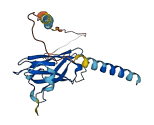
Descriptions
The autoinhibited protein was predicted that may have potential autoinhibitory elements via cis-regPred.
Autoinhibitory domains (AIDs)
Target domain |
|
Relief mechanism |
|
Assay |
cis-regPred |
Accessory elements
No accessory elements
Autoinhibited structure

Activated structure
2 structures for Q9QY76
| Entry ID | Method | Resolution | Chain | Position | Source |
|---|---|---|---|---|---|
| 7X14 | X-ray | 168 A | A | 1-125 | PDB |
| AF-Q9QY76-F1 | Predicted | AlphaFoldDB |
No variants for Q9QY76
| Variant ID(s) | Position | Change | Description | Diseaes Association | Provenance |
|---|---|---|---|---|---|
| No variants for Q9QY76 | |||||
No associated diseases with Q9QY76
1 regional properties for Q9QY76
| Type | Name | Position | InterPro Accession |
|---|---|---|---|
| domain | Major sperm protein (MSP) domain | 7 - 124 | IPR000535 |
Functions
7 GO annotations of cellular component
| Name | Definition |
|---|---|
| cytoplasm | The contents of a cell excluding the plasma membrane and nucleus, but including other subcellular structures. |
| endoplasmic reticulum | The irregular network of unit membranes, visible only by electron microscopy, that occurs in the cytoplasm of many eukaryotic cells. The membranes form a complex meshwork of tubular channels, which are often expanded into slitlike cavities called cisternae. The ER takes two forms, rough (or granular), with ribosomes adhering to the outer surface, and smooth (with no ribosomes attached). |
| endoplasmic reticulum membrane | The lipid bilayer surrounding the endoplasmic reticulum. |
| Golgi apparatus | A membrane-bound cytoplasmic organelle of the endomembrane system that further processes the core oligosaccharides (e.g. N-glycans) added to proteins in the endoplasmic reticulum and packages them into membrane-bound vesicles. The Golgi apparatus operates at the intersection of the secretory, lysosomal, and endocytic pathways. |
| integral component of membrane | The component of a membrane consisting of the gene products and protein complexes having at least some part of their peptide sequence embedded in the hydrophobic region of the membrane. |
| membrane | A lipid bilayer along with all the proteins and protein complexes embedded in it an attached to it. |
| plasma membrane | The membrane surrounding a cell that separates the cell from its external environment. It consists of a phospholipid bilayer and associated proteins. |
6 GO annotations of molecular function
| Name | Definition |
|---|---|
| beta-tubulin binding | Binding to the microtubule constituent protein beta-tubulin. |
| enzyme binding | Binding to an enzyme, a protein with catalytic activity. |
| FFAT motif binding | Binding to a FFAT motif, a short motif containing diphenylalanine in an acidic tract that targets proteins to the cytosolic surface of the ER and to the nuclear membrane by binding directly to members of the VAP (VAMP-associated protein) protein family. |
| microtubule binding | Binding to a microtubule, a filament composed of tubulin monomers. |
| protein heterodimerization activity | Binding to a nonidentical protein to form a heterodimer. |
| protein homodimerization activity | Binding to an identical protein to form a homodimer. |
15 GO annotations of biological process
| Name | Definition |
|---|---|
| cellular calcium ion homeostasis | Any process involved in the maintenance of an internal steady state of calcium ions at the level of a cell. |
| COPII-coated vesicle budding | The evagination of an endoplasmic reticulum membrane, resulting in formation of a COPII-coated vesicle. |
| endoplasmic reticulum membrane organization | A process that is carried out at the cellular level which results in the assembly, arrangement of constituent parts, or disassembly of an endoplasmic reticulum membrane. |
| endoplasmic reticulum organization | A process that is carried out at the cellular level which results in the assembly, arrangement of constituent parts, or disassembly of the endoplasmic reticulum. |
| endoplasmic reticulum to Golgi vesicle-mediated transport | The directed movement of substances from the endoplasmic reticulum (ER) to the Golgi, mediated by COP II vesicles. Small COP II coated vesicles form from the ER and then fuse directly with the cis-Golgi. Larger structures are transported along microtubules to the cis-Golgi. |
| endoplasmic reticulum unfolded protein response | The series of molecular signals generated as a consequence of the presence of unfolded proteins in the endoplasmic reticulum (ER) or other ER-related stress; results in changes in the regulation of transcription and translation. |
| endoplasmic reticulum-plasma membrane tethering | The attachment of an endoplasmic reticulum membrane to the plasma membrane via molecular tethers. |
| IRE1-mediated unfolded protein response | The series of molecular signals mediated by the endoplasmic reticulum stress sensor IRE1 (Inositol-requiring transmembrane kinase/endonuclease). Begins with activation of IRE1 in response to endoplasmic reticulum (ER) stress, and ends with regulation of a downstream cellular process, e.g. transcription. One target of activated IRE1 is the transcription factor HAC1 in yeast, or XBP1 in mammals; IRE1 cleaves an intron of a mRNA coding for HAC1/XBP1 to generate an activated HAC1/XBP1 transcription factor, which controls the up regulation of UPR-related genes. At least in mammals, IRE1 can also signal through additional intracellular pathways including JNK and NF-kappaB. |
| modulation by host of viral RNA genome replication | A process in which a host organism modulates the frequency, rate or extent of viral RNA genome replication. |
| negative regulation by host of viral genome replication | A process in which a host organism stops, prevents or reduces the frequency, rate or extent of viral genome replication. |
| negative regulation by virus of viral protein levels in host cell | Any process where the infecting virus reduces the levels of viral proteins in a cell. |
| positive regulation by host of viral genome replication | A process in which a host organism activates or increases the frequency, rate or extent of viral genome replication. |
| positive regulation of viral genome replication | Any process that activates or increases the frequency, rate or extent of viral genome replication. |
| suppression of viral release by host | A process in which a host organism stops, prevents or reduces the frequency, rate or extent of the release of a virus with which it is infected, from its cells. |
| viral release from host cell | The dissemination of mature viral particles from the host cell, e.g. by cell lysis or the budding of virus particles from the cell membrane. |
10 homologous proteins in AiPD
| UniProt AC | Gene Name | Protein Name | Species | Evidence Code |
|---|---|---|---|---|
| Q2T9W7 | MOSPD1 | Motile sperm domain-containing protein 1 | Bos taurus (Bovine) | PR |
| A2VDZ9 | VAPB | Vesicle-associated membrane protein-associated protein B | Bos taurus (Bovine) | PR |
| O95292 | VAPB | Vesicle-associated membrane protein-associated protein B/C | Homo sapiens (Human) | PR |
| Q8VEL0 | Mospd1 | Motile sperm domain-containing protein 1 | Mus musculus (Mouse) | PR |
| Q5RJS6 | Mospd1 | Motile sperm domain-containing protein 1 | Rattus norvegicus (Rat) | PR |
| Q9Z269 | Vapb | Vesicle-associated membrane protein-associated protein B | Rattus norvegicus (Rat) | PR |
| Q1ECE0 | PVA41 | Vesicle-associated protein 4-1 | Arabidopsis thaliana (Mouse-ear cress) | PR |
| Q8LPQ7 | PVA43 | Vesicle-associated protein 4-3 | Arabidopsis thaliana (Mouse-ear cress) | PR |
| Q8VYN2 | PVA42 | Vesicle-associated protein 4-2 | Arabidopsis thaliana (Mouse-ear cress) | PR |
| Q8VZ95 | PVA11 | Vesicle-associated protein 1-1 | Arabidopsis thaliana (Mouse-ear cress) | PR |
| 10 | 20 | 30 | 40 | 50 | 60 |
| MAKVEQVLSL | EPQHELKFRG | PFTDVVTTNL | KLGNPTDRNV | CFKVKTTVPR | RYCVRPNSGV |
| 70 | 80 | 90 | 100 | 110 | 120 |
| IDAGASLNVS | VMLQPFDYDP | NEKSKHKFMV | QSMFAPPDTS | DMEAVWKEAK | PEDLMDSKLR |
| 130 | 140 | 150 | 160 | 170 | 180 |
| CVFELPAENA | KPHDVEINKI | IPTSASKTEA | PAAAKSLTSP | LDDTEVKKVM | EECRRLQGEV |
| 190 | 200 | 210 | 220 | 230 | 240 |
| QRLREESRQL | KEEDGLRVRK | AMPSNSPVAA | LAATGKEEGL | SARLLALVVL | FFIVGVIIGK |
| IAL |