Q9PU47
Gene name |
PDLIM3 (ALP) |
Protein name |
PDZ and LIM domain protein 3 |
Names |
Alpha-actinin-associated LIM protein |
Species |
Gallus gallus (Chicken) |
KEGG Pathway |
gga:414873 |
EC number |
|
Protein Class |
|
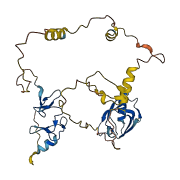
Descriptions
The autoinhibited protein was predicted that may have potential autoinhibitory elements via cis-regPred.
Autoinhibitory domains (AIDs)
Target domain |
|
Relief mechanism |
|
Assay |
cis-regPred |
Accessory elements
No accessory elements
Autoinhibited structure

Activated structure
1 structures for Q9PU47
| Entry ID | Method | Resolution | Chain | Position | Source |
|---|---|---|---|---|---|
| AF-Q9PU47-F1 | Predicted | AlphaFoldDB |
No variants for Q9PU47
| Variant ID(s) | Position | Change | Description | Diseaes Association | Provenance |
|---|---|---|---|---|---|
| No variants for Q9PU47 | |||||
No associated diseases with Q9PU47
Functions
7 GO annotations of cellular component
| Name | Definition |
|---|---|
| actin cytoskeleton | The part of the cytoskeleton (the internal framework of a cell) composed of actin and associated proteins. Includes actin cytoskeleton-associated complexes. |
| adherens junction | A cell-cell junction composed of the epithelial cadherin-catenin complex. The epithelial cadherins, or E-cadherins, of each interacting cell extend through the plasma membrane into the extracellular space and bind to each other. The E-cadherins bind to catenins on the cytoplasmic side of the membrane, where the E-cadherin-catenin complex binds to cytoskeletal components and regulatory and signaling molecules. |
| filamentous actin | A two-stranded helical polymer of the protein actin. |
| focal adhesion | A cell-substrate junction that anchors the cell to the extracellular matrix and that forms a point of termination of actin filaments. In insects focal adhesion has also been referred to as hemi-adherens junction (HAJ). |
| lamellipodium | A thin sheetlike process extended by the leading edge of a migrating cell or extending cell process; contains a dense meshwork of actin filaments. |
| stress fiber | A contractile actin filament bundle that consists of short actin filaments with alternating polarity, cross-linked by alpha-actinin and possibly other actin bundling proteins, and with myosin present in a periodic distribution along the fiber. |
| Z disc | Platelike region of a muscle sarcomere to which the plus ends of actin filaments are attached. |
4 GO annotations of molecular function
| Name | Definition |
|---|---|
| actin binding | Binding to monomeric or multimeric forms of actin, including actin filaments. |
| alpha-actinin binding | Binding to alpha-actinin, one of a family of proteins that cross-link F-actin as antiparallel homodimers. Alpha-actinin has a molecular mass of 93-103 KDa; at the N-terminus there are two calponin homology domains, at the C-terminus there are two EF-hands. These two domains are connected by the rod domain. This domain is formed by triple-helical spectrin repeats. |
| metal ion binding | Binding to a metal ion. |
| muscle alpha-actinin binding | Binding to muscle isoforms of actinin. Muscle alpha-actinin isoforms are found in skeletal and cardiac muscle and are localized to the Z-disc. |
3 GO annotations of biological process
| Name | Definition |
|---|---|
| actin cytoskeleton organization | A process that is carried out at the cellular level which results in the assembly, arrangement of constituent parts, or disassembly of cytoskeletal structures comprising actin filaments and their associated proteins. |
| heart development | The process whose specific outcome is the progression of the heart over time, from its formation to the mature structure. The heart is a hollow, muscular organ, which, by contracting rhythmically, keeps up the circulation of the blood. |
| muscle structure development | The progression of a muscle structure over time, from its formation to its mature state. Muscle structures are contractile cells, tissues or organs that are found in multicellular organisms. |
10 homologous proteins in AiPD
| UniProt AC | Gene Name | Protein Name | Species | Evidence Code |
|---|---|---|---|---|
| Q3SYZ8 | PDLIM3 | PDZ and LIM domain protein 3 | Bos taurus (Bovine) | PR |
| P49024 | PXN | Paxillin | Gallus gallus (Chicken) | PR |
| P49023 | PXN | Paxillin | Homo sapiens (Human) | PR |
| O43294 | TGFB1I1 | Transforming growth factor beta-1-induced transcript 1 protein | Homo sapiens (Human) | PR |
| Q53GG5 | PDLIM3 | PDZ and LIM domain protein 3 | Homo sapiens (Human) | PR |
| Q62219 | Tgfb1i1 | Transforming growth factor beta-1-induced transcript 1 protein | Mus musculus (Mouse) | PR |
| Q8VI36 | Pxn | Paxillin | Mus musculus (Mouse) | PR |
| O70209 | Pdlim3 | PDZ and LIM domain protein 3 | Mus musculus (Mouse) | PR |
| Q6QGC0 | PDLIM3 | PDZ and LIM domain protein 3 | Sus scrofa (Pig) | PR |
| Q66H76 | Pxn | Paxillin | Rattus norvegicus (Rat) | PR |
| 10 | 20 | 30 | 40 | 50 | 60 |
| MPQNVILPGP | APWGFRLSGG | IDFNQPLIIT | RITPGSKAST | ANLCPGDIIV | AINGLSTENM |
| 70 | 80 | 90 | 100 | 110 | 120 |
| THNDAQERIK | AAAHQLSLRI | ERAETKLWSP | QVSEDGKANP | YKINLEAEPQ | EFKPIGTAHN |
| 130 | 140 | 150 | 160 | 170 | 180 |
| RRAQPFVAAA | NIDDKRQVVS | SSYNSPIGLY | SSGNIQDALH | GQLRSLIPNA | SQNDPAPAAV |
| 190 | 200 | 210 | 220 | 230 | 240 |
| PQSDVYRMLH | SNQEEPSQPR | QSGSFKVLQN | LVSEEDGRPV | GTRSVKAPVT | KIPTGLPGAQ |
| 250 | 260 | 270 | 280 | 290 | 300 |
| KVPQCDKCGS | GILGTVVKAR | DKYRHPECFV | CSDCNLNLKQ | KGYFFVEGQL | YCEAHARARM |
| 310 | |||||
| RPPEGYEAVT | VYPKC |