Q66H76
Gene name |
Pxn |
Protein name |
Paxillin |
Names |
|
Species |
Rattus norvegicus (Rat) |
KEGG Pathway |
rno:360820 |
EC number |
|
Protein Class |
|
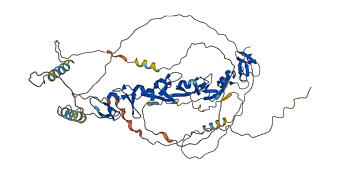
Descriptions
The autoinhibited protein was predicted that may have potential autoinhibitory elements via cis-regPred.
Autoinhibitory domains (AIDs)
Target domain |
|
Relief mechanism |
|
Assay |
cis-regPred |
Accessory elements
No accessory elements
Autoinhibited structure

Activated structure
1 structures for Q66H76
| Entry ID | Method | Resolution | Chain | Position | Source |
|---|---|---|---|---|---|
| AF-Q66H76-F1 | Predicted | AlphaFoldDB |
No variants for Q66H76
| Variant ID(s) | Position | Change | Description | Diseaes Association | Provenance |
|---|---|---|---|---|---|
| No variants for Q66H76 | |||||
No associated diseases with Q66H76
7 regional properties for Q66H76
| Type | Name | Position | InterPro Accession |
|---|---|---|---|
| domain | Zinc finger, LIM-type | 356 - 415 | IPR001781-1 |
| domain | Zinc finger, LIM-type | 416 - 473 | IPR001781-2 |
| domain | Zinc finger, LIM-type | 474 - 533 | IPR001781-3 |
| domain | Zinc finger, LIM-type | 534 - 591 | IPR001781-4 |
| domain | Paxillin, Lim domain 4 | 535 - 586 | IPR001904 |
| domain | Paxillin, Lim domain 2 | 417 - 468 | IPR047072 |
| domain | Paxillin/TGFB1I1, LIM domain 1 | 358 - 410 | IPR047075 |
Functions
8 GO annotations of cellular component
| Name | Definition |
|---|---|
| cell cortex | The region of a cell that lies just beneath the plasma membrane and often, but not always, contains a network of actin filaments and associated proteins. |
| cell leading edge | The area of a motile cell closest to the direction of movement. |
| cell-cell junction | A cell junction that forms a connection between two or more cells of an organism; excludes direct cytoplasmic intercellular bridges, such as ring canals in insects. |
| cytosol | The part of the cytoplasm that does not contain organelles but which does contain other particulate matter, such as protein complexes. |
| focal adhesion | A cell-substrate junction that anchors the cell to the extracellular matrix and that forms a point of termination of actin filaments. In insects focal adhesion has also been referred to as hemi-adherens junction (HAJ). |
| lamellipodium | A thin sheetlike process extended by the leading edge of a migrating cell or extending cell process; contains a dense meshwork of actin filaments. |
| plasma membrane | The membrane surrounding a cell that separates the cell from its external environment. It consists of a phospholipid bilayer and associated proteins. |
| stress fiber | A contractile actin filament bundle that consists of short actin filaments with alternating polarity, cross-linked by alpha-actinin and possibly other actin bundling proteins, and with myosin present in a periodic distribution along the fiber. |
11 GO annotations of molecular function
| Name | Definition |
|---|---|
| beta-catenin binding | Binding to a catenin beta subunit. |
| BH4 domain binding | Binding to a BH4 protein domain, present in Bcl-2 family members. All anti-apoptotic proteins contain BH1 and BH2 domains; some also contain an additional N-terminal BH4 domain, which is almost never seen in pro-apoptotic proteins. Loss of the BH4 domain can diminish or abrogate anti-apoptotic function or even impart outright death-promoting properties to the protein. |
| integrin binding | Binding to an integrin. |
| MAP-kinase scaffold activity | The binding activity of a molecule that functions as a physical support for the assembly of a multiprotein mitogen-activated protein kinase (MAPK) complex. Binds multiple kinases of the MAPKKK cascade, and also upstream signaling proteins, permitting those molecules to function in a coordinated way. Bringing together multiple enzymes and their substrates enables the signal to be transduced quickly and efficiently. |
| metal ion binding | Binding to a metal ion. |
| neuropilin binding | Binding to a member of the neuropilin family. |
| protein kinase binding | Binding to a protein kinase, any enzyme that catalyzes the transfer of a phosphate group, usually from ATP, to a protein substrate. |
| protein phosphatase binding | Binding to a protein phosphatase. |
| protein-containing complex binding | Binding to a macromolecular complex. |
| transcription coregulator activity | A transcription regulator activity that modulates the transcription of specific gene sets via binding to a DNA-bound DNA-binding transcription factor, either on its own or as part of a complex. Coregulators often act by altering chromatin structure and modifications. For example, one class of transcription coregulators modifies chromatin structure through covalent modification of histones. A second class remodels the conformation of chromatin in an ATP-dependent fashion. A third class modulates interactions of DNA-bound DNA-binding transcription factors with other transcription coregulators. |
| vinculin binding | Binding to vinculin, a protein found in muscle, fibroblasts, and epithelial cells that binds actin and appears to mediate attachment of actin filaments to integral proteins of the plasma membrane. |
17 GO annotations of biological process
| Name | Definition |
|---|---|
| branching morphogenesis of an epithelial tube | The process in which the anatomical structures of branches in an epithelial tube are generated and organized. A tube is a long hollow cylinder. |
| cellular response to reactive oxygen species | Any process that results in a change in state or activity of a cell (in terms of movement, secretion, enzyme production, gene expression, etc.) as a result of a reactive oxygen species stimulus. Reactive oxygen species include singlet oxygen, superoxide, and oxygen free radicals. |
| cytoskeleton organization | A process that is carried out at the cellular level which results in the assembly, arrangement of constituent parts, or disassembly of cytoskeletal structures. |
| endothelial cell migration | The orderly movement of an endothelial cell into the extracellular matrix to form an endothelium. |
| focal adhesion assembly | The aggregation and bonding together of a set of components to form a focal adhesion, a complex of intracellular signaling and structural proteins that provides a structural link between the internal actin cytoskeleton and the ECM, and also function as a locus of signal transduction activity. |
| growth hormone receptor signaling pathway | The series of molecular signals generated as a consequence of growth hormone receptor binding to its physiological ligand. |
| integrin-mediated signaling pathway | The series of molecular signals initiated by an extracellular ligand binding to an integrin on the surface of a target cell, and ending with the regulation of a downstream cellular process, e.g. transcription. |
| lamellipodium assembly | Formation of a lamellipodium, a thin sheetlike extension of the surface of a migrating cell. |
| peptidyl-tyrosine phosphorylation | The phosphorylation of peptidyl-tyrosine to form peptidyl-O4'-phospho-L-tyrosine. |
| positive regulation of angiogenesis | Any process that activates or increases angiogenesis. |
| positive regulation of MAPK cascade | Any process that activates or increases the frequency, rate or extent of signal transduction mediated by the MAPK cascade. |
| positive regulation of protein kinase activity | Any process that activates or increases the frequency, rate or extent of protein kinase activity. |
| positive regulation of stress fiber assembly | Any process that activates or increases the frequency, rate or extent of the assembly of a stress fiber, a bundle of microfilaments and other proteins found in fibroblasts. |
| regulation of cell shape | Any process that modulates the surface configuration of a cell. |
| response to peptide | Any process that results in a change in state or activity of a cell or an organism (in terms of movement, secretion, enzyme production, gene expression, etc.) as a result of a peptide stimulus. |
| substrate adhesion-dependent cell spreading | The morphogenetic process that results in flattening of a cell as a consequence of its adhesion to a substrate. |
| transforming growth factor beta receptor signaling pathway | The series of molecular signals initiated by an extracellular ligand binding to a transforming growth factor beta receptor on the surface of a target cell, and ending with the regulation of a downstream cellular process, e.g. transcription. |
10 homologous proteins in AiPD
| UniProt AC | Gene Name | Protein Name | Species | Evidence Code |
|---|---|---|---|---|
| Q3SYZ8 | PDLIM3 | PDZ and LIM domain protein 3 | Bos taurus (Bovine) | PR |
| Q9PU47 | PDLIM3 | PDZ and LIM domain protein 3 | Gallus gallus (Chicken) | PR |
| P49024 | PXN | Paxillin | Gallus gallus (Chicken) | PR |
| Q53GG5 | PDLIM3 | PDZ and LIM domain protein 3 | Homo sapiens (Human) | PR |
| O43294 | TGFB1I1 | Transforming growth factor beta-1-induced transcript 1 protein | Homo sapiens (Human) | PR |
| P49023 | PXN | Paxillin | Homo sapiens (Human) | PR |
| O70209 | Pdlim3 | PDZ and LIM domain protein 3 | Mus musculus (Mouse) | PR |
| Q62219 | Tgfb1i1 | Transforming growth factor beta-1-induced transcript 1 protein | Mus musculus (Mouse) | PR |
| Q8VI36 | Pxn | Paxillin | Mus musculus (Mouse) | PR |
| Q6QGC0 | PDLIM3 | PDZ and LIM domain protein 3 | Sus scrofa (Pig) | PR |
| 10 | 20 | 30 | 40 | 50 | 60 |
| MDDLDALLAD | LESTTSHISK | RPVFLSEEPP | YSYPTGNHTY | QEIAVPPPVP | PPPSSEALNG |
| 70 | 80 | 90 | 100 | 110 | 120 |
| TVLDPLDQWQ | PSGSRYAHQQ | PPSPSPIYSS | STKNSSASNP | QDSVGSLCSR | AGEEEHVYSF |
| 130 | 140 | 150 | 160 | 170 | 180 |
| PNKQKSAEPS | PTVMSSSLGS | NLSELDRLLL | ELNAVQRSPS | GFSAGMVSVQ | ASREPLGSWG |
| 190 | 200 | 210 | 220 | 230 | 240 |
| TEGRAIILSP | FFQDEAESSP | PLPGALSPLY | GVPESNNLLG | GKAGPLMKEK | PKRNGGRGLE |
| 250 | 260 | 270 | 280 | 290 | 300 |
| DVRPSVESLL | DELENSVPSP | VPAITVNQGE | MSSPQRVTSS | QQQTRISASS | ATRELDELMA |
| 310 | 320 | 330 | 340 | 350 | 360 |
| SLSDFKFMAQ | GKTGSSSPPG | GLSKPGSQLD | SMLGSLQSDL | NKLGVATVAK | GVCGACKKPI |
| 370 | 380 | 390 | 400 | 410 | 420 |
| AGQVVTAMGK | TWHPEHFVCT | HCQEEIGSRN | FFERDGQPYC | EKDYHSLFSP | RCYYCNGPIL |
| 430 | 440 | 450 | 460 | 470 | 480 |
| DKVVTALDRT | WHPEHFFCAQ | CGAFFGPEGF | HEKDGKAYCR | KDYFDMFAPK | CGGCARAILE |
| 490 | 500 | 510 | 520 | 530 | 540 |
| NYISALNTLW | HPECFVCREC | FTPFVNGSFF | EHDGQPYCEV | HYHERRGSLC | SGCQKPITGR |
| 550 | 560 | 570 | 580 | ||
| CITAMAKKFH | PEHFVCAFCL | KQLNKGTFKE | QNDKPYCQSC | FLKLFC |