Q99KJ0
Gene name |
Ubxn2a (Ubxd4) |
Protein name |
UBX domain-containing protein 2A |
Names |
UBX domain-containing protein 4 |
Species |
Mus musculus (Mouse) |
KEGG Pathway |
mmu:217379 |
EC number |
|
Protein Class |
|
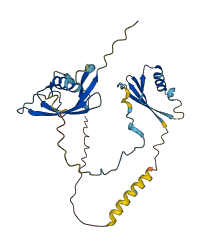
Descriptions
The autoinhibited protein was predicted that may have potential autoinhibitory elements via cis-regPred.
Autoinhibitory domains (AIDs)
Target domain |
|
Relief mechanism |
|
Assay |
cis-regPred |
Accessory elements
No accessory elements
Autoinhibited structure

Activated structure
1 structures for Q99KJ0
| Entry ID | Method | Resolution | Chain | Position | Source |
|---|---|---|---|---|---|
| AF-Q99KJ0-F1 | Predicted | AlphaFoldDB |
20 variants for Q99KJ0
| Variant ID(s) | Position | Change | Description | Diseaes Association | Provenance |
|---|---|---|---|---|---|
| rs227046761 | 9 | S>R | No | EVA | |
| rs3389223042 | 13 | E>G | No | EVA | |
| rs237280309 | 15 | A>V | No | EVA | |
| rs225905842 | 26 | L>P | No | EVA | |
| rs256985097 | 35 | E>A | No | EVA | |
| rs3389233242 | 58 | Q>K | No | EVA | |
| rs3389203875 | 68 | L>F | No | EVA | |
| rs3389203850 | 74 | T>A | No | EVA | |
| rs250600007 | 104 | W>R | No | EVA | |
| rs51256796 | 106 | I>V | No | EVA | |
| rs3389229094 | 109 | K>VSDG* | No | EVA | |
| rs3389223039 | 113 | D>G | No | EVA | |
| rs3389226916 | 135 | S>* | No | EVA | |
| rs3401636886 | 136 | G>V | No | EVA | |
| rs3389245327 | 141 | L>V | No | EVA | |
| rs246655618 | 160 | K>E | No | EVA | |
| rs3389226906 | 177 | I>V | No | EVA | |
| rs3389237284 | 198 | S>R | No | EVA | |
| rs579635486 | 211 | Q>R | No | EVA | |
| rs237903886 | 255 | F>S | No | EVA |
No associated diseases with Q99KJ0
Functions
4 GO annotations of cellular component
| Name | Definition |
|---|---|
| cis-Golgi network | The network of interconnected tubular and cisternal structures located at the convex side of the Golgi apparatus, which abuts the endoplasmic reticulum. |
| cytosol | The part of the cytoplasm that does not contain organelles but which does contain other particulate matter, such as protein complexes. |
| endoplasmic reticulum | The irregular network of unit membranes, visible only by electron microscopy, that occurs in the cytoplasm of many eukaryotic cells. The membranes form a complex meshwork of tubular channels, which are often expanded into slitlike cavities called cisternae. The ER takes two forms, rough (or granular), with ribosomes adhering to the outer surface, and smooth (with no ribosomes attached). |
| nucleus | A membrane-bounded organelle of eukaryotic cells in which chromosomes are housed and replicated. In most cells, the nucleus contains all of the cell's chromosomes except the organellar chromosomes, and is the site of RNA synthesis and processing. In some species, or in specialized cell types, RNA metabolism or DNA replication may be absent. |
2 GO annotations of molecular function
| Name | Definition |
|---|---|
| acetylcholine receptor binding | Binding to an acetylcholine receptor. |
| ubiquitin binding | Binding to ubiquitin, a protein that when covalently bound to other cellular proteins marks them for proteolytic degradation. |
9 GO annotations of biological process
| Name | Definition |
|---|---|
| autophagosome assembly | The formation of a double membrane-bounded structure, the autophagosome, that occurs when a specialized membrane sac, called the isolation membrane, starts to enclose a portion of the cytoplasm. |
| cellular response to leukemia inhibitory factor | Any process that results in a change in state or activity of a cell (in terms of movement, secretion, enzyme production, gene expression, etc.) as a result of a leukemia inhibitory factor stimulus. |
| Golgi organization | A process that is carried out at the cellular level which results in the assembly, arrangement of constituent parts, or disassembly of the Golgi apparatus. |
| membrane fusion | The membrane organization process that joins two lipid bilayers to form a single membrane. |
| nuclear membrane reassembly | The reformation of the nuclear membranes following their breakdown in the context of a normal process. |
| proteasome-mediated ubiquitin-dependent protein catabolic process | The chemical reactions and pathways resulting in the breakdown of a protein or peptide by hydrolysis of its peptide bonds, initiated by the covalent attachment of ubiquitin, and mediated by the proteasome. |
| regulation of gene expression | Any process that modulates the frequency, rate or extent of gene expression. Gene expression is the process in which a gene's coding sequence is converted into a mature gene product (protein or RNA). |
| regulation of protein catabolic process | Any process that modulates the frequency, rate or extent of the chemical reactions and pathways resulting in the breakdown of a protein by the destruction of the native, active configuration, with or without the hydrolysis of peptide bonds. |
| regulation of protein ubiquitination | Any process that modulates the frequency, rate or extent of the addition of ubiquitin groups to a protein. |
12 homologous proteins in AiPD
| UniProt AC | Gene Name | Protein Name | Species | Evidence Code |
|---|---|---|---|---|
| Q3SZC4 | NSFL1C | NSFL1 cofactor p47 | Bos taurus (Bovine) | PR |
| Q5ZK10 | NSFL1C | NSFL1 cofactor p47 | Gallus gallus (Chicken) | PR |
| Q5T124 | UBXN11 | UBX domain-containing protein 11 | Homo sapiens (Human) | PR |
| Q14CS0 | UBXN2B | UBX domain-containing protein 2B | Homo sapiens (Human) | PR |
| Q9UNZ2 | NSFL1C | NSFL1 cofactor p47 | Homo sapiens (Human) | PR |
| Q0KL01 | Ubxn2b | UBX domain-containing protein 2B | Mus musculus (Mouse) | PR |
| Q9CZ44 | Nsfl1c | NSFL1 cofactor p47 | Mus musculus (Mouse) | PR |
| Q9D572 | Ubxn11 | UBX domain-containing protein 11 | Mus musculus (Mouse) | PR |
| O35987 | Nsfl1c | NSFL1 cofactor p47 | Rattus norvegicus (Rat) | PR |
| Q8R512 | Ubxn11 | UBX domain-containing protein 11 | Rattus norvegicus (Rat) | PR |
| P0C627 | Ubxn2b | UBX domain-containing protein 2B | Rattus norvegicus (Rat) | PR |
| F4IXN6 | PUX6 | Plant UBX domain-containing protein 6 | Arabidopsis thaliana (Mouse-ear cress) | PR |
| 10 | 20 | 30 | 40 | 50 | 60 |
| MKEVDNLDSI | KEEWACETGP | PDSQPLNDNQ | QKDCEYFVDS | LFEEAGKAGA | KCLSPTEQKK |
| 70 | 80 | 90 | 100 | 110 | 120 |
| QVDVNIKLWK | NGFTVNDDFR | SYSDGASQQF | LNSIKKGELP | SELWGIFDKE | EVDVKVEDKK |
| 130 | 140 | 150 | 160 | 170 | 180 |
| NEVCMSTKPV | FQPFSGQGHR | LGSATPRIVS | KAKSVEVDNK | STLSAVSLNN | LEPITRIQIW |
| 190 | 200 | 210 | 220 | 230 | 240 |
| LANGERTVQR | FNVSHRVSHI | KDFIEKYQGS | QRSPPFALAT | ALPFLRFLDE | TLTLEEADLK |
| 250 | |||||
| NAVIIQRLQK | TAEPFRKL |