Q7SZE3
Gene name |
llgl2 (pen) |
Protein name |
LLGL scribble cell polarity complex component 2 |
Names |
Lethal(2) giant larvae protein homolog 2, Protein penner |
Species |
Danio rerio (Zebrafish) (Brachydanio rerio) |
KEGG Pathway |
dre:795670 |
EC number |
|
Protein Class |
|
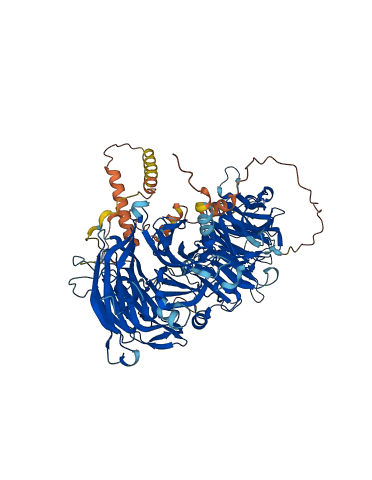
Descriptions
The autoinhibited protein was predicted that may have potential autoinhibitory elements via cis-regPred.
Autoinhibitory domains (AIDs)
Target domain |
|
Relief mechanism |
|
Assay |
cis-regPred |
Accessory elements
No accessory elements
Autoinhibited structure

Activated structure
1 structures for Q7SZE3
| Entry ID | Method | Resolution | Chain | Position | Source |
|---|---|---|---|---|---|
| AF-Q7SZE3-F1 | Predicted | AlphaFoldDB |
No variants for Q7SZE3
| Variant ID(s) | Position | Change | Description | Diseaes Association | Provenance |
|---|---|---|---|---|---|
| No variants for Q7SZE3 | |||||
No associated diseases with Q7SZE3
5 regional properties for Q7SZE3
| Type | Name | Position | InterPro Accession |
|---|---|---|---|
| repeat | WD40 repeat | 24 - 60 | IPR001680-1 |
| repeat | WD40 repeat | 62 - 110 | IPR001680-2 |
| repeat | WD40 repeat | 220 - 258 | IPR001680-3 |
| repeat | WD40 repeat | 392 - 449 | IPR001680-4 |
| domain | Lethal giant larvae homologue 2 | 272 - 370 | IPR013577 |
3 GO annotations of cellular component
| Name | Definition |
|---|---|
| cortical actin cytoskeleton | The portion of the actin cytoskeleton, comprising filamentous actin and associated proteins, that lies just beneath the plasma membrane. |
| cytoplasm | The contents of a cell excluding the plasma membrane and nucleus, but including other subcellular structures. |
| plasma membrane | The membrane surrounding a cell that separates the cell from its external environment. It consists of a phospholipid bilayer and associated proteins. |
2 GO annotations of molecular function
| Name | Definition |
|---|---|
| GTPase activator activity | Binds to and increases the activity of a GTPase, an enzyme that catalyzes the hydrolysis of GTP. |
| myosin II binding | Binding to a class II myosin, any member of the class of 'conventional' double-headed myosins that includes muscle myosin. |
21 GO annotations of biological process
| Name | Definition |
|---|---|
| cell projection assembly | Formation of a prolongation or process extending from a cell, e.g. a flagellum or axon. |
| cortical actin cytoskeleton organization | A process that is carried out at the cellular level which results in the assembly, arrangement of constituent parts, or disassembly of actin-based cytoskeletal structures in the cell cortex, i.e. just beneath the plasma membrane. |
| cytoskeleton organization | A process that is carried out at the cellular level which results in the assembly, arrangement of constituent parts, or disassembly of cytoskeletal structures. |
| epidermis development | The process whose specific outcome is the progression of the epidermis over time, from its formation to the mature structure. The epidermis is the outer epithelial layer of an animal, it may be a single layer that produces an extracellular material (e.g. the cuticle of arthropods) or a complex stratified squamous epithelium, as in the case of many vertebrate species. |
| establishment of spindle orientation | Any process that set the alignment of spindle relative to other cellular structures. |
| exocytosis | A process of secretion by a cell that results in the release of intracellular molecules (e.g. hormones, matrix proteins) contained within a membrane-bounded vesicle. Exocytosis can occur either by full fusion, when the vesicle collapses into the plasma membrane, or by a kiss-and-run mechanism that involves the formation of a transient contact, a pore, between a granule (for exemple of chromaffin cells) and the plasma membrane. The latter process most of the time leads to only partial secretion of the granule content. Exocytosis begins with steps that prepare vesicles for fusion with the membrane (tethering and docking) and ends when molecules are secreted from the cell. |
| hemidesmosome assembly | Assembly of hemidesmosomes, integrin-containing protein complexes that bind to laminin in the basal lamina. Hemidesmosomes form the contact between the basal surface of epithelial cells and the underlying basal lamina. |
| Kupffer's vesicle development | The progression of the Kupffer's vesicle over time from its initial formation until its mature state. The Kupffer's vesicle is a small but distinctive epithelial sac containing fluid, located midventrally posterior to the yolk cell or its extension, and transiently present during most of the segmentation period. |
| motile cilium assembly | The aggregation, arrangement and bonding together of a set of components to form a motile cilium. |
| negative regulation of cell migration | Any process that stops, prevents, or reduces the frequency, rate or extent of cell migration. |
| negative regulation of cell population proliferation | Any process that stops, prevents or reduces the rate or extent of cell proliferation. |
| negative regulation of epithelial cell proliferation | Any process that stops, prevents or reduces the rate or extent of epithelial cell proliferation. |
| negative regulation of epithelial to mesenchymal transition | Any process that decreases the rate, frequency, or extent of epithelial to mesenchymal transition. Epithelial to mesenchymal transition where an epithelial cell loses apical/basolateral polarity, severs intercellular adhesive junctions, degrades basement membrane components and becomes a migratory mesenchymal cell. |
| photoreceptor cell morphogenesis | The process in which the structures of a photoreceptor cell are generated and organized. This process occurs while the initially relatively unspecialized cell is acquiring the specialized features of a photoreceptor cell, a sensory cell that reacts to the presence of light. An example of this is found in Drosophila melanogaster. |
| posterior lateral line neuromast development | The process whose specific outcome is the progression of the posterior lateral line neuromast over time, from its formation to the mature structure. The neuromast is the sensory receptor of the anterior lateral line system and is composed of a population of sensory hair cells, and nonsensory supporting cells and mantle cells. Neuromast are located superficially on the epithelium or in lateral line canals. |
| regulation of epidermis development | Any process that modulates the frequency, rate or extent of epidermis development. |
| regulation of establishment or maintenance of cell polarity | Any process that modulates the frequency, rate or extent of the specification, formation or maintenance of anisotropic intracellular organization or cell growth patterns. |
| regulation of Notch signaling pathway | Any process that modulates the frequency, rate or extent of the Notch signaling pathway. |
| regulation of protein secretion | Any process that modulates the frequency, rate or extent of the controlled release of a protein from a cell. |
| skin development | The process whose specific outcome is the progression of the skin over time, from its formation to the mature structure. The skin is the external membranous integument of an animal. In vertebrates the skin generally consists of two layers, an outer nonsensitive and nonvascular epidermis (cuticle or skarfskin) composed of cells which are constantly growing and multiplying in the deeper, and being thrown off in the superficial layers, as well as an inner vascular dermis (cutis, corium or true skin) composed mostly of connective tissue. |
| skin epidermis development | The process whose specific outcome is the progression of the skin epidermis over time, from its formation to the mature structure. |
12 homologous proteins in AiPD
| UniProt AC | Gene Name | Protein Name | Species | Evidence Code |
|---|---|---|---|---|
| P38163 | SRO77 | Lethal(2) giant larvae protein homolog SRO77 | Saccharomyces cerevisiae (strain ATCC 204508 / S288c) (Baker's yeast) | PR |
| Q12038 | SRO7 | Lethal(2) giant larvae protein homolog SRO7 | Saccharomyces cerevisiae (strain ATCC 204508 / S288c) (Baker's yeast) | PR |
| Q15334 | LLGL1 | Lethal(2) giant larvae protein homolog 1 | Homo sapiens (Human) | PR |
| Q5T5C0 | STXBP5 | Syntaxin-binding protein 5 | Homo sapiens (Human) | PR |
| Q9Y2K9 | STXBP5L | Syntaxin-binding protein 5-like | Homo sapiens (Human) | PR |
| Q6P1M3 | LLGL2 | LLGL scribble cell polarity complex component 2 | Homo sapiens (Human) | PR |
| Q80Y17 | Llgl1 | Lethal(2) giant larvae protein homolog 1 | Mus musculus (Mouse) | PR |
| Q8K400 | Stxbp5 | Syntaxin-binding protein 5 | Mus musculus (Mouse) | PR |
| Q5DQR4 | Stxbp5l | Syntaxin-binding protein 5-like | Mus musculus (Mouse) | PR |
| Q8K4K5 | Llgl1 | Lethal(2) giant larvae protein homolog 1 | Rattus norvegicus (Rat) | PR |
| Q9WU70 | Stxbp5 | Syntaxin-binding protein 5 | Rattus norvegicus (Rat) | PR |
| Q5SQE2 | stxbp5l | Syntaxin-binding protein 5-like | Danio rerio (Zebrafish) (Brachydanio rerio) | PR |
| 10 | 20 | 30 | 40 | 50 | 60 |
| MKRFRRHGHE | SQRDKHKQDL | YQFNKTVEHG | FPHQPSALGF | SPSLELLAIG | TRSGAIKLYG |
| 70 | 80 | 90 | 100 | 110 | 120 |
| APGVEFMGLH | DENAAVTQVH | FLPNQVELVT | LLEDNSLHMW | TLRAHNSMCE | LLEIGRFTLS |
| 130 | 140 | 150 | 160 | 170 | 180 |
| GPPGAIPSVT | RVTAVLAHSS | GELLLLGTEG | GHVFVVEVPG | FRELEENNIS | VEDVQNRVPE |
| 190 | 200 | 210 | 220 | 230 | 240 |
| DYVGRRNLES | VETLHENPLN | PRQVLIGYSR | GLMVLWDLDR | QRPVQHFLGT | QQLESVWWME |
| 250 | 260 | 270 | 280 | 290 | 300 |
| DGESILSSHS | DGSYCQWTVT | GEDPQTEPEK | QETPYGAFPC | KAISKIIQLP | SKQGPPFLIF |
| 310 | 320 | 330 | 340 | 350 | 360 |
| SGGMPRASYG | DRHCISVIHS | KTHEALDFTS | RIIDFFVIRE | GENHKGEPSA | LVVLVEEELV |
| 370 | 380 | 390 | 400 | 410 | 420 |
| VVDLQTEGWP | VIQTPYLVPL | HCSAITCSHH | VSSIPLKLWE | RVQAAGAHQN | THYSRKPWPI |
| 430 | 440 | 450 | 460 | 470 | 480 |
| NGGKNLAPDP | PQRDLLLTGH | EDGTVRFWDA | SGVCLYPMYK | LSTAGVFHTD | ADPNDNMNQG |
| 490 | 500 | 510 | 520 | 530 | 540 |
| SEGEWPPFRK | VGCFDPYSDD | PRLGIQKIHL | CKYSGYLTVA | GTAGQILVLE | LNDEAAEQMV |
| 550 | 560 | 570 | 580 | 590 | 600 |
| EATVVDLLQG | QEGFRWKGQA | RLDVREEPVL | FPPGFQPFAL | VQCQPPAVVT | AIALHSEWKL |
| 610 | 620 | 630 | 640 | 650 | 660 |
| VGFGTSHGFG | LYDYNQRNNI | MVKCTLNPSD | QMAMEGPLSR | VKSIKKSLRQ | SFRRIRRSRV |
| 670 | 680 | 690 | 700 | 710 | 720 |
| SMRKHHTNNA | AKLQEINARL | EAEALQEMEL | APVQRKIEAR | SSDDSFTGLV | RTLYFADTFV |
| 730 | 740 | 750 | 760 | 770 | 780 |
| SDSSHSTPSL | WAGTNGGAVF | AYVLRVPPQE | RRAEDPVTAH | AAKEIQLMHR | APVVGLVVLD |
| 790 | 800 | 810 | 820 | 830 | 840 |
| GKGAPLPEPL | EVAHDLARSP | EMHGSHHLLV | VSEEQFKLFT | LPKVSSKSKL | KLTAVDGSRV |
| 850 | 860 | 870 | 880 | 890 | 900 |
| RRVGVAWFGS | RTDEQLESCL | VVLTNQGELH | VISLPSIKML | VHYPCIRRED | VSGIASCVFT |
| 910 | 920 | 930 | 940 | 950 | 960 |
| KYGQGFYLIS | PSEFERFSLS | TRWVVQPHCL | VEPPLQMRSK | SPSSPVHRDL | PDGVPTEHRN |
| 970 | 980 | 990 | 1000 | 1010 | |
| FKGDSEGYEN | SARQVMEHAL | LNDESVLQEI | QKSLEGDQTT | FLENNLKTKP | KAGNVLSNGD |