Q9WU70
Gene name |
Stxbp5 (Llgl3) |
Protein name |
Syntaxin-binding protein 5 |
Names |
Lethal(2) giant larvae protein homolog 3, Tomosyn-1 |
Species |
Rattus norvegicus (Rat) |
KEGG Pathway |
rno:81022 |
EC number |
|
Protein Class |
|
Descriptions
The autoinhibited protein was predicted that may have potential autoinhibitory elements via cis-regPred.
Autoinhibitory domains (AIDs)
Target domain |
|
Relief mechanism |
|
Assay |
cis-regPred |
Accessory elements
No accessory elements
Autoinhibited structure

Activated structure
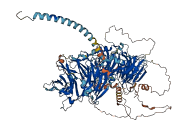
2 structures for Q9WU70
| Entry ID | Method | Resolution | Chain | Position | Source |
|---|---|---|---|---|---|
| 1URQ | X-ray | 200 A | A | 1086-1145 | PDB |
| AF-Q9WU70-F1 | Predicted | AlphaFoldDB |
No variants for Q9WU70
| Variant ID(s) | Position | Change | Description | Diseaes Association | Provenance |
|---|---|---|---|---|---|
| No variants for Q9WU70 | |||||
No associated diseases with Q9WU70
No regional properties for Q9WU70
| Type | Name | Position | InterPro Accession |
|---|---|---|---|
| No domain, repeats, and functional sites for Q9WU70 | |||
Functions
14 GO annotations of cellular component
| Name | Definition |
|---|---|
| acetylcholine-gated channel complex | A homo- or hetero-pentameric protein complex that forms a transmembrane channel through which ions may pass in response to acetylcholine binding. |
| anchoring junction | A cell junction that mechanically attaches a cell (and its cytoskeleton) to neighboring cells or to the extracellular matrix. |
| cytoplasm | The contents of a cell excluding the plasma membrane and nucleus, but including other subcellular structures. |
| extrinsic component of neuronal dense core vesicle membrane | The component of the neuronal dense core vesicle membrane consisting of gene products and protein complexes that are loosely bound to one of its surfaces, but not integrated into the hydrophobic region. |
| extrinsic component of presynaptic membrane | The component of the presynaptic membrane consisting of gene products and protein complexes that are loosely bound to one of its surfaces, but not integrated into the hydrophobic region. |
| hippocampal mossy fiber to CA3 synapse | One of the giant synapses that form between the mossy fiber axons of dentate gyrus granule cells and the large complex spines of CA3 pyramidal cells. It consists of a giant bouton known as the mossy fiber expansion, synapsed to the complex, multiheaded spine (thorny excresence) of a CA3 pyramidal cell. |
| neuromuscular junction | The junction between the axon of a motor neuron and a muscle fiber. In response to the arrival of action potentials, the presynaptic button releases molecules of neurotransmitters into the synaptic cleft. These diffuse across the cleft and transmit the signal to the postsynaptic membrane of the muscle fiber, leading to a change in post-synaptic potential. |
| plasma membrane | The membrane surrounding a cell that separates the cell from its external environment. It consists of a phospholipid bilayer and associated proteins. |
| presynapse | The part of a synapse that is part of the presynaptic cell. |
| presynaptic cytosol | The region of the cytosol consisting of all cytosol that is part of the presynapse. |
| Schaffer collateral - CA1 synapse | A synapse between the Schaffer collateral axon of a CA3 pyramidal cell and a CA1 pyramidal cell. |
| secretory granule | A small subcellular vesicle, surrounded by a membrane, that is formed from the Golgi apparatus and contains a highly concentrated protein destined for secretion. Secretory granules move towards the periphery of the cell and upon stimulation, their membranes fuse with the cell membrane, and their protein load is exteriorized. Processing of the contained protein may take place in secretory granules. |
| SNARE complex | A protein complex involved in membrane fusion; a stable ternary complex consisting of a four-helix bundle, usually formed from one R-SNARE and three Q-SNAREs with an ionic layer sandwiched between hydrophobic layers. One well-characterized example is the neuronal SNARE complex formed of synaptobrevin 2, syntaxin 1a, and SNAP-25. |
| synaptic vesicle | A secretory organelle, typically 50 nm in diameter, of presynaptic nerve terminals; accumulates in high concentrations of neurotransmitters and secretes these into the synaptic cleft by fusion with the 'active zone' of the presynaptic plasma membrane. |
4 GO annotations of molecular function
| Name | Definition |
|---|---|
| GTPase activator activity | Binds to and increases the activity of a GTPase, an enzyme that catalyzes the hydrolysis of GTP. |
| myosin II binding | Binding to a class II myosin, any member of the class of 'conventional' double-headed myosins that includes muscle myosin. |
| syntaxin binding | Binding to a syntaxin, a SNAP receptor involved in the docking of synaptic vesicles at the presynaptic zone of a synapse. |
| syntaxin-1 binding | Binding to a syntaxin-1 SNAP receptor. |
8 GO annotations of biological process
| Name | Definition |
|---|---|
| exocytosis | A process of secretion by a cell that results in the release of intracellular molecules (e.g. hormones, matrix proteins) contained within a membrane-bounded vesicle. Exocytosis can occur either by full fusion, when the vesicle collapses into the plasma membrane, or by a kiss-and-run mechanism that involves the formation of a transient contact, a pore, between a granule (for exemple of chromaffin cells) and the plasma membrane. The latter process most of the time leads to only partial secretion of the granule content. Exocytosis begins with steps that prepare vesicles for fusion with the membrane (tethering and docking) and ends when molecules are secreted from the cell. |
| positive regulation of exocytosis | Any process that activates or increases the frequency, rate or extent of exocytosis. |
| protein transport | The directed movement of proteins into, out of or within a cell, or between cells, by means of some agent such as a transporter or pore. |
| regulation of exocytosis | Any process that modulates the frequency, rate or extent of exocytosis. |
| regulation of protein secretion | Any process that modulates the frequency, rate or extent of the controlled release of a protein from a cell. |
| regulation of synaptic vesicle exocytosis | Any process that modulates the frequency, rate or extent of synaptic vesicle exocytosis. |
| regulation of synaptic vesicle priming | Any process that modulates the frequency, rate or extent of synaptic vesicle priming. Synaptic vesicle priming is the formation of SNARE-containing complexes, bringing synaptic vesicle membrane and plasma membranes into close proximity and thereby facilitating membrane fusion. |
| synaptic vesicle cycle | A biological process in which synaptic vesicles are loaded with neurotransmitters, move to the active zone, exocytose and are then recycled via endocytosis, ultimately leading to reloading with neurotransmitters. |
10 homologous proteins in AiPD
| UniProt AC | Gene Name | Protein Name | Species | Evidence Code |
|---|---|---|---|---|
| Q9Y2K9 | STXBP5L | Syntaxin-binding protein 5-like | Homo sapiens (Human) | PR |
| Q15334 | LLGL1 | Lethal(2) giant larvae protein homolog 1 | Homo sapiens (Human) | PR |
| Q6P1M3 | LLGL2 | LLGL scribble cell polarity complex component 2 | Homo sapiens (Human) | PR |
| Q5T5C0 | STXBP5 | Syntaxin-binding protein 5 | Homo sapiens (Human) | PR |
| Q80Y17 | Llgl1 | Lethal(2) giant larvae protein homolog 1 | Mus musculus (Mouse) | PR |
| Q5DQR4 | Stxbp5l | Syntaxin-binding protein 5-like | Mus musculus (Mouse) | PR |
| Q8K400 | Stxbp5 | Syntaxin-binding protein 5 | Mus musculus (Mouse) | PR |
| Q8K4K5 | Llgl1 | Lethal(2) giant larvae protein homolog 1 | Rattus norvegicus (Rat) | PR |
| Q5SQE2 | stxbp5l | Syntaxin-binding protein 5-like | Danio rerio (Zebrafish) (Brachydanio rerio) | PR |
| Q7SZE3 | llgl2 | LLGL scribble cell polarity complex component 2 | Danio rerio (Zebrafish) (Brachydanio rerio) | PR |
| 10 | 20 | 30 | 40 | 50 | 60 |
| MRKFNIRKVL | DGLTAGSSSA | SQQQQQQQHP | PGNREPEIQE | TLQSEHFQLC | KTVRHGFPYQ |
| 70 | 80 | 90 | 100 | 110 | 120 |
| PSALAFDPVQ | KILAVGTQTG | ALRLFGRPGV | ECYCQHDSGA | AVIQLQFLIN | EGALVSALAD |
| 130 | 140 | 150 | 160 | 170 | 180 |
| DTLHLWNLRQ | KRPAVLHSLK | FCRERVTFCH | LPFQSKWLYV | GTERGNIHIV | NVESFTLSGY |
| 190 | 200 | 210 | 220 | 230 | 240 |
| VIMWNKAIEL | SSKSHPGPVV | HISDNPMDEG | KLLIGFESGT | VVLWDLKSKK | ADYRYTYDEA |
| 250 | 260 | 270 | 280 | 290 | 300 |
| IHSVAWHHEG | KQFICSHSDG | TLTIWNVRSP | TKPVQTITPH | GKQLKDGKKP | EPCKPILKVE |
| 310 | 320 | 330 | 340 | 350 | 360 |
| FKTTRSGEPF | IILSGGLSYD | TVGRRPCLTV | MHGKSTAVLE | MDYSIVDFLT | LCETPYPNDF |
| 370 | 380 | 390 | 400 | 410 | 420 |
| QEPYAVVVLL | EKDLVLIDLA | QNGYPIFENP | YPLSIHESPV | TCCEYFADCP | VDLIPALYSV |
| 430 | 440 | 450 | 460 | 470 | 480 |
| GARQKRQGYS | KKEWPINGGN | WGLGAQSYPE | IIITGHADGS | IKFWDASAIT | LQVLYKLKTS |
| 490 | 500 | 510 | 520 | 530 | 540 |
| KVFEKSRNKD | DRQNTDIVDE | DPYAIQIISW | CPESRMLCIA | GVSAHVIIYR | FSKQEVVTEV |
| 550 | 560 | 570 | 580 | 590 | 600 |
| IPMLEVRLLY | EINDVETPEG | EQPPPLSTPV | GSSTSQPIPP | QSHPSTSSSS | SDGLRDNVPC |
| 610 | 620 | 630 | 640 | 650 | 660 |
| LKVKNSPLKQ | SPGYQTELVI | QLVWVGGEPP | QQITSLALNS | SYGLVVFGNS | NGIAMVDYLQ |
| 670 | 680 | 690 | 700 | 710 | 720 |
| KAVLLNLSTI | ELYGSNDPYR | REPRSPRKSR | QPSGAGLCDI | TEGTVVPEDR | CKSPTSGSSS |
| 730 | 740 | 750 | 760 | 770 | 780 |
| PHNSDDEQKV | NNFIEKVKTQ | SRKFSKMVAS | DLAKMSRKLS | LPTDLKPDLD | VKDNSFSRSR |
| 790 | 800 | 810 | 820 | 830 | 840 |
| SSSVTSIDKE | SREAISALHF | CETFTRKADS | SPSPCLWVGT | TVGTAFVITL | NLPLGPEQRL |
| 850 | 860 | 870 | 880 | 890 | 900 |
| LQPVIVSPSG | TILRLKGAIL | RMAFLDAAGC | LMPPAYEPWT | EHNVPEEKDE | KEKLKKRRPV |
| 910 | 920 | 930 | 940 | 950 | 960 |
| SVSPSSSQEI | SENQYAVICS | EKQAKVISLP | TQNCAYKQNI | TETSFVLRGD | IVALSNSVCL |
| 970 | 980 | 990 | 1000 | 1010 | 1020 |
| ACFCANGHIM | TFSLPSLRPL | LDVYYLPLTN | MRIARTFCFA | NSGQALYLVS | PTEIQRLTYS |
| 1030 | 1040 | 1050 | 1060 | 1070 | 1080 |
| QETCENLQEM | LGELFTPVET | PEAPNRGFFK | GLFGGGAQSL | DREELFGESS | SGKASRSLAQ |
| 1090 | 1100 | 1110 | 1120 | 1130 | 1140 |
| HIPGPGGIEG | VKGAASGVVG | ELARARLALD | ERGQKLSDLE | ERTAAMMSSA | DSFSKHAHEM |
| 1150 | |||||
| MLKYKDKKWY | QF |