Q6DHF9
Gene name |
six1a (six1b) |
Protein name |
Homeobox protein six1a |
Names |
Homeobox protein six1b, Sine oculis homeobox homolog 1a, Sine oculis homeobox homolog 1b |
Species |
Danio rerio (Zebrafish) (Brachydanio rerio) |
KEGG Pathway |
dre:494168 |
EC number |
|
Protein Class |
|
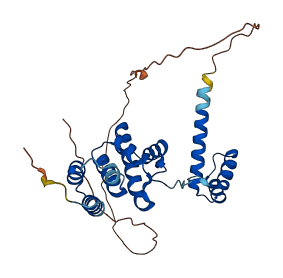
Descriptions
The autoinhibited protein was predicted that may have potential autoinhibitory elements via cis-regPred.
Autoinhibitory domains (AIDs)
Target domain |
|
Relief mechanism |
|
Assay |
cis-regPred |
Accessory elements
No accessory elements
Autoinhibited structure

Activated structure
1 structures for Q6DHF9
| Entry ID | Method | Resolution | Chain | Position | Source |
|---|---|---|---|---|---|
| AF-Q6DHF9-F1 | Predicted | AlphaFoldDB |
No variants for Q6DHF9
| Variant ID(s) | Position | Change | Description | Diseaes Association | Provenance |
|---|---|---|---|---|---|
| No variants for Q6DHF9 | |||||
No associated diseases with Q6DHF9
3 GO annotations of cellular component
| Name | Definition |
|---|---|
| cytoplasm | The contents of a cell excluding the plasma membrane and nucleus, but including other subcellular structures. |
| nucleus | A membrane-bounded organelle of eukaryotic cells in which chromosomes are housed and replicated. In most cells, the nucleus contains all of the cell's chromosomes except the organellar chromosomes, and is the site of RNA synthesis and processing. In some species, or in specialized cell types, RNA metabolism or DNA replication may be absent. |
| transcription regulator complex | A protein complex that is capable of associating with DNA by direct binding, or via other DNA-binding proteins or complexes, and regulating transcription. |
2 GO annotations of molecular function
| Name | Definition |
|---|---|
| DNA-binding transcription factor activity, RNA polymerase II-specific | A DNA-binding transcription factor activity that modulates the transcription of specific gene sets transcribed by RNA polymerase II. |
| RNA polymerase II cis-regulatory region sequence-specific DNA binding | Binding to a specific upstream regulatory DNA sequence (transcription factor recognition sequence or binding site) located in cis relative to the transcription start site (i.e., on the same strand of DNA) of a gene transcribed by RNA polymerase II. |
6 GO annotations of biological process
| Name | Definition |
|---|---|
| apoptotic process | A programmed cell death process which begins when a cell receives an internal (e.g. DNA damage) or external signal (e.g. an extracellular death ligand), and proceeds through a series of biochemical events (signaling pathway phase) which trigger an execution phase. The execution phase is the last step of an apoptotic process, and is typically characterized by rounding-up of the cell, retraction of pseudopodes, reduction of cellular volume (pyknosis), chromatin condensation, nuclear fragmentation (karyorrhexis), plasma membrane blebbing and fragmentation of the cell into apoptotic bodies. When the execution phase is completed, the cell has died. |
| negative regulation of DNA-templated transcription | Any process that stops, prevents, or reduces the frequency, rate or extent of cellular DNA-templated transcription. |
| regulation of inner ear receptor cell differentiation | Any process that modulates the frequency, rate or extent of inner ear receptor cell differentiation. |
| regulation of skeletal muscle cell proliferation | Any process that modulates the frequency, rate or extent of skeletal muscle cell proliferation. |
| regulation of transcription by RNA polymerase II | Any process that modulates the frequency, rate or extent of transcription mediated by RNA polymerase II. |
| skeletal muscle fiber development | The process whose specific outcome is the progression of the skeletal muscle fiber over time, from its formation to the mature structure. Muscle fibers are formed by the maturation of myotubes. They can be classed as slow, intermediate/fast or fast. |
12 homologous proteins in AiPD
| UniProt AC | Gene Name | Protein Name | Species | Evidence Code |
|---|---|---|---|---|
| O93307 | SIX6 | Homeobox protein SIX6 | Gallus gallus (Chicken) | PR |
| Q95RW8 | Optix | Protein Optix | Drosophila melanogaster (Fruit fly) | PR |
| O95343 | SIX3 | Homeobox protein SIX3 | Homo sapiens (Human) | PR |
| O95475 | SIX6 | Homeobox protein SIX6 | Homo sapiens (Human) | PR |
| Q15475 | SIX1 | Homeobox protein SIX1 | Homo sapiens (Human) | PR |
| Q9NPC8 | SIX2 | Homeobox protein SIX2 | Homo sapiens (Human) | PR |
| Q9QZ28 | Six6 | Homeobox protein SIX6 | Mus musculus (Mouse) | PR |
| Q62233 | Six3 | Homeobox protein SIX3 | Mus musculus (Mouse) | PR |
| Q62231 | Six1 | Homeobox protein SIX1 | Mus musculus (Mouse) | PR |
| Q62232 | Six2 | Homeobox protein SIX2 | Mus musculus (Mouse) | PR |
| Q94165 | ceh-34 | Homeobox protein ceh-34 | Caenorhabditis elegans | PR |
| Q6NZ04 | six1b | Homeobox protein six1b | Danio rerio (Zebrafish) (Brachydanio rerio) | PR |
| 10 | 20 | 30 | 40 | 50 | 60 |
| MSILPSFGFT | QEQVACVCEV | LQQGGNLERL | GRFLWSLPAC | DHLHKNESVL | KAKAVVAFHR |
| 70 | 80 | 90 | 100 | 110 | 120 |
| GNFRELYKIL | ESYQFSTHNH | PKMQQLWLKA | HYVEAEKLRG | RPLGAVGKYR | VRRKFPLPRT |
| 130 | 140 | 150 | 160 | 170 | 180 |
| IWDGEETSYC | FKEKSRSVLR | EWYTHNPYPS | PREKRELAEA | TGLTTTQVSN | WFKNRRQRDR |
| 190 | 200 | 210 | 220 | 230 | 240 |
| AAEAKERENG | ENNGVGGKQS | QRSPLDGVKS | LMSSSEDEFS | PPQSPEHSSV | LLLQGTMNNP |
| 250 | 260 | 270 | 280 | ||
| AAPAYPMPGL | GAPHPLHGMQ | GHPHQIQDSL | LGSLTSSLVD | LGS |