Q61457
Gene name |
Ccne1 (Ccne) |
Protein name |
G1/S-specific cyclin-E1 |
Names |
|
Species |
Mus musculus (Mouse) |
KEGG Pathway |
mmu:12447 |
EC number |
|
Protein Class |
|
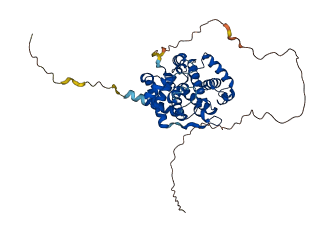
Descriptions
The autoinhibited protein was predicted that may have potential autoinhibitory elements via cis-regPred.
Autoinhibitory domains (AIDs)
Target domain |
|
Relief mechanism |
|
Assay |
cis-regPred |
Accessory elements
No accessory elements
Autoinhibited structure

Activated structure
1 structures for Q61457
| Entry ID | Method | Resolution | Chain | Position | Source |
|---|---|---|---|---|---|
| AF-Q61457-F1 | Predicted | AlphaFoldDB |
17 variants for Q61457
| Variant ID(s) | Position | Change | Description | Diseaes Association | Provenance |
|---|---|---|---|---|---|
| rs241840896 | 14 | K>Q | No | EVA | |
| rs219679282 | 18 | G>S | No | EVA | |
| rs257661796 | 23 | V>A | No | EVA | |
| rs257876052 | 52 | S>T | No | EVA | |
| rs3388902793 | 89 | A>E | No | EVA | |
| rs248519857 | 89 | A>T | No | EVA | |
| rs3388874689 | 155 | E>D | No | EVA | |
| rs32379441 | 179 | H>Q | No | EVA | |
| rs3388902798 | 192 | S>L | No | EVA | |
| rs3388889614 | 195 | F>Y | No | EVA | |
| rs3388900245 | 267 | Q>R | No | EVA | |
| rs3388904117 | 277 | A>T | No | EVA | |
| rs3388889606 | 290 | L>F | No | EVA | |
| rs237930061 | 320 | C>G | No | EVA | |
| rs3388889625 | 325 | C>Y | No | EVA | |
| rs3397543355 | 334 | M>I | No | EVA | |
| rs3388904148 | 339 | M>T | No | EVA |
No associated diseases with Q61457
6 GO annotations of cellular component
| Name | Definition |
|---|---|
| centrosome | A structure comprised of a core structure (in most organisms, a pair of centrioles) and peripheral material from which a microtubule-based structure, such as a spindle apparatus, is organized. Centrosomes occur close to the nucleus during interphase in many eukaryotic cells, though in animal cells it changes continually during the cell-division cycle. |
| cyclin E1-CDK2 complex | A protein complex consisting of cyclin E1 and cyclin-dependent kinase 2 (CDK2). Cyclins are characterized by periodicity in protein abundance throughout the cell cycle. Cyclin-dependent kinases represent a family of serine/threonine protein kinases that become active upon binding to a cyclin regulatory partner. |
| cyclin-dependent protein kinase holoenzyme complex | Cyclin-dependent protein kinases (CDKs) are enzyme complexes that contain a kinase catalytic subunit associated with a regulatory cyclin partner. |
| cytoplasm | The contents of a cell excluding the plasma membrane and nucleus, but including other subcellular structures. |
| nucleoplasm | That part of the nuclear content other than the chromosomes or the nucleolus. |
| nucleus | A membrane-bounded organelle of eukaryotic cells in which chromosomes are housed and replicated. In most cells, the nucleus contains all of the cell's chromosomes except the organellar chromosomes, and is the site of RNA synthesis and processing. In some species, or in specialized cell types, RNA metabolism or DNA replication may be absent. |
4 GO annotations of molecular function
| Name | Definition |
|---|---|
| cyclin-dependent protein serine/threonine kinase regulator activity | Modulates the activity of a cyclin-dependent protein serine/threonine kinase, enzymes of the protein kinase family that are regulated through association with cyclins and other proteins. |
| kinase activity | Catalysis of the transfer of a phosphate group, usually from ATP, to a substrate molecule. |
| protein kinase binding | Binding to a protein kinase, any enzyme that catalyzes the transfer of a phosphate group, usually from ATP, to a protein substrate. |
| protein-containing complex binding | Binding to a macromolecular complex. |
15 GO annotations of biological process
| Name | Definition |
|---|---|
| cell division | The process resulting in division and partitioning of components of a cell to form more cells; may or may not be accompanied by the physical separation of a cell into distinct, individually membrane-bounded daughter cells. |
| chromosome organization involved in meiotic cell cycle | A process of chromosome organization that is involved in a meiotic cell cycle. |
| DNA replication initiation | The process in which DNA-dependent DNA replication is started; this begins with the ATP dependent loading of an initiator complex onto the DNA, this is followed by DNA melting and helicase activity. In bacteria, the gene products that enable the helicase activity are loaded after the initial melting and in archaea and eukaryotes, the gene products that enable the helicase activity are inactive when they are loaded and subsequently activate. |
| G1/S transition of mitotic cell cycle | The mitotic cell cycle transition by which a cell in G1 commits to S phase. The process begins with the build up of G1 cyclin-dependent kinase (G1 CDK), resulting in the activation of transcription of G1 cyclins. The process ends with the positive feedback of the G1 cyclins on the G1 CDK which commits the cell to S phase, in which DNA replication is initiated. |
| homologous chromosome pairing at meiosis | The meiotic cell cycle process where side by side pairing and physical juxtaposition of homologous chromosomes is created during meiotic prophase. Homologous chromosome pairing begins when the chromosome arms begin to pair from the clustered telomeres and ends when synaptonemal complex or linear element assembly is complete. |
| mitotic cell cycle phase transition | The cell cycle process by which a cell commits to entering the next mitotic cell cycle phase. |
| negative regulation of transcription by RNA polymerase II | Any process that stops, prevents, or reduces the frequency, rate or extent of transcription mediated by RNA polymerase II. |
| positive regulation of cell differentiation | Any process that activates or increases the frequency, rate or extent of cell differentiation. |
| positive regulation of mesenchymal stem cell proliferation | Any process that activates or increases the frequency, rate or extent of mesenchymal stem cell proliferation. |
| protein phosphorylation | The process of introducing a phosphate group on to a protein. |
| regulation of cell cycle | Any process that modulates the rate or extent of progression through the cell cycle. |
| regulation of cyclin-dependent protein serine/threonine kinase activity | Any process that modulates the frequency, rate or extent of cyclin-dependent protein serine/threonine kinase activity. |
| regulation of protein localization | Any process that modulates the frequency, rate or extent of any process in which a protein is transported to, or maintained in, a specific location. |
| telomere maintenance | Any process that contributes to the maintenance of proper telomeric length and structure by affecting and monitoring the activity of telomeric proteins, the length of telomeric DNA and the replication and repair of the DNA. These processes includes those that shorten, lengthen, replicate and repair the telomeric DNA sequences. |
| Wnt signaling pathway | The series of molecular signals initiated by binding of a Wnt protein to a frizzled family receptor on the surface of the target cell and ending with a change in cell state. |
13 homologous proteins in AiPD
| UniProt AC | Gene Name | Protein Name | Species | Evidence Code |
|---|---|---|---|---|
| P20438 | CLN2 | G1/S-specific cyclin CLN2 | Saccharomyces cerevisiae (strain ATCC 204508 / S288c) (Baker's yeast) | PR |
| P24869 | CLB2 | G2/mitotic-specific cyclin-2 | Saccharomyces cerevisiae (strain ATCC 204508 / S288c) (Baker's yeast) | PR |
| P24864 | CCNE1 | G1/S-specific cyclin-E1 | Homo sapiens (Human) | PR |
| P30280 | Ccnd2 | G1/S-specific cyclin-D2 | Mus musculus (Mouse) | PR |
| Q10PQ9 | SDS | Cyclin-SDS-like | Oryza sativa subsp japonica (Rice) | PR |
| Q0JIF2 | CYCB1-1 | Cyclin-B1-1 | Oryza sativa subsp japonica (Rice) | PR |
| Q10Q62 | CYCF3-2 | Putative cyclin-F3-2 | Oryza sativa subsp japonica (Rice) | PR |
| A0MEB5 | CYCA3-3 | Cyclin-A3-3 | Arabidopsis thaliana (Mouse-ear cress) | PR |
| O48790 | CYCB1-4 | Cyclin-B1-4 | Arabidopsis thaliana (Mouse-ear cress) | PR |
| Q9FMH5 | CYCA3-1 | Putative cyclin-A3-1 | Arabidopsis thaliana (Mouse-ear cress) | PR |
| Q1PFW3 | SDS | Cyclin-SDS | Arabidopsis thaliana (Mouse-ear cress) | PR |
| Q9C6A9 | CYCA3-2 | Cyclin-A3-2 | Arabidopsis thaliana (Mouse-ear cress) | PR |
| P47794 | ccne1 | G1/S-specific cyclin-E1 | Danio rerio (Zebrafish) (Brachydanio rerio) | PR |
| 10 | 20 | 30 | 40 | 50 | 60 |
| MPRERDSTDH | SNMKEEGGSD | LSVRSRKRKA | NVAVFLQDPD | EEIAKIDKTV | KSEDSSQPWD |
| 70 | 80 | 90 | 100 | 110 | 120 |
| DNSACVDPCS | FIPTPNKEED | NELEYPRTAF | QPRKIRPPRA | SPLPVLNWGN | REEVWRIMLN |
| 130 | 140 | 150 | 160 | 170 | 180 |
| KEKTYLRDEH | FLQRHPLLQA | RMRAVLLDWL | MEVCEVYKLH | RETFYLAQDF | FDRYMASQHN |
| 190 | 200 | 210 | 220 | 230 | 240 |
| IIKTLLQLIG | ISALFIASKL | EEIYPPKLHQ | FAYVTDGACS | GDEILTMELM | MMKALKWRLS |
| 250 | 260 | 270 | 280 | 290 | 300 |
| PLTIVSWLNV | YVQVAYVNDT | GEVLMPQYPQ | QVFVQIAELL | DLCVLDVGCL | EFPYGVLAAS |
| 310 | 320 | 330 | 340 | 350 | 360 |
| ALYHFSSLEL | MQKVSGYQWC | DIEKCVKWMV | PFAMVIREMG | SSKLKHFRGV | PMEDSHNIQT |
| 370 | 380 | 390 | 400 | ||
| HTNSLDLLDK | AQAKKAILSE | QNRISPPPSV | VLTPPPSSKK | QSSEQETE |