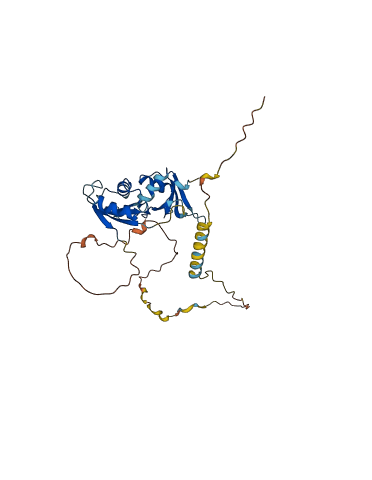
Descriptions
The autoinhibited protein was predicted that may have potential autoinhibitory elements via cis-regPred.
Autoinhibitory domains (AIDs)
Target domain |
|
Relief mechanism |
|
Assay |
cis-regPred |
Accessory elements
No accessory elements
Autoinhibited structure

Activated structure
1 structures for Q4KM14
| Entry ID | Method | Resolution | Chain | Position | Source |
|---|---|---|---|---|---|
| AF-Q4KM14-F1 | Predicted | AlphaFoldDB |
No variants for Q4KM14
| Variant ID(s) | Position | Change | Description | Diseaes Association | Provenance |
|---|---|---|---|---|---|
| No variants for Q4KM14 | |||||
No associated diseases with Q4KM14
4 regional properties for Q4KM14
| Type | Name | Position | InterPro Accession |
|---|---|---|---|
| domain | RNA recognition motif domain | 6 - 89 | IPR000504-1 |
| domain | RNA recognition motif domain | 99 - 178 | IPR000504-2 |
| domain | SECp43, RNA recognition motif 2 | 98 - 179 | IPR034510 |
| domain | tRNA selenocysteine 1-associated protein 1, C-terminal | 189 - 310 | IPR041085 |
2 GO annotations of cellular component
| Name | Definition |
|---|---|
| cytosol | The part of the cytoplasm that does not contain organelles but which does contain other particulate matter, such as protein complexes. |
| nucleus | A membrane-bounded organelle of eukaryotic cells in which chromosomes are housed and replicated. In most cells, the nucleus contains all of the cell's chromosomes except the organellar chromosomes, and is the site of RNA synthesis and processing. In some species, or in specialized cell types, RNA metabolism or DNA replication may be absent. |
1 GO annotations of molecular function
| Name | Definition |
|---|---|
| mRNA binding | Binding to messenger RNA (mRNA), an intermediate molecule between DNA and protein. mRNA includes UTR and coding sequences, but does not contain introns. |
2 GO annotations of biological process
| Name | Definition |
|---|---|
| mRNA splice site selection | Selection of a splice site by components of the assembling spliceosome. |
| translation | The cellular metabolic process in which a protein is formed, using the sequence of a mature mRNA or circRNA molecule to specify the sequence of amino acids in a polypeptide chain. Translation is mediated by the ribosome, and begins with the formation of a ternary complex between aminoacylated initiator methionine tRNA, GTP, and initiation factor 2, which subsequently associates with the small subunit of the ribosome and an mRNA or circRNA. Translation ends with the release of a polypeptide chain from the ribosome. |
8 homologous proteins in AiPD
| UniProt AC | Gene Name | Protein Name | Species | Evidence Code |
|---|---|---|---|---|
| Q8N9W6 | BOLL | Protein boule-like | Homo sapiens (Human) | PR |
| P42696 | RBM34 | RNA-binding protein 34 | Homo sapiens (Human) | PR |
| Q05CL8 | Larp7 | La-related protein 7 | Mus musculus (Mouse) | PR |
| Q924M5 | Boll | Protein boule-like | Mus musculus (Mouse) | PR |
| Q8C854 | Myef2 | Myelin expression factor 2 | Mus musculus (Mouse) | PR |
| Q5XI01 | Larp7 | La-related protein 7 | Rattus norvegicus (Rat) | PR |
| Q9S7N9 | CID12 | Polyadenylate-binding protein-interacting protein 12 | Arabidopsis thaliana (Mouse-ear cress) | PR |
| Q93ZV7 | LA1 | La protein 1 | Arabidopsis thaliana (Mouse-ear cress) | PR |
| 10 | 20 | 30 | 40 | 50 | 60 |
| MFNRMTSLWM | GDLDPYMDEN | FIKQAFSTMG | ETAFGVKIIT | HRVTGGSAGY | CFVEMADEAS |
| 70 | 80 | 90 | 100 | 110 | 120 |
| VDRCVQRLNG | KLVPGSNPPR | KFKLNYATYG | KRPEPGPEFS | VFVGDLTSEV | DDYQLHQFFL |
| 130 | 140 | 150 | 160 | 170 | 180 |
| KKFPSCKGAK | VVTDPYGNSR | GYGFVKFSDE | NEQKKALEEF | QNASGLGGKP | IRISIAVNKG |
| 190 | 200 | 210 | 220 | 230 | 240 |
| NKASTYHNQN | NTYNTNYQQQ | YYRQPYNSYY | PQWGYDQYSG | YNYGYNPYAA | PPPMMGPPPP |
| 250 | 260 | 270 | 280 | 290 | 300 |
| MGMPPMPPDM | QGSTEAHDGT | EEVEEDPSED | PNPQVDVEEL | NRQYMERSEE | LYDSLMECHW |
| 310 | |||||
| LPMDTITSDI | SMMNGS |