Q3B7Z2
Gene name |
Osbp (Kiaa4220) |
Protein name |
Oxysterol-binding protein 1 |
Names |
|
Species |
Mus musculus (Mouse) |
KEGG Pathway |
mmu:76303 |
EC number |
|
Protein Class |
|
Descriptions
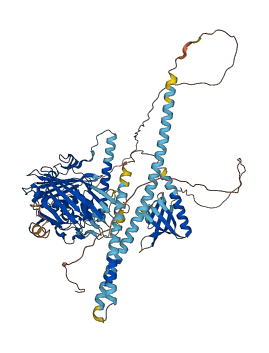
The autoinhibited protein was predicted that may have potential autoinhibitory elements via cis-regPred.
Autoinhibitory domains (AIDs)
Target domain |
|
Relief mechanism |
|
Assay |
cis-regPred |
Accessory elements
No accessory elements
Autoinhibited structure

Activated structure
1 structures for Q3B7Z2
| Entry ID | Method | Resolution | Chain | Position | Source |
|---|---|---|---|---|---|
| AF-Q3B7Z2-F1 | Predicted | AlphaFoldDB |
27 variants for Q3B7Z2
| Variant ID(s) | Position | Change | Description | Diseaes Association | Provenance |
|---|---|---|---|---|---|
| rs6343747 | 43 | P>S | No | EVA | |
| rs6343747 | 43 | P>T | No | EVA | |
| rs228185369 | 52 | T>A | No | EVA | |
| rs3389522582 | 188 | S>* | No | EVA | |
| rs3409346073 | 239 | E>D | No | EVA | |
| rs3412866943 | 278 | L>I | No | EVA | |
| rs255915497 | 329 | N>D | No | EVA | |
| rs3389528658 | 350 | D>N | No | EVA | |
| rs3389493551 | 392 | Y>* | No | EVA | |
| rs3389476278 | 392 | Y>F | No | EVA | |
| rs3389521119 | 435 | P>Q | No | EVA | |
| rs3389523083 | 482 | Y>C | No | EVA | |
| rs3389485381 | 483 | S>P | No | EVA | |
| rs3389528635 | 490 | S>T | No | EVA | |
| rs3389508732 | 500 | T>I | No | EVA | |
| rs3389476257 | 515 | C>Y | No | EVA | |
| rs3389540012 | 565 | H>Q | No | EVA | |
| rs3408268792 | 580 | V>G | No | EVA | |
| rs3389485348 | 585 | V>L | No | EVA | |
| rs3389436675 | 665 | R>L | No | EVA | |
| rs238616994 | 668 | G>A | No | EVA | |
| rs3389508721 | 671 | A>P | No | EVA | |
| rs3389436662 | 703 | A>V | No | EVA | |
| rs3389493572 | 722 | M>K | No | EVA | |
| rs3412978444 | 741 | Q>* | No | EVA | |
| rs3389436708 | 742 | R>L | No | EVA | |
| rs3408951766 | 756 | T>A | No | EVA |
No associated diseases with Q3B7Z2
Functions
14 GO annotations of cellular component
| Name | Definition |
|---|---|
| cell junction | A cellular component that forms a specialized region of connection between two or more cells, or between a cell and the extracellular matrix, or between two membrane-bound components of a cell, such as flagella. |
| cytoplasm | The contents of a cell excluding the plasma membrane and nucleus, but including other subcellular structures. |
| cytosol | The part of the cytoplasm that does not contain organelles but which does contain other particulate matter, such as protein complexes. |
| endoplasmic reticulum membrane | The lipid bilayer surrounding the endoplasmic reticulum. |
| Golgi apparatus | A membrane-bound cytoplasmic organelle of the endomembrane system that further processes the core oligosaccharides (e.g. N-glycans) added to proteins in the endoplasmic reticulum and packages them into membrane-bound vesicles. The Golgi apparatus operates at the intersection of the secretory, lysosomal, and endocytic pathways. |
| Golgi membrane | The lipid bilayer surrounding any of the compartments of the Golgi apparatus. |
| intracellular membrane-bounded organelle | Organized structure of distinctive morphology and function, bounded by a single or double lipid bilayer membrane and occurring within the cell. Includes the nucleus, mitochondria, plastids, vacuoles, and vesicles. Excludes the plasma membrane. |
| membrane | A lipid bilayer along with all the proteins and protein complexes embedded in it an attached to it. |
| nucleolus | A small, dense body one or more of which are present in the nucleus of eukaryotic cells. It is rich in RNA and protein, is not bounded by a limiting membrane, and is not seen during mitosis. Its prime function is the transcription of the nucleolar DNA into 45S ribosomal-precursor RNA, the processing of this RNA into 5.8S, 18S, and 28S components of ribosomal RNA, and the association of these components with 5S RNA and proteins synthesized outside the nucleolus. This association results in the formation of ribonucleoprotein precursors; these pass into the cytoplasm and mature into the 40S and 60S subunits of the ribosome. |
| nucleoplasm | That part of the nuclear content other than the chromosomes or the nucleolus. |
| perinuclear endoplasmic reticulum | The portion of endoplasmic reticulum, the intracellular network of tubules and cisternae, that occurs near the nucleus. The lumen of the perinuclear endoplasmic reticulum is contiguous with the nuclear envelope lumen (also called perinuclear space), the region between the inner and outer nuclear membranes. |
| perinuclear region of cytoplasm | Cytoplasm situated near, or occurring around, the nucleus. |
| plasma membrane | The membrane surrounding a cell that separates the cell from its external environment. It consists of a phospholipid bilayer and associated proteins. |
| trans-Golgi network | The network of interconnected tubular and cisternal structures located within the Golgi apparatus on the side distal to the endoplasmic reticulum, from which secretory vesicles emerge. The trans-Golgi network is important in the later stages of protein secretion where it is thought to play a key role in the sorting and targeting of secreted proteins to the correct destination. |
5 GO annotations of molecular function
| Name | Definition |
|---|---|
| phosphatidylinositol-4-phosphate binding | Binding to phosphatidylinositol-4-phosphate, a derivative of phosphatidylinositol in which the inositol ring is phosphorylated at the 4' position. |
| protein domain specific binding | Binding to a specific domain of a protein. |
| sterol binding | Binding to a sterol, a steroid containing a hydroxy group in the 3 position, closely related to cholestan-3-ol. |
| sterol transfer activity | Removes a sterol from a membrane or a monolayer lipid particle, transports it through the aqueous phase while protected in a hydrophobic pocket, and brings it to an acceptor membrane or lipid particle. |
| sterol transporter activity | Enables the directed movement of sterols into, out of or within a cell, or between cells. Sterol are steroids with one or more hydroxyl groups and a hydrocarbon side-chain in the molecule. |
8 GO annotations of biological process
| Name | Definition |
|---|---|
| ceramide transport | The directed movement of ceramides into, out of or within a cell, or between cells, by means of some agent such as a transporter or pore. Ceramides are a class of lipid composed of sphingosine linked to a fatty acid. |
| intracellular cholesterol transport | The directed movement of cholesterol, cholest-5-en-3-beta-ol, within cells. |
| phospholipid transport | The directed movement of phospholipids into, out of or within a cell, or between cells, by means of some agent such as a transporter or pore. Phospholipids are any lipids containing phosphoric acid as a mono- or diester. |
| positive regulation of insulin secretion involved in cellular response to glucose stimulus | Any process that increases the frequency, rate or extent of the regulated release of insulin that contributes to the response of a cell to glucose. |
| positive regulation of secretory granule organization | Any process that activates or increases the frequency, rate or extent of secretory granule organization. |
| positive regulation of tyrosine phosphorylation of STAT protein | Any process that activates or increases the frequency, rate or extent of the introduction of a phosphate group to a tyrosine residue of a STAT (Signal Transducer and Activator of Transcription) protein. |
| sphingomyelin biosynthetic process | The chemical reactions and pathways resulting in the formation of sphingomyelin, N-acyl-4-sphingenyl-1-O-phosphorylcholine. |
| sterol transport | The directed movement of sterols into, out of or within a cell, or between cells, by means of some agent such as a transporter or pore. Sterols are steroids with one or more hydroxyl groups and a hydrocarbon side-chain in the molecule. |
8 homologous proteins in AiPD
| UniProt AC | Gene Name | Protein Name | Species | Evidence Code |
|---|---|---|---|---|
| Q969R2 | OSBP2 | Oxysterol-binding protein 2 | Homo sapiens (Human) | PR |
| P22059 | OSBP | Oxysterol-binding protein 1 | Homo sapiens (Human) | PR |
| B9EJ86 | Osbpl8 | Oxysterol-binding protein-related protein 8 | Mus musculus (Mouse) | PR |
| Q5QNQ6 | Osbp2 | Oxysterol-binding protein 2 | Mus musculus (Mouse) | PR |
| Q8BX94 | Osbpl2 | Oxysterol-binding protein-related protein 2 | Mus musculus (Mouse) | PR |
| Q8S8P9 | ORP1B | Oxysterol-binding protein-related protein 1B | Arabidopsis thaliana (Mouse-ear cress) | PR |
| Q9SAF0 | ORP1D | Oxysterol-binding protein-related protein 1D | Arabidopsis thaliana (Mouse-ear cress) | PR |
| Q8L751 | ORP1C | Oxysterol-binding protein-related protein 1C | Arabidopsis thaliana (Mouse-ear cress) | PR |
| 10 | 20 | 30 | 40 | 50 | 60 |
| MAATELRGVV | GPGPAAIAAP | GGGGAGPPAV | GGGGGRGDAG | PGPGVAAATA | ATAGGPGPGA |
| 70 | 80 | 90 | 100 | 110 | 120 |
| GGVAAGGPGS | APPAAGSGGS | GAGGSGSARE | GWLFKWTNYI | KGYQRRWFVL | SNGLLSYYRS |
| 130 | 140 | 150 | 160 | 170 | 180 |
| KAEMRHTCRG | TINLATANIT | VEDSCNFIIS | NGGAQTYHLK | ASSEVERQRW | VTALELAKAK |
| 190 | 200 | 210 | 220 | 230 | 240 |
| AVKMLAESDD | SGDEESVSQT | DKTELQSTLR | TLSSKVEDLS | TCNDLIAKHG | TALQRSLSEL |
| 250 | 260 | 270 | 280 | 290 | 300 |
| ESLKLPAESN | EKIKQVNERA | TLFRITSNAM | INACRDFLML | AQTHSKKWQK | SLQYERDQRI |
| 310 | 320 | 330 | 340 | 350 | 360 |
| RLEETLEQLA | KQHNHLERAF | RGATVLPANP | PGSAGSGKDQ | CCSGKGDMSD | EDDENEFFDA |
| 370 | 380 | 390 | 400 | 410 | 420 |
| PEIITMPENL | GHKRTGSNIS | GASSDVSLDE | QYKHQLEETK | KEKRTRIPYK | PNYSLNLWSI |
| 430 | 440 | 450 | 460 | 470 | 480 |
| MKNCIGKELS | KIPMPVNFNE | PLSMLQRLTE | DLEYHELLDR | AAKCENSLEQ | LCYVAAFTVS |
| 490 | 500 | 510 | 520 | 530 | 540 |
| SYSTTVFRTS | KPFNPLLGET | FELDRLEENG | YRSICEQVSH | HPPAAAHHAE | SKNGWTLRQE |
| 550 | 560 | 570 | 580 | 590 | 600 |
| IKITSKFRGK | YLSIMPLGTI | HCIFHSTGHH | YTWKKVTTTV | HNIIVGKLWI | DQSGEIDIVN |
| 610 | 620 | 630 | 640 | 650 | 660 |
| HKTGDKCNLK | FVPYSYFSRD | VARKVTGEVT | DPSGKVHFAL | LGTWDEKMDC | FKVQAASGEN |
| 670 | 680 | 690 | 700 | 710 | 720 |
| GGDARQRGHE | AEDSRVMLWK | RNPLPKNAEN | MYYFSELALT | LNAWEGGTAP | TDSRLRPDQR |
| 730 | 740 | 750 | 760 | 770 | 780 |
| LMENGRWDEA | NAEKQRLEEK | QRLSRKKREA | EAAKATEDGT | PHDPYKALWF | ERKKDPVTRE |
| 790 | 800 | ||||
| LTHIYSGEYW | ECKEKQDWGS | CPDIF |