P97813
Gene name |
Pld2 |
Protein name |
Phospholipase D2 |
Names |
PLD 2, mPLD2, Choline phosphatase 2, PLD1C, Phosphatidylcholine-hydrolyzing phospholipase D2 |
Species |
Mus musculus (Mouse) |
KEGG Pathway |
mmu:18806 |
EC number |
3.1.4.4: Phosphoric diester hydrolases |
Protein Class |
|
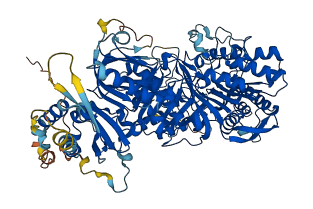
Descriptions
The autoinhibited protein was predicted that may have potential autoinhibitory elements via cis-regPred.
Autoinhibitory domains (AIDs)
Target domain |
|
Relief mechanism |
|
Assay |
cis-regPred |
Accessory elements
No accessory elements
Autoinhibited structure

Activated structure
1 structures for P97813
| Entry ID | Method | Resolution | Chain | Position | Source |
|---|---|---|---|---|---|
| AF-P97813-F1 | Predicted | AlphaFoldDB |
27 variants for P97813
| Variant ID(s) | Position | Change | Description | Diseaes Association | Provenance |
|---|---|---|---|---|---|
| rs3389172890 | 22 | M>R | No | EVA | |
| rs3389180874 | 28 | D>Y | No | EVA | |
| rs3389173194 | 58 | V>M | No | EVA | |
| rs3389174265 | 78 | G>A | No | EVA | |
| rs3389137021 | 104 | F>L | No | EVA | |
| rs3389168550 | 120 | L>* | No | EVA | |
| rs3389180709 | 148 | P>T | No | EVA | |
| rs3389187054 | 188 | F>I | No | EVA | |
| rs3389168565 | 203 | K>* | No | EVA | |
| rs3389187033 | 211 | K>M | No | EVA | |
| rs3401171859 | 240 | V>A | No | EVA | |
| rs3389180842 | 268 | Q>* | No | EVA | |
| rs3389174235 | 292 | K>N | No | EVA | |
| rs3389148976 | 431 | R>Q | No | EVA | |
| rs3389173138 | 482 | V>A | No | EVA | |
| rs3389144897 | 488 | T>I | No | EVA | |
| rs3389180817 | 539 | P>L | No | EVA | |
| rs3389185309 | 641 | N>D | No | EVA | |
| rs3389172889 | 684 | L>F | No | EVA | |
| rs3389180823 | 694 | G>R | No | EVA | |
| rs3402387501 | 715 | H>Y | No | EVA | |
| rs3401758226 | 761 | I>L | No | EVA | |
| rs3389174174 | 781 | G>R | No | EVA | |
| rs3389144849 | 782 | K>M | No | EVA | |
| rs3389136997 | 846 | W>R | No | EVA | |
| rs3389172825 | 869 | T>I | No | EVA | |
| rs3389144838 | 931 | V>M | No | EVA |
No associated diseases with P97813
5 regional properties for P97813
| Type | Name | Position | InterPro Accession |
|---|---|---|---|
| domain | Phox homology | 64 - 195 | IPR001683 |
| domain | Phospholipase D/Transphosphatidylase | 437 - 464 | IPR001736-1 |
| domain | Phospholipase D/Transphosphatidylase | 751 - 778 | IPR001736-2 |
| domain | Pleckstrin homology domain | 203 - 313 | IPR001849 |
| domain | Phospholipase D-like domain | 627 - 795 | IPR025202 |
Functions
| Description | ||
|---|---|---|
| EC Number | 3.1.4.4 | Phosphoric diester hydrolases |
| Subcellular Localization |
|
|
| PANTHER Family | ||
| PANTHER Subfamily | ||
| PANTHER Protein Class | ||
| PANTHER Pathway Category | No pathway information available | |
9 GO annotations of cellular component
| Name | Definition |
|---|---|
| brush border membrane | The portion of the plasma membrane surrounding the brush border. |
| caveola | A membrane raft that forms small pit, depression, or invagination that communicates with the outside of a cell and extends inward, indenting the cytoplasm and the cell membrane. Examples include flask-shaped invaginations of the plasma membrane in adipocytes associated with caveolin proteins, and minute pits or incuppings of the cell membrane formed during pinocytosis. Caveolae may be pinched off to form free vesicles within the cytoplasm. |
| endoplasmic reticulum membrane | The lipid bilayer surrounding the endoplasmic reticulum. |
| Golgi apparatus | A membrane-bound cytoplasmic organelle of the endomembrane system that further processes the core oligosaccharides (e.g. N-glycans) added to proteins in the endoplasmic reticulum and packages them into membrane-bound vesicles. The Golgi apparatus operates at the intersection of the secretory, lysosomal, and endocytic pathways. |
| intracellular membrane-bounded organelle | Organized structure of distinctive morphology and function, bounded by a single or double lipid bilayer membrane and occurring within the cell. Includes the nucleus, mitochondria, plastids, vacuoles, and vesicles. Excludes the plasma membrane. |
| lamellipodium | A thin sheetlike process extended by the leading edge of a migrating cell or extending cell process; contains a dense meshwork of actin filaments. |
| nucleus | A membrane-bounded organelle of eukaryotic cells in which chromosomes are housed and replicated. In most cells, the nucleus contains all of the cell's chromosomes except the organellar chromosomes, and is the site of RNA synthesis and processing. In some species, or in specialized cell types, RNA metabolism or DNA replication may be absent. |
| plasma membrane | The membrane surrounding a cell that separates the cell from its external environment. It consists of a phospholipid bilayer and associated proteins. |
| sarcolemma | The outer membrane of a muscle cell, consisting of the plasma membrane, a covering basement membrane (about 100 nm thick and sometimes common to more than one fiber), and the associated loose network of collagen fibers. |
4 GO annotations of molecular function
| Name | Definition |
|---|---|
| N-acylphosphatidylethanolamine-specific phospholipase D activity | Catalysis of the release of N-acylethanolamine from N-acyl-phosphatidylethanolamine (NAPE) to generate N-acylethanolamine (NAE). |
| phosphatidylinositol binding | Binding to an inositol-containing glycerophospholipid, i.e. phosphatidylinositol (PtdIns) and its phosphorylated derivatives. |
| phospholipase D activity | Catalysis of the reaction: a phosphatidylcholine + H2O = choline + a phosphatidate. |
| protein kinase C binding | Binding to protein kinase C. |
16 GO annotations of biological process
| Name | Definition |
|---|---|
| G protein-coupled receptor internalization | The process that results in the uptake of a G protein-coupled receptor into an endocytic vesicle. |
| inositol lipid-mediated signaling | The series of molecular signals in which a cell uses an inositol-containing lipid to convert a signal into a response. Inositol lipids include the phosphoinositides (phosphatidylinositol and its phosphorylated derivatives), ceramides containing inositol, and inositol glycolipids. |
| neuron projection development | The process whose specific outcome is the progression of a neuron projection over time, from its formation to the mature structure. A neuron projection is any process extending from a neural cell, such as axons or dendrites (collectively called neurites). |
| phosphatidic acid biosynthetic process | The chemical reactions and pathways resulting in the formation of phosphatidic acid, any derivative of glycerol phosphate in which both the remaining hydroxyl groups of the glycerol moiety are esterified with fatty acids. |
| phospholipid catabolic process | The chemical reactions and pathways resulting in the breakdown of phospholipids, any lipid containing phosphoric acid as a mono- or diester. |
| positive regulation of cell adhesion | Any process that activates or increases the frequency, rate or extent of cell adhesion. |
| positive regulation of cell migration | Any process that activates or increases the frequency, rate or extent of cell migration. |
| positive regulation of mast cell degranulation | Any process that activates or increases the frequency, rate or extent of mast cell degranulation. |
| positive regulation of phosphatidylinositol 3-kinase signaling | Any process that activates or increases the frequency, rate or extent of signal transduction mediated by the phosphatidylinositol 3-kinase cascade. |
| positive regulation of receptor-mediated endocytosis | Any process that activates or increases the frequency, rate or extent of receptor mediated endocytosis, the uptake of external materials by cells, utilizing receptors to ensure specificity of transport. |
| receptor-mediated endocytosis | An endocytosis process in which cell surface receptors ensure specificity of transport. A specific receptor on the cell surface binds tightly to the extracellular macromolecule (the ligand) that it recognizes; the plasma-membrane region containing the receptor-ligand complex then undergoes endocytosis, forming a transport vesicle containing the receptor-ligand complex and excluding most other plasma-membrane proteins. Receptor-mediated endocytosis generally occurs via clathrin-coated pits and vesicles. |
| regulation of vesicle-mediated transport | Any process that modulates the rate, frequency, or extent of vesicle-mediated transport, the directed movement of substances, either within a vesicle or in the vesicle membrane, into, out of or within a cell. |
| response to hydrogen peroxide | Any process that results in a change in state or activity of a cell or an organism (in terms of movement, secretion, enzyme production, gene expression, etc.) as a result of a hydrogen peroxide (H2O2) stimulus. |
| response to hypoxia | Any process that results in a change in state or activity of a cell or an organism (in terms of movement, secretion, enzyme production, gene expression, etc.) as a result of a stimulus indicating lowered oxygen tension. Hypoxia, defined as a decline in O2 levels below normoxic levels of 20.8 - 20.95%, results in metabolic adaptation at both the cellular and organismal level. |
| response to organic cyclic compound | Any process that results in a change in state or activity of a cell or an organism (in terms of movement, secretion, enzyme production, gene expression, etc.) as a result of an organic cyclic compound stimulus. |
| response to peptide hormone | Any process that results in a change in state or activity of a cell or an organism (in terms of movement, secretion, enzyme production, gene expression, etc.) as a result of a peptide hormone stimulus. A peptide hormone is any of a class of peptides that are secreted into the blood stream and have endocrine functions in living animals. |
10 homologous proteins in AiPD
| UniProt AC | Gene Name | Protein Name | Species | Evidence Code |
|---|---|---|---|---|
| Q0V8L6 | PLD2 | Phospholipase D2 | Bos taurus (Bovine) | PR |
| Q13393 | PLD1 | Phospholipase D1 | Homo sapiens (Human) | PR |
| O14939 | PLD2 | Phospholipase D2 | Homo sapiens (Human) | PR |
| Q9Z280 | Pld1 | Phospholipase D1 | Mus musculus (Mouse) | PR |
| P70496 | Pld1 | Phospholipase D1 | Rattus norvegicus (Rat) | PR |
| P70498 | Pld2 | Phospholipase D2 | Rattus norvegicus (Rat) | PR |
| P58766 | PLDALPHA3 | Phospholipase D alpha 3 | Arabidopsis thaliana (Mouse-ear cress) | PR |
| Q9M9W8 | PLPZETA2 | Phospholipase D zeta 2 | Arabidopsis thaliana (Mouse-ear cress) | PR |
| Q9LRZ5 | PLDZETA1 | Phospholipase D zeta 1 | Arabidopsis thaliana (Mouse-ear cress) | PR |
| Q9C5Y0 | PLDDELTA | Phospholipase D delta | Arabidopsis thaliana (Mouse-ear cress) | PR |
| 10 | 20 | 30 | 40 | 50 | 60 |
| MTVTQKNLFP | YGDYLNSSQL | HMEPDEVDTL | REGEDPADRM | HPYLAIYDLQ | PLKAHPLVFA |
| 70 | 80 | 90 | 100 | 110 | 120 |
| PGVPVIAQVV | GTERYTSGSK | VGTCTLYSVR | LTHGDFTWTT | KKKFRHFQEL | HRDLQRHKVL |
| 130 | 140 | 150 | 160 | 170 | 180 |
| MSLLPLARFA | VTHSPAREAA | AEDIPSLPRG | GSEGSARHTA | SKQKYLENYL | NRLLTMSFYR |
| 190 | 200 | 210 | 220 | 230 | 240 |
| NYHAMTEFLE | VSQLSFIPDL | GSKGLEGVIR | KRSGGHRVPG | FTFCGRDQVC | YRWSKRWLVV |
| 250 | 260 | 270 | 280 | 290 | 300 |
| KDSFLLYMRP | ETGAISFVQL | FDPGFEVQVG | KRSTETRYGV | RIDTSHRSLI | LKCSSYRQAR |
| 310 | 320 | 330 | 340 | 350 | 360 |
| WWGQEITELA | QGSGRDFLQL | HQHDSYAPPR | PGTLARWFVN | GAGYFAAVAD | AILRAQEEIF |
| 370 | 380 | 390 | 400 | 410 | 420 |
| ITDWWLSPEI | YLKRPAHSDD | WRLDIMLKRK | AEEGVRVSIL | LFKEVELALG | INSGYSKRTL |
| 430 | 440 | 450 | 460 | 470 | 480 |
| MLLHPNIKVM | RHPDLVTLWA | HHEKLLVVDQ | VVAFLGGLDL | AFGRWDDVQY | RLTDLGDPSE |
| 490 | 500 | 510 | 520 | 530 | 540 |
| PVHLQTPTLG | SDPAATPDLS | HNQFFWLGKD | YSNLITKDWV | QLDRPFEDFI | DRETTPRMPW |
| 550 | 560 | 570 | 580 | 590 | 600 |
| RDVGVVVHGV | AARDLARHFI | QRWNFTKTTK | ARYKTPLYPY | LLPKSTSTAN | NLPFMIPGGQ |
| 610 | 620 | 630 | 640 | 650 | 660 |
| CATVQVLRSV | DRWSAGTLEN | SILNAYLHTI | RESQHFLYIE | NQFFISCSDG | RTVLNKVGDE |
| 670 | 680 | 690 | 700 | 710 | 720 |
| IVDRILKAHE | QGQCFRVYLL | LPLLPGFEGD | ISTGGGNSIQ | AILHFTYRTL | CRGEHSILHR |
| 730 | 740 | 750 | 760 | 770 | 780 |
| LKAAMGTAWR | DYMSICGLRT | HGELGGHPIS | ELIYIHSKML | IADDRTVIIG | SANINDRSLL |
| 790 | 800 | 810 | 820 | 830 | 840 |
| GKRDSELAIL | IKDTEMEPSL | MDGVEYQAGR | FALSLRKHCF | SVILGANTWP | DLDLRDPVCD |
| 850 | 860 | 870 | 880 | 890 | 900 |
| DFFQLWQETA | ENNATIYEQI | FRCLPSNATR | SLRALREYVA | VESLATVSPS | LAQSELAHIQ |
| 910 | 920 | 930 | |||
| GHLVHFPLKF | LEDESLLPPL | GSKEGMIPLE | VWT |