P54352
Gene name |
eas (CG3525) |
Protein name |
Ethanolamine kinase |
Names |
EK, Protein easily shocked |
Species |
Drosophila melanogaster (Fruit fly) |
KEGG Pathway |
dme:Dmel_CG3525 |
EC number |
2.7.1.82: Phosphotransferases with an alcohol group as acceptor |
Protein Class |
|
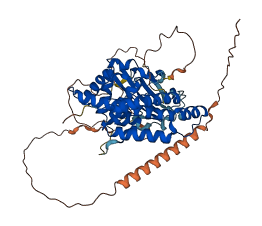
Descriptions
The autoinhibited protein was predicted that may have potential autoinhibitory elements via cis-regPred.
Autoinhibitory domains (AIDs)
Target domain |
|
Relief mechanism |
|
Assay |
cis-regPred |
Accessory elements
No accessory elements
Autoinhibited structure

Activated structure
1 structures for P54352
| Entry ID | Method | Resolution | Chain | Position | Source |
|---|---|---|---|---|---|
| AF-P54352-F1 | Predicted | AlphaFoldDB |
No variants for P54352
| Variant ID(s) | Position | Change | Description | Diseaes Association | Provenance |
|---|---|---|---|---|---|
| No variants for P54352 | |||||
No associated diseases with P54352
No regional properties for P54352
| Type | Name | Position | InterPro Accession |
|---|---|---|---|
| No domain, repeats, and functional sites for P54352 | |||
Functions
| Description | ||
|---|---|---|
| EC Number | 2.7.1.82 | Phosphotransferases with an alcohol group as acceptor |
| Subcellular Localization |
|
|
| PANTHER Family | ||
| PANTHER Subfamily | ||
| PANTHER Protein Class | ||
| PANTHER Pathway Category | No pathway information available | |
1 GO annotations of cellular component
| Name | Definition |
|---|---|
| cytoplasm | The contents of a cell excluding the plasma membrane and nucleus, but including other subcellular structures. |
3 GO annotations of molecular function
| Name | Definition |
|---|---|
| ATP binding | Binding to ATP, adenosine 5'-triphosphate, a universally important coenzyme and enzyme regulator. |
| choline kinase activity | Catalysis of the reaction: ATP + choline = ADP + choline phosphate + 2 H(+). |
| ethanolamine kinase activity | Catalysis of the reaction: ATP + ethanolamine = ADP + 2 H(+) + phosphoethanolamine. |
12 GO annotations of biological process
| Name | Definition |
|---|---|
| associative learning | Learning by associating a stimulus (the cause) with a particular outcome (the effect). |
| asymmetric neuroblast division | The process resulting in the physical partitioning and separation of a neuroblast into two daughter cells with different developmental potentials. |
| brain development | The process whose specific outcome is the progression of the brain over time, from its formation to the mature structure. Brain development begins with patterning events in the neural tube and ends with the mature structure that is the center of thought and emotion. The brain is responsible for the coordination and control of bodily activities and the interpretation of information from the senses (sight, hearing, smell, etc.). |
| habituation | A decrease in a behavioral response to a repeated stimulus. This is exemplified by the failure of a person to show a startle response to a loud noise that has been repeatedly presented. |
| long-term memory | The memory process that deals with the storage, retrieval and modification of information a long time (typically weeks, months or years) after receiving that information. This type of memory is typically dependent on gene transcription regulated by second messenger activation. |
| mechanosensory behavior | Behavior that is dependent upon the sensation of a mechanical stimulus. |
| mushroom body development | The process whose specific outcome is the progression of the mushroom body over time, from its formation to the mature structure. The mushroom body is composed of the prominent neuropil structures of the insect central brain, thought to be crucial for olfactory associated learning. These consist mainly of a bulbous calyx and tightly packaged arrays of thin parallel fibers of the Kenyon cells. |
| phosphatidylethanolamine biosynthetic process | The chemical reactions and pathways resulting in the formation of phosphatidylethanolamine, any of a class of glycerophospholipids in which a phosphatidyl group is esterified to the hydroxyl group of ethanolamine. |
| phosphatidylethanolamine metabolic process | The chemical reactions and pathways involving phosphatidylethanolamine, any of a class of glycerophospholipids in which a phosphatidyl group is esterified to the hydroxyl group of ethanolamine. It is a major structural phospholipid in mammalian systems. It tends to be more abundant than phosphatidylcholine in the internal membranes of the cell and is an abundant component of prokaryotic membranes. |
| phosphorylation | The process of introducing a phosphate group into a molecule, usually with the formation of a phosphoric ester, a phosphoric anhydride or a phosphoric amide. |
| response to hypoxia | Any process that results in a change in state or activity of a cell or an organism (in terms of movement, secretion, enzyme production, gene expression, etc.) as a result of a stimulus indicating lowered oxygen tension. Hypoxia, defined as a decline in O2 levels below normoxic levels of 20.8 - 20.95%, results in metabolic adaptation at both the cellular and organismal level. |
| response to mechanical stimulus | Any process that results in a change in state or activity of a cell or an organism (in terms of movement, secretion, enzyme production, gene expression, etc.) as a result of a mechanical stimulus. |
9 homologous proteins in AiPD
| UniProt AC | Gene Name | Protein Name | Species | Evidence Code |
|---|---|---|---|---|
| P20485 | CKI1 | Choline kinase | Saccharomyces cerevisiae (strain ATCC 204508 / S288c) (Baker's yeast) | PR |
| P35790 | CHKA | Choline kinase alpha | Homo sapiens (Human) | PR |
| Q9HBU6 | ETNK1 | Ethanolamine kinase 1 | Homo sapiens (Human) | PR |
| O54804 | Chka | Choline kinase alpha | Mus musculus (Mouse) | PR |
| A7MCT6 | Etnk2 | Ethanolamine kinase 2 | Mus musculus (Mouse) | PR |
| Q9D4V0 | Etnk1 | Ethanolamine kinase 1 | Mus musculus (Mouse) | PR |
| Q01134 | Chka | Choline kinase alpha | Rattus norvegicus (Rat) | PR |
| D3ZRW8 | Etnk2 | Ethanolamine kinase 2 | Rattus norvegicus (Rat) | PR |
| Q8L518 | At1g74320 | Probable choline kinase 2 | Arabidopsis thaliana (Mouse-ear cress) | PR |
| 10 | 20 | 30 | 40 | 50 | 60 |
| MGTETKSNSY | TGQISTSGGN | PKVMKDSLSL | VRQTVNQQTL | SLSQSNQVQN | QLNSHSNSNS |
| 70 | 80 | 90 | 100 | 110 | 120 |
| YPNPSGSENK | NENEQNSRDI | RAKPEDKSRK | EAIVPFVPIF | VEEADVIQGA | KELLKVIRPT |
| 130 | 140 | 150 | 160 | 170 | 180 |
| WDLSHVEFKI | RVVPQIEDRY | PAQNAMVMMT | LYSFTDGITN | KLVGCFHKEI | SKLNDENGGS |
| 190 | 200 | 210 | 220 | 230 | 240 |
| YLPIKTQGLS | PVQSEDPVII | EKEDDDEFTD | DRAADDGSPV | QYSDNVVLVR | IYGNKTDLLI |
| 250 | 260 | 270 | 280 | 290 | 300 |
| DRKAETQNFL | LLHTYGLAPS | LYATFKNGLV | YEYVPGTTLN | TDSVLCPEIW | PLVARRMAEM |
| 310 | 320 | 330 | 340 | 350 | 360 |
| HRKVRKHGDS | SATKPMPMIW | KKTQSFLDLV | PERFSDAEKH | KRVKETFLPI | GRLREEFNKL |
| 370 | 380 | 390 | 400 | 410 | 420 |
| YEYLEALDSP | IVFSHNDLLL | GNVIYTQSLN | TVNFIDYEYA | DYNFQAFDIG | NHFAEMCGVD |
| 430 | 440 | 450 | 460 | 470 | 480 |
| EVDYSRYPKR | EFQLQWLRVY | LEEYLQRSNI | QNDEVELLYV | QVNQFALASH | IFWTVWSLLQ |
| 490 | 500 | 510 | |||
| AEHSTIDFDY | VGYAFLRYNE | YLARKVEFLS | LTAAKNNK |