O54804
Gene name |
Chka (Chk) |
Protein name |
Choline kinase alpha |
Names |
CK, CHETK-alpha, Ethanolamine kinase, EK |
Species |
Mus musculus (Mouse) |
KEGG Pathway |
mmu:12660 |
EC number |
2.7.1.32: Phosphotransferases with an alcohol group as acceptor |
Protein Class |
|
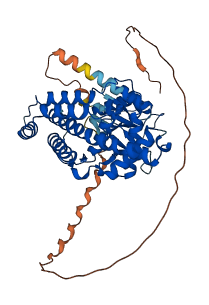
Descriptions
The autoinhibited protein was predicted that may have potential autoinhibitory elements via cis-regPred.
Autoinhibitory domains (AIDs)
Target domain |
|
Relief mechanism |
|
Assay |
cis-regPred |
Accessory elements
No accessory elements
Autoinhibited structure

Activated structure
1 structures for O54804
| Entry ID | Method | Resolution | Chain | Position | Source |
|---|---|---|---|---|---|
| AF-O54804-F1 | Predicted | AlphaFoldDB |
20 variants for O54804
| Variant ID(s) | Position | Change | Description | Diseaes Association | Provenance |
|---|---|---|---|---|---|
| rs216994478 | 51 | T>N | No | EVA | |
| rs864276473 | 64 | L>P | No | EVA | |
| rs3389529761 | 165 | N>Y | No | EVA | |
| rs3389509459 | 187 | S>P | No | EVA | |
| rs3409272626 | 192 | L>V | No | EVA | |
| rs36262694 | 193 | F>Y | No | EVA | |
| rs3389515650 | 202 | E>K | No | EVA | |
| rs3389493711 | 207 | S>C | No | EVA | |
| rs3389509408 | 219 | D>A | No | EVA | |
| rs3389509408 | 219 | D>V | No | EVA | |
| rs3411715012 | 225 | A>S | No | EVA | |
| rs3408835176 | 226 | E>G | No | EVA | |
| rs3412960061 | 274 | L>I | No | EVA | |
| rs3389472123 | 287 | S>L | No | EVA | |
| rs3389518269 | 301 | N>I | No | EVA | |
| rs214046561 | 316 | N>S | No | EVA | |
| rs235305459 | 321 | K>E | No | EVA | |
| rs217141100 | 361 | N>S | No | EVA | |
| rs3389472060 | 387 | E>K | No | EVA | |
| rs3389514783 | 440 | R>G | No | EVA |
No associated diseases with O54804
1 regional properties for O54804
| Type | Name | Position | InterPro Accession |
|---|---|---|---|
| domain | Calcium uniporter protein, C-terminal | 156 - 315 | IPR006769 |
Functions
| Description | ||
|---|---|---|
| EC Number | 2.7.1.32 | Phosphotransferases with an alcohol group as acceptor |
| Subcellular Localization |
|
|
| PANTHER Family | ||
| PANTHER Subfamily | ||
| PANTHER Protein Class | ||
| PANTHER Pathway Category | No pathway information available | |
3 GO annotations of cellular component
| Name | Definition |
|---|---|
| cytoplasm | The contents of a cell excluding the plasma membrane and nucleus, but including other subcellular structures. |
| cytosol | The part of the cytoplasm that does not contain organelles but which does contain other particulate matter, such as protein complexes. |
| lipid droplet | An intracellular non-membrane-bounded organelle comprising a matrix of coalesced lipids surrounded by a phospholipid monolayer. May include associated proteins. |
8 GO annotations of molecular function
| Name | Definition |
|---|---|
| ATP binding | Binding to ATP, adenosine 5'-triphosphate, a universally important coenzyme and enzyme regulator. |
| choline binding | Binding to choline, the amine 2-hydroxy-N,N,N-trimethylethanaminium. |
| choline kinase activity | Catalysis of the reaction: ATP + choline = ADP + choline phosphate + 2 H(+). |
| cholinesterase activity | Catalysis of the reaction: an acylcholine + H2O = choline + a carboxylic acid anion. |
| ethanolamine kinase activity | Catalysis of the reaction: ATP + ethanolamine = ADP + 2 H(+) + phosphoethanolamine. |
| identical protein binding | Binding to an identical protein or proteins. |
| protein homodimerization activity | Binding to an identical protein to form a homodimer. |
| protein tyrosine kinase activity | Catalysis of the reaction: ATP + a protein tyrosine = ADP + protein tyrosine phosphate. |
7 GO annotations of biological process
| Name | Definition |
|---|---|
| CDP-choline pathway | The phosphatidylcholine biosynthetic process that begins with the phosphorylation of choline and ends with the combination of CDP-choline with diacylglycerol to form phosphatidylcholine. |
| cellular response to glucose starvation | Any process that results in a change in state or activity of a cell (in terms of movement, secretion, enzyme production, gene expression, etc.) as a result of deprivation of glucose. |
| choline metabolic process | The chemical reactions and pathways involving choline (2-hydroxyethyltrimethylammonium), an amino alcohol that occurs widely in living organisms as a constituent of certain types of phospholipids and in the neurotransmitter acetylcholine. |
| ethanolamine metabolic process | The chemical reactions and pathways involving ethanolamine (2-aminoethanol), an important water-soluble base of phospholipid (phosphatidylethanolamine). |
| lipid droplet disassembly | The disaggregation of a lipid particle into its constituent components. |
| phosphatidylcholine biosynthetic process | The chemical reactions and pathways resulting in the formation of phosphatidylcholines, any of a class of glycerophospholipids in which the phosphatidyl group is esterified to the hydroxyl group of choline. |
| phosphatidylethanolamine biosynthetic process | The chemical reactions and pathways resulting in the formation of phosphatidylethanolamine, any of a class of glycerophospholipids in which a phosphatidyl group is esterified to the hydroxyl group of ethanolamine. |
8 homologous proteins in AiPD
| UniProt AC | Gene Name | Protein Name | Species | Evidence Code |
|---|---|---|---|---|
| P20485 | CKI1 | Choline kinase | Saccharomyces cerevisiae (strain ATCC 204508 / S288c) (Baker's yeast) | PR |
| P54352 | eas | Ethanolamine kinase | Drosophila melanogaster (Fruit fly) | PR |
| P35790 | CHKA | Choline kinase alpha | Homo sapiens (Human) | PR |
| Q9D4V0 | Etnk1 | Ethanolamine kinase 1 | Mus musculus (Mouse) | PR |
| A7MCT6 | Etnk2 | Ethanolamine kinase 2 | Mus musculus (Mouse) | PR |
| D3ZRW8 | Etnk2 | Ethanolamine kinase 2 | Rattus norvegicus (Rat) | PR |
| Q01134 | Chka | Choline kinase alpha | Rattus norvegicus (Rat) | PR |
| Q8L518 | At1g74320 | Probable choline kinase 2 | Arabidopsis thaliana (Mouse-ear cress) | PR |
| 10 | 20 | 30 | 40 | 50 | 60 |
| MKTKFCTGGE | AEPSPLGLLL | SCGGNAAPTP | GVGQQRDAAG | ELESKQLGGR | TQPLALPPPP |
| 70 | 80 | 90 | 100 | 110 | 120 |
| PPPLPLPPPP | SPPLADEQPE | PRTRRRAYLW | CKEFLPGAWR | GLREDQFHIS | VIRGGLSNML |
| 130 | 140 | 150 | 160 | 170 | 180 |
| FQCSLPDSIA | SVGDEPRKVL | LRLYGAILKM | RSCNKEGSEQ | AQNENEFQGA | EAMVLESVMF |
| 190 | 200 | 210 | 220 | 230 | 240 |
| AILAERSLGP | KLFGIFPQGR | LEQFIPSRRL | DTEELRLPDI | SAEIAEKMAT | FHGMKMPFNK |
| 250 | 260 | 270 | 280 | 290 | 300 |
| EPKWLFGTME | KYLNQVLRLK | FSREARVQQL | HKILSYNLPL | ELENLRSLLQ | YTRSPVVFCH |
| 310 | 320 | 330 | 340 | 350 | 360 |
| NDCQEGNILL | LEGQENSERR | KLMLIDFEYS | SYNYRGFDIG | NHFCEWMYDY | TYEKYPFFRA |
| 370 | 380 | 390 | 400 | 410 | 420 |
| NIQKYPSRKQ | QLHFISSYLT | TFQNDFESLS | SEEQFATKED | MLLEVNRFAL | ASHFLWGLWS |
| 430 | 440 | 450 | |||
| IVQAKISSIE | FGYMEYAQAR | FEAYFDQKRK | LGV |